

How Long Does Car Recovery Take? Realistic Wait Times for Greater Manchester Drivers
The gap between a 25-minute and a 90-minute wait often comes down to where you are, what time it is, and what the M60 is doing. This guide gives realistic recovery wait times for motorways, A roads, and Manchester city centre, and explains what happens between your call and the truck arriving.
Table of Contents
You have broken down. You have called for recovery. Now the question that matters is: how long until someone actually arrives?
The honest answer is that it varies more than most people expect, and the gap between a 25-minute wait and a 90-minute wait often comes down to factors you cannot control: where exactly you are, what time it is, and what the M60 is doing at that moment.
This guide gives you realistic wait time expectations based on road type and time of day in Greater Manchester, explains what actually happens in the minutes between your call and the recovery truck arriving, and covers what genuinely helps and what does not during the wait.
What the Major Providers Publish as Their Average Times
The AA and RAC both publish average attendance figures. Based on their most recent published data:
- AA: 40 to 50 minutes average nationally, across 3.5 million annual callouts with a fleet of around 2,700 patrols
- RAC: 40 to 45 minutes average nationally, across 2.4 million annual callouts with approximately 1,700 patrols
These are national averages that cover everything from a quick city centre battery job to a remote breakdown on a Welsh A road at 2am. They are useful as a baseline but they do not tell you what to expect on the M60 at 8am on a Thursday morning. That requires a bit more granularity.
Motorway Breakdowns: Faster Dispatch, More Moving Parts
Motorway breakdowns tend to get faster initial dispatch than equivalent breakdowns on residential streets. Major providers position patrols on or near motorway routes because the volume and urgency of callouts justifies it. National Highways traffic officers also patrol independently and will attend stopped vehicles on managed motorways, sometimes arriving before the breakdown provider does.
On the M60, M62, M56, and M61 around Greater Manchester, realistic attendance times from a major provider are:
- Off-peak hours (10am to 3pm weekdays): 25 to 40 minutes
- Morning peak (7:30 to 9:30am): 45 to 75 minutes
- Evening peak (4pm to 6:30pm): 45 to 75 minutes
- Weekend evenings (Friday and Saturday from 8pm): 50 to 90 minutes due to high call volume
- Bank holidays and severe weather: 60 to 120 minutes or more
One thing that most waiting time estimates do not factor in: on a smart motorway section, even after your recovery vehicle arrives, National Highways may need to formally close a lane before the truck can safely manoeuvre. On a busy section of the M60 during peak hours, that clearance coordination can add 15 to 30 minutes to the time between arrival and actually getting moving again.
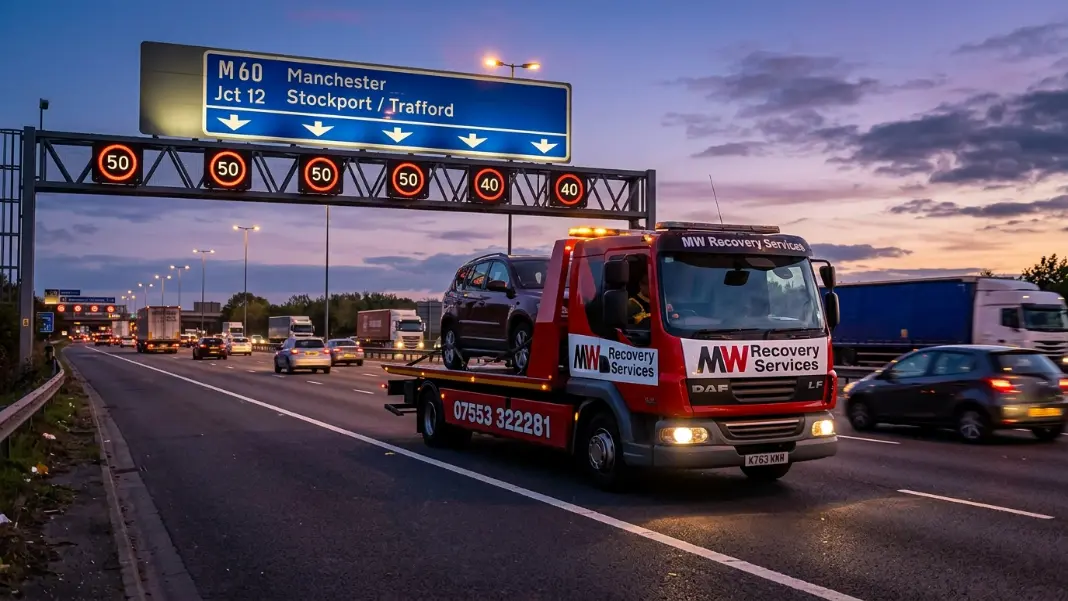
Motorway recovery tends to get faster initial dispatch, but peak-hour congestion and National Highways clearance add time between arrival and getting moving again.
A Roads and B Roads in Greater Manchester
A road breakdowns do not have motorway-level traffic management protocols. There is no automatic camera detection, no National Highways involvement, and the recovery driver has to navigate normal traffic to reach you.
The trade-off is that A road locations in Greater Manchester are generally well-served by local operators. Typical response times on the major A roads in the region, outside of peak hours:
- A57 (Eccles/Salford corridor): 25 to 45 minutes
- A6 (Stockport/Hazel Grove): 30 to 50 minutes
- A580 East Lancashire Road: 30 to 55 minutes
- A34 (Cheadle/Wilmslow direction): 25 to 45 minutes
Rush hour on these routes adds roughly 20 to 30 minutes in most cases. The A57 through Salford and the A580 are particularly vulnerable to peak-hour congestion that slows recovery vehicle access.
Manchester City Centre: Often Quicker Than You Would Expect
Breaking down in Manchester city centre (Deansgate, Piccadilly, Ancoats, Northern Quarter, Spinningfields) tends to get faster responses than the motorway or outer A road averages would suggest, despite the traffic density. The reason is coverage density: local recovery operators spend significant time in and around the city, so the nearest available vehicle is often genuinely close.
Realistic response times for Manchester city centre breakdowns are 20 to 35 minutes during most of the working day. Late-night city centre callouts (11pm to 4am) also tend to be faster in absolute terms because traffic conditions allow the recovery vehicle to move freely even if it is coming from further away.
Multi-storey and underground car parks are the exception. A flatbed truck cannot access most city centre multi-storeys. If your car has broken down in an underground or low-clearance structure, the crew may need to push the vehicle to a ground-level bay before it can be loaded. Add 15 to 20 minutes for this on-site.
What Actually Happens in the 40 Minutes Between Your Call and the Truck Arriving
Most people imagine the recovery truck parked around the corner waiting for the phone. The reality is more logistical than that, and understanding the process helps make sense of why the wait is the length it is.
When you call, the dispatcher logs the job and identifies the nearest available vehicle. Available matters here: a vehicle on the other side of Manchester that just finished a job is not immediately available even if it is geographically close. The dispatcher has real-time visibility of which vehicles are free, which are en route to another job, and which calls have priority. Motorway callouts in live lanes take precedence over broken down in a residential car park.
Once a vehicle is assigned, the driver finishes any current job paperwork, checks and loads equipment specific to your type of recovery (flatbed, wheel-lift, specific straps for certain vehicles), and then routes to you. In peak traffic on the M60 or through Salford, routing that looks straightforward on a map can take significantly longer than the distance alone implies.
On arrival, the driver carries out a brief risk assessment before approaching the vehicle, particularly on A roads without formalised lane management. Loading a car onto a flatbed on a live road takes longer than in a car park because the crew is managing traffic risk alongside the vehicle itself.
The M60 and M62: Peak Hour Specifics That Affect Your Wait
If you break down during peak hours on Greater Manchester's motorway network, wait time extends for two different reasons: the recovery vehicle takes longer to reach you through congested traffic, and once it arrives, carriageway clearance involves more coordination with other vehicles.
M60 congestion patterns worth knowing if you use it regularly:
- Morning peak (7:30 to 9:30am): Junctions 7 to 9 (M63/A57 area, Eccles) and junctions 17 to 18 (the Simister interchange with M61/M62) are consistently the worst sections. Average speeds on these stretches regularly drop below 20mph during this window.
- Evening peak (4pm to 6:30pm): Junctions 12 to 16 (the Salford/Eccles corridor) and junctions 24 to 27 (Stockport/A6 area) typically see the heaviest evening congestion.
On the M62, the morning peak runs eastbound from around 7am to 9:30am. The westbound peak (toward Manchester) runs from 4pm to 7pm. If you break down heading westbound on the M62 between junctions 18 and 21 during the evening commute, a recovery truck coming from the Manchester direction is fighting the same traffic you came from.
MW Recovery covers both motorway corridors across Greater Manchester. For specific callout information on each route, the M60 motorway recovery page and M62 motorway recovery page cover how the service operates on each road.
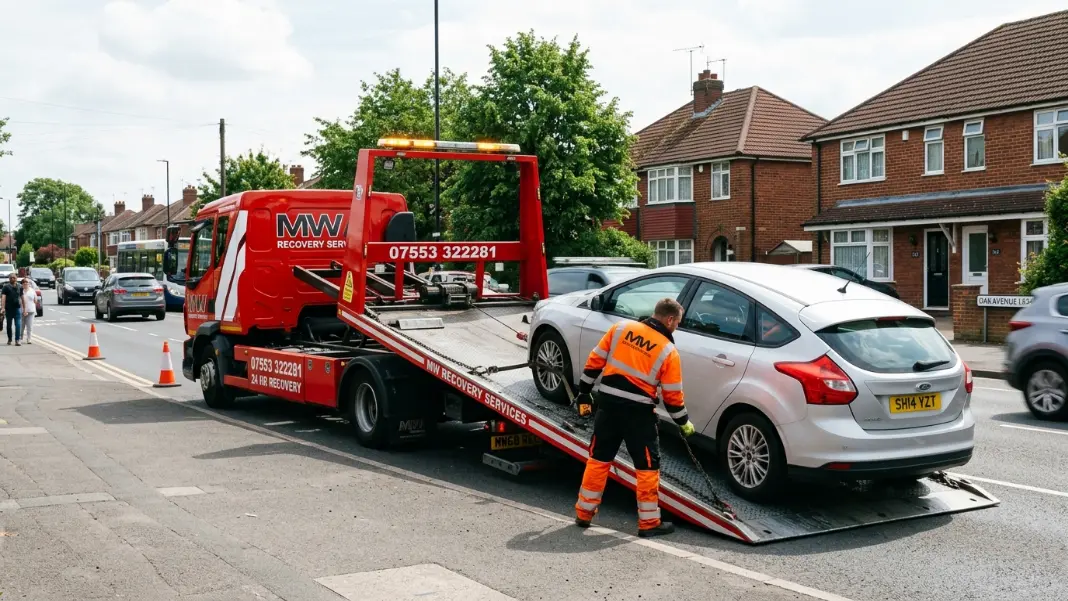
Between the call and the truck arriving, the dispatcher is identifying the nearest free vehicle, the driver is finishing a current job, and both are routing through the same traffic you are stuck in.
Weather and Winter: How Much Longer Things Actually Take
Cold weather increases breakdown frequency and extends response times simultaneously. More callouts in the system means longer queues for dispatchers. Ice and standing water mean the recovery driver takes longer to reach you safely. In severe conditions, National Highways may also restrict access to certain carriageways until they are treated.
In Greater Manchester winters, a few situations stand out:
- Black ice on the M62 elevated sections: The M62 crosses moorland between junctions 22 and 24. Ice conditions on these sections can exist when the lower-elevation Manchester roads are clear. A recovery driver coming from Manchester may encounter significantly different conditions than those at your location.
- Heavy rainfall across the whole network: Surface water on the M60 and A roads reduces safe approach and loading speeds. Add 20 to 40 minutes on top of normal times in heavy rain.
- Freezing temperatures overnight (November to February): Battery failures and cold-start problems peak in this window, increasing call volume sharply. Waiting times extend because more people are calling at the same time.
Specialist and Commercial Recoveries: Different Time Expectations Entirely
Standard response time figures apply to passenger cars. For other vehicle types, both wait times and on-site times are longer:
- Vans and light commercial vehicles: Add 15 to 30 minutes if a larger flatbed is needed rather than a standard car transporter
- HGVs and articulated lorries: Specialist heavy recovery requires specific equipment. Initial attendance of 90 minutes or more is standard, and clearance from a live motorway lane can take several hours
- Motorcycles: Require specific tie-down and restraint systems. Not all vehicles carry them. Confirm when calling
- Electric vehicles: Most EVs cannot be towed with driven wheels on the ground. A flatbed is required. If the initial dispatch is a wheel-lift vehicle, there may be a delay while a flatbed is sourced and re-dispatched
What Genuinely Helps While You Wait
A few practical points rather than a generic list:
Give the dispatcher a precise location when you call. "On the M60 near Eccles" covers roughly four miles of motorway. "M60 westbound, just past junction 12, before the bridge over the A57" saves the driver routing time and helps the dispatcher prioritise correctly. Use gantry sign numbers, junction markers, or the nearest visible road sign. The more specific you are, the faster the driver reaches the right spot.
If you are on a motorway or A road, do not stand near the vehicle after leaving it. Stand behind the barrier if one is present. The secondary collision risk for people standing alongside broken-down vehicles is why every breakdown guide emphasises this. It is not overcaution.
Hazard lights on immediately, and leave them on. Battery drain is a secondary concern compared with visibility. At motorway speeds, a car with visible hazard lights at 150 metres gives drivers time to react. A stationary dark vehicle at 50 metres does not.
If you have a high-visibility vest in the vehicle, put it on before you exit. The Highway Code recommends carrying one.
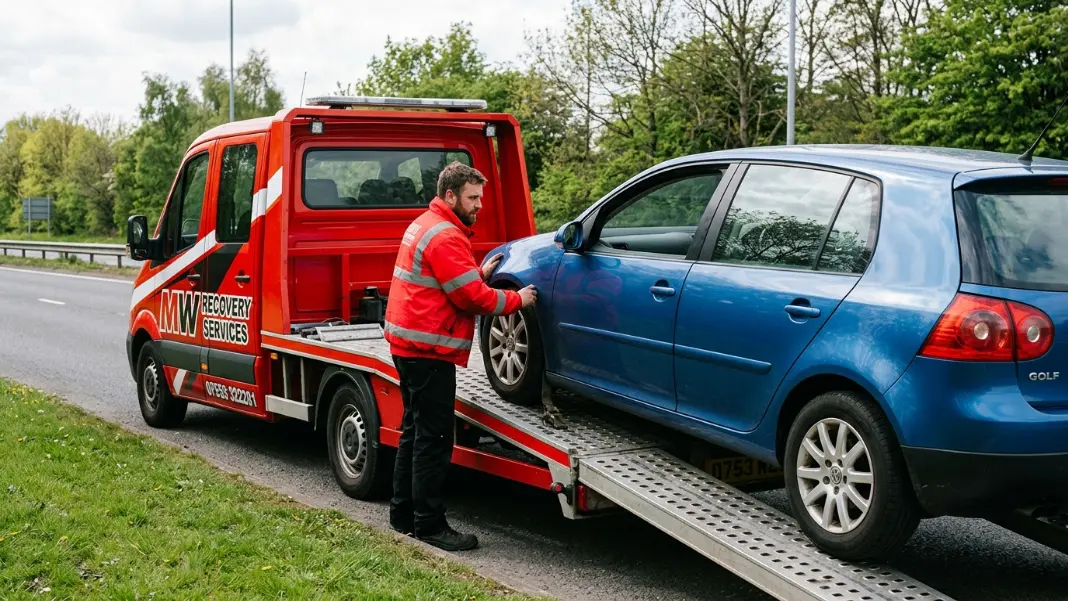
Electric vehicles and certain automatics must go on a flatbed rather than a wheel-lift. If the first dispatch is the wrong vehicle type, re-dispatching adds time to the overall wait.
How Response Times Work for a Local Manchester Operator vs a National Provider
National providers spread their fleets across the entire country. Coverage density in any given local area depends on how many patrols are currently working in that region versus deployed elsewhere. During a high-demand period nationally, local availability can drop even in an area with normally good coverage.
Local operators working specifically in Greater Manchester operate differently. Their vehicles are based in the region and their dispatch is focused on local callouts rather than a national queue. In outer areas like Oldham, Wigan, and Leigh where national provider coverage can be thinner, a locally-based operator is often the faster option.
For MW Recovery across Greater Manchester, typical response times are 30 to 60 minutes on A roads and residential areas, 20 to 35 minutes in and around Manchester city centre, and variable on motorways depending on current traffic and whether National Highways clearance is needed before approach.
Full coverage detail is on the breakdown recovery service page and the location pages for Salford, Stockport, and Oldham. If you need immediate recovery assistance, the breakdown recovery near me page covers how to reach us across the region.
Frequently Asked Questions
Common questions about this topic
The AA averages 40 to 50 minutes nationally across 3.5 million annual callouts. The RAC averages 40 to 45 minutes nationally. These are averages across all conditions and all parts of the country. In Greater Manchester, city centre callouts tend to be faster (20 to 35 minutes), while motorway callouts during peak hours can realistically extend to 60 to 90 minutes total from call to the vehicle being loaded and moving.
Need Car Recovery in Manchester?
MW Recovery provides fast, professional breakdown recovery and roadside assistance across all of Greater Manchester. One call and we are on our way.