
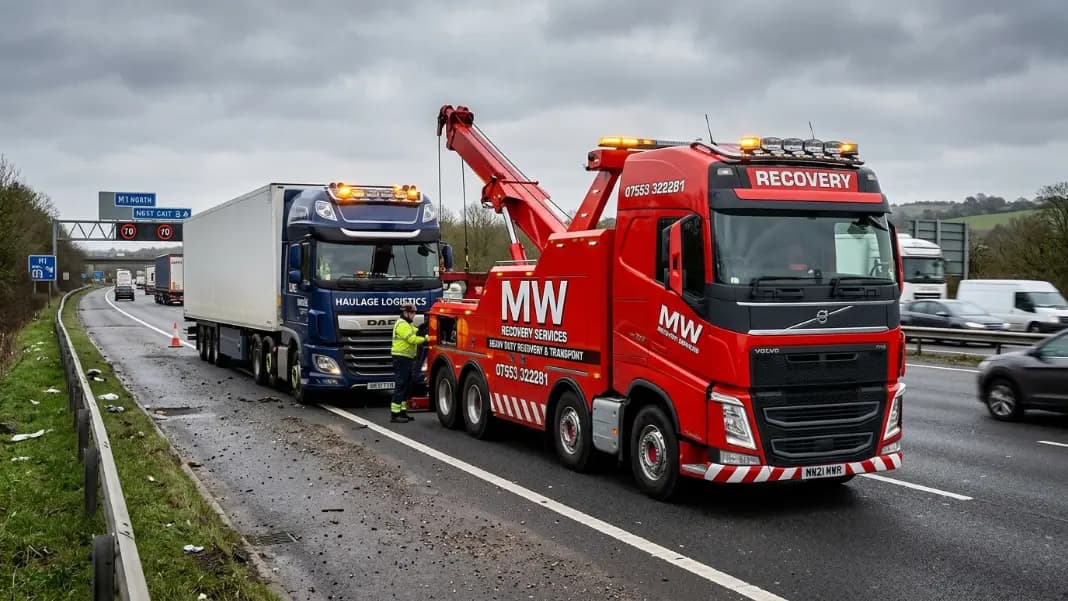
Lorry and Truck Breakdown Recovery: What You Need to Know
HGV and lorry breakdowns need specialist recovery. What fleet managers and drivers need to know about commercial vehicle recovery in the UK.
Table of Contents
A van breaking down is an inconvenience. A lorry breaking down is an event. The vehicle is bigger, heavier, and harder to move. The driver may be carrying time-sensitive freight. The road impact is immediate. And the recovery process involves regulations, equipment, and specialist knowledge that most standard recovery companies simply do not have.
This guide is for fleet managers, owner-operators, and HGV drivers who want to understand what commercial vehicle recovery actually involves, what questions to ask before signing up with a recovery provider, and what to do when your lorry stops on a UK road or motorway.
Why HGV recovery is different from car recovery
The obvious difference is size and weight. A fully laden artic weighs up to 44 tonnes. Even an unladen rigid HGV tips the scales at 7 to 15 tonnes depending on size. Recovery equipment rated for a family hatchback is not rated for a lorry, and using the wrong equipment risks further damage to the vehicle, injury to the recovery crew, and a blocked carriageway for longer.
Beyond weight, HGV recovery involves different legal requirements. A broken-down lorry on a motorway may need Highways England Incident Traffic Management to be deployed before any recovery can begin. Moving an HGV on a public road after recovery may require a police escort if the dimensions exceed normal permit thresholds. The recovery operator needs to know these requirements and coordinate them. A company that only handles cars will not.
Payload matters too. Depending on the cargo, a broken-down lorry may need to be partially or fully offloaded before recovery can take place. Hazardous cargo requires additional notification and specialist handling. Refrigerated cargo has a time clock running from the moment the vehicle stops. Fleet managers dealing with refrigerated transport need a recovery provider who understands the urgency and can coordinate cargo transfer if needed.
Common causes of HGV breakdowns
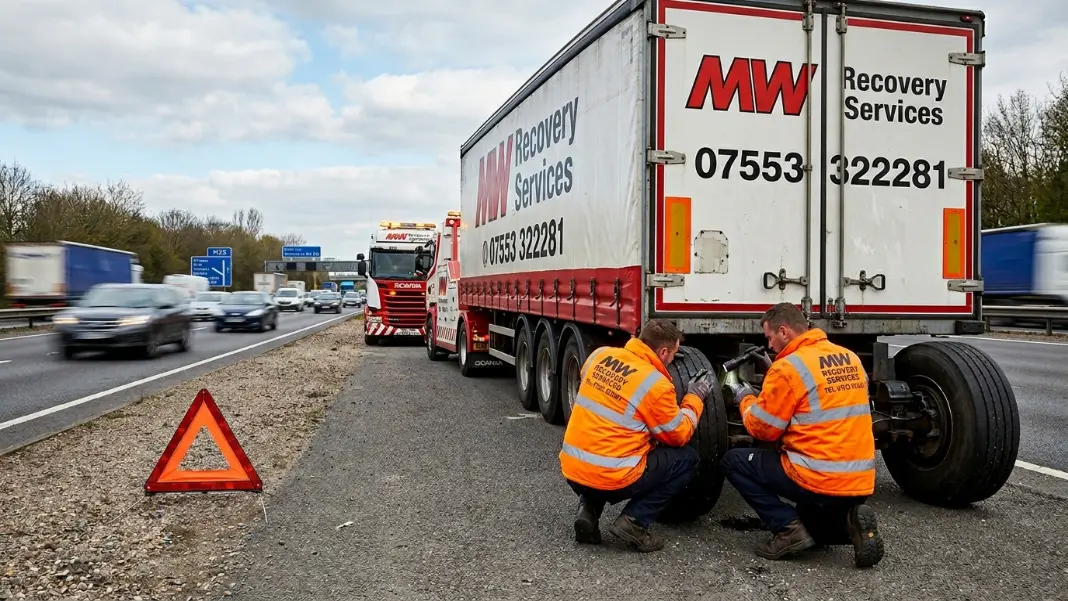
Tyre failure is the most frequent cause of HGV breakdown on UK roads. At commercial vehicle weights and duty cycles, tyres wear faster and are more vulnerable to road debris. A blowout on a drive axle on the motorway is a serious incident. The vehicle needs to be brought safely to the hard shoulder and the tyre replaced or the vehicle recovered to a tyre fitting facility. Commercial tyre stocks are not the same as car tyre stocks, and a recovery operator who cannot source the correct tyre size quickly will add significant delay.
Brake system failures are the second most common cause. Air brake systems on HGVs are complex and a fault anywhere in the system can immobilise the vehicle. Frozen air lines in winter, faulty relay valves, and worn brake chambers are all regular callout causes. A recovery technician who can diagnose an air brake fault at the roadside and determine whether it is repairable on site or requires recovery saves significant time and cost.
Electrical and AdBlue system faults have become increasingly common with the shift to Euro 6 engines. A lorry that has run low on AdBlue may enter reduced power mode or derate completely if the fault is not addressed. This can happen mid-journey with no advance warning if the level sensor has failed. Our recovery team carries AdBlue and can refill and reset on site in many cases.
Fuel system problems, starter motor failures, and overheating round out the most common HGV breakdown causes. Overheating on a motorway gradient in summer is a situation many drivers have experienced. The correct response is to pull over before the engine is damaged, not to push on hoping it cools down.
What happens when an HGV breaks down on a motorway
The sequence is more structured than for a car breakdown. Highways England and the police have specific procedures for commercial vehicles stopped on motorway hard shoulders because of the road impact and the risk to the recovery crew.
When an HGV breaks down on a motorway, the driver should contact their fleet manager or recovery provider and also call Highways England's 24-hour control room on 0300 123 5000 to report the incident. On smart motorways without a hard shoulder, the driver should move to the nearest Emergency Refuge Area if possible, or come to a controlled stop and immediately call for assistance. Do not walk along the motorway or on the carriageway.
Highways England may deploy a Traffic Officer vehicle to the scene to assist with signing and protect the recovery crew while they work. For large or complex recoveries, lane closures may be required and the decision to implement them goes through the regional traffic management centre. A recovery operator with experience of motorway HGV recoveries will coordinate with Highways England rather than arriving and improvising.
Our HGV and commercial vehicle recovery coverage
MW Recovery Services operates across Greater Manchester and the surrounding area including the M60, M62, M61, M56, and M6. Our HGV recovery service covers rigid and articulated vehicles up to 3.5 tonnes on our standard equipment. For heavier commercial vehicles, we coordinate with specialist heavy recovery operators and manage the process on behalf of the fleet operator.
We also provide fleet recovery and management services for companies operating multiple vehicles in and around Greater Manchester. Fleet accounts give priority response and consolidated billing for operators who cannot afford delays when a vehicle goes off the road.
What to have ready before you call
When you call for HGV recovery, having certain information to hand speeds up the dispatch and the recovery itself:
- Exact location including road name, junction number, or what3words reference
- Vehicle registration and make, model, and body type
- Gross vehicle weight and current payload if laden
- Nature of the fault as far as the driver can describe it
- Whether the vehicle is on the carriageway, hard shoulder, or refuge area
- Whether cargo is hazardous, refrigerated, or time-critical
- Whether the vehicle has been there long and whether the driver is safe and inside the cab
Roadside repair vs full recovery: the decision process
Not every HGV breakdown needs the vehicle to be moved. Many faults are repairable at the roadside if the operator has the right parts and skills. A tyre change, an air brake valve replacement, an AdBlue top-up, or a starter motor bypass are all jobs that a well-equipped technician can complete on the hard shoulder, getting the lorry back on the road faster than a full recovery and workshop repair.
The decision to attempt roadside repair vs recover to a workshop depends on the fault, the location, the time available, and the safety of working at that location. A blowout in a Highways England managed lane where the vehicle cannot clear the live carriageway needs recovery before any repair work begins. A fault on a quiet industrial estate forecourt is a different situation.
Our technicians make this assessment on arrival. If a roadside repair is safe and feasible, we do it. If not, we recover to the nearest suitable facility and the repair happens there. We do not perform unnecessary recoveries to inflate the bill. The goal is to get your vehicle back on the road as quickly as possible.
What fleet managers need from a recovery provider
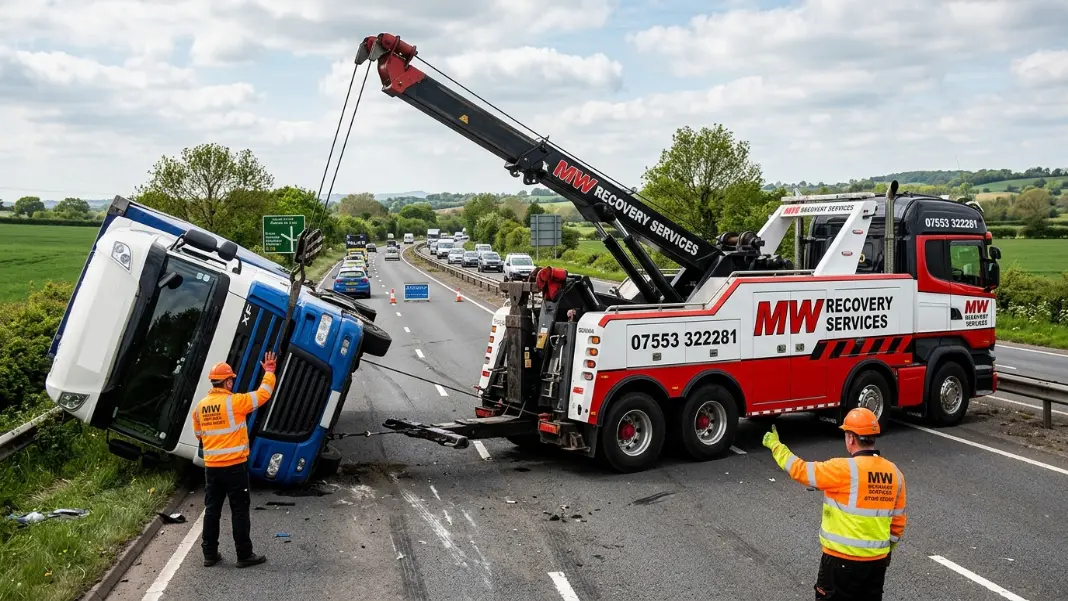
Fleet managers running commercial vehicles need different things from a recovery company than a private car owner does. Response time is the first requirement, but not the only one. Documentation matters. A recovery that does not produce a proper job sheet, mileage record, and cause of breakdown note is a problem for fleet maintenance records and insurance purposes.
Consistent pricing matters too. Ad-hoc callout pricing from a company that does not know your fleet means you have no idea what a recovery will cost until you get the invoice. A fleet account with agreed rates removes that uncertainty and makes budgeting possible.
Direct driver contact is important when the fleet manager is not available. Drivers need to be able to call a number that is answered 24 hours a day, get confirmation that help is coming, and receive an honest ETA. A service that routes drivers through an automated system in the middle of the night is not adequate for commercial operations.
If you manage a fleet in Greater Manchester and want to discuss how we can support your recovery requirements, call 07553 322281. We work with operators of all sizes from single-vehicle owner-operators through to larger fleets needing priority callout and consolidated billing.
Frequently Asked Questions
Common questions about this topic
Not safely in most cases. HGVs require recovery equipment rated for commercial vehicle weights, different loading and securing techniques, and knowledge of commercial vehicle regulations. A car recovery operator using standard equipment on a heavy vehicle risks vehicle damage and personal injury. Always use a recovery provider with confirmed HGV capability.
Need Car Recovery in Manchester?
MW Recovery provides fast, professional breakdown recovery and roadside assistance across all of Greater Manchester. One call and we are on our way.