
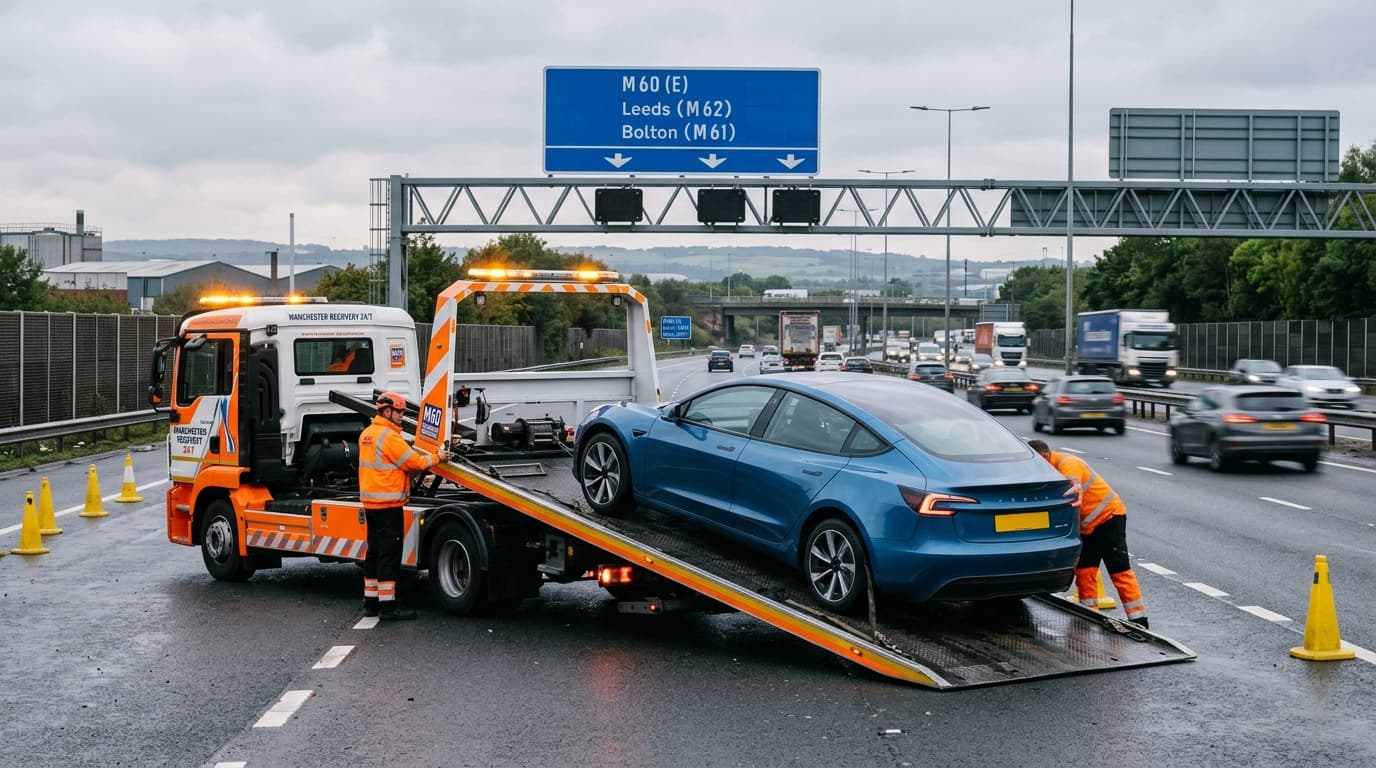
How We Recovered a Tesla Model 3 from the M60: An EV Recovery Case Study
Electric vehicles cannot be towed with their wheels on the ground. Here is exactly how our team safely recovered a stranded Tesla Model 3 from a live lane on the M60 in under 40 minutes.
Table of Contents
Electric vehicles are on every road in Greater Manchester now. But recovery companies that learned their trade on petrol cars are still catching up with what EVs actually need when something goes wrong. This is the account of one callout that showed exactly why EV recovery requires a different approach, and what happens when a driver is left stranded on one of the UK's busiest motorways.
The Callout: M60 Junction 12, 6:40pm on a Tuesday
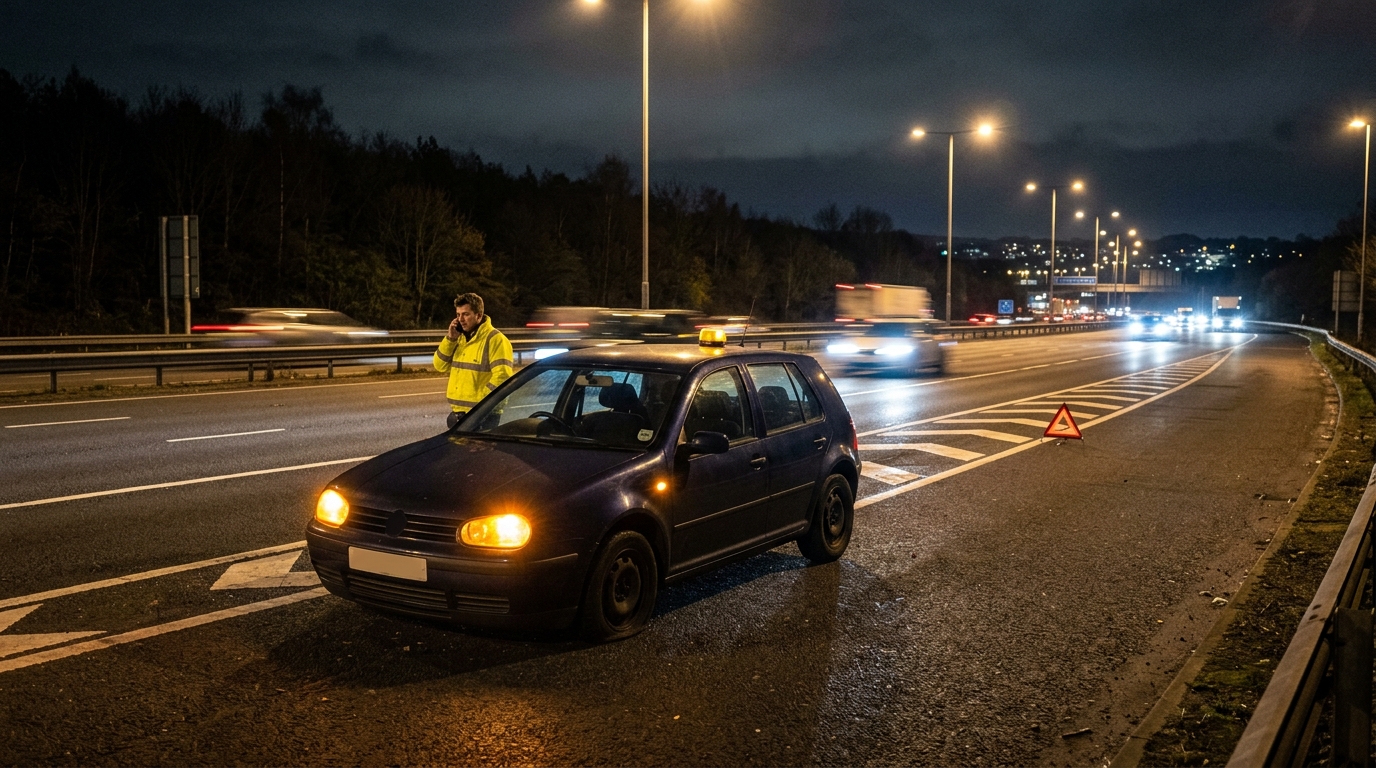
The call came in during the evening rush. A driver in a Tesla Model 3 Long Range had pulled onto the hard shoulder approaching junction 12 of the M60 near Eccles. The car had given a low battery warning on the Barton Bridge section and she had just made it to the safety of the hard shoulder before the charge ran out completely.
The car was stationary, the hazard lights were on, and traffic was moving at speed in the nearside lane. Her Tesla app showed 0% charge remaining. She had called a national breakdown provider first. They told her their nearest flatbed was 90 minutes away and that their standard patrol vehicles could not assist with an EV that needed towing.
She found us through a Google search for EV recovery Manchester and called 07553 322281. Our nearest driver was already on the M602 after completing a job in Salford. He reached her position in 19 minutes.
Why EV Recovery Is Different
This is the part most drivers do not know until they need to know it. An electric vehicle cannot be towed with any of its driven wheels touching the road surface. In a rear-wheel drive Tesla Model 3, that means the rear wheels must be off the ground at all times during transport.
The reason is the motor. In an EV, the motor is connected directly to the driven wheels with no clutch and no neutral gear that disconnects them. If you drag a Tesla backwards with its rear wheels rolling, the motor generates electricity. That back-EMF can damage the motor windings, overheat the inverter, and in serious cases cause thermal runaway in the battery pack. Tesla's own guidelines are clear: flatbed only, all four wheels off the ground.
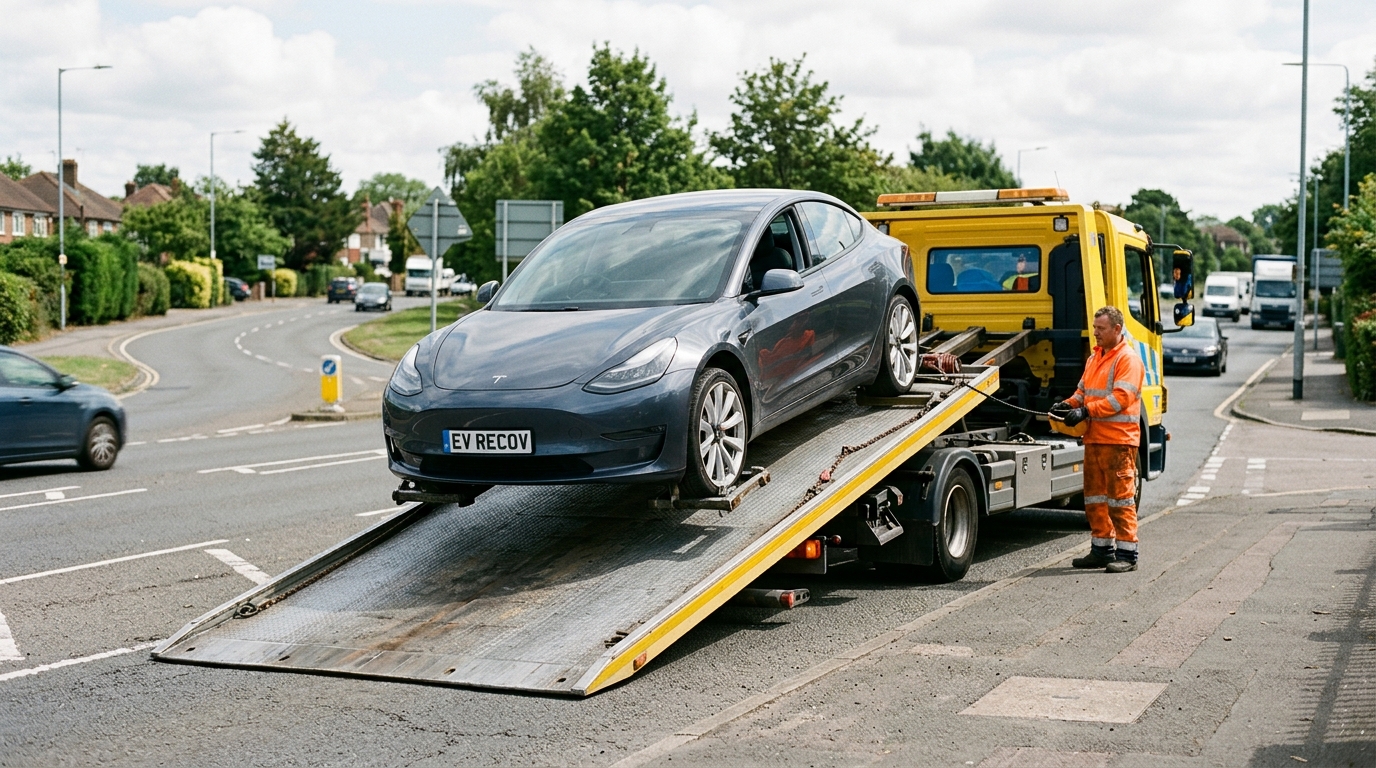
A standard breakdown patrol van with a tow bar cannot legally or safely move a Tesla. This is why the national provider could not help. Our flatbed truck can carry any vehicle with all wheels clear of the road surface, which is the only correct method for EVs.
The Recovery: Hard Shoulder to Home in 38 Minutes Total
Our driver arrived and immediately assessed the position. The vehicle was well clear of the live lane on the wide M60 hard shoulder near junction 12. He deployed cones and warning triangles behind the recovery truck and set up approach lighting given the fading light.
Loading a Tesla onto a flatbed requires care with the ramps and sill positioning. Tesla sills are lower than most petrol cars and the battery pack beneath the floor is vulnerable to impact. Our driver used extended ramps at a shallow angle and guided the car onto the bed using the Tesla's low-speed creep function with the key card, without putting any mechanical load on the drivetrain.
The car was secured on the flatbed within 12 minutes of arrival. The driver and her passenger were in the cab within 15 minutes and we cleared the hard shoulder cleanly. Total time from call to clear: 38 minutes.
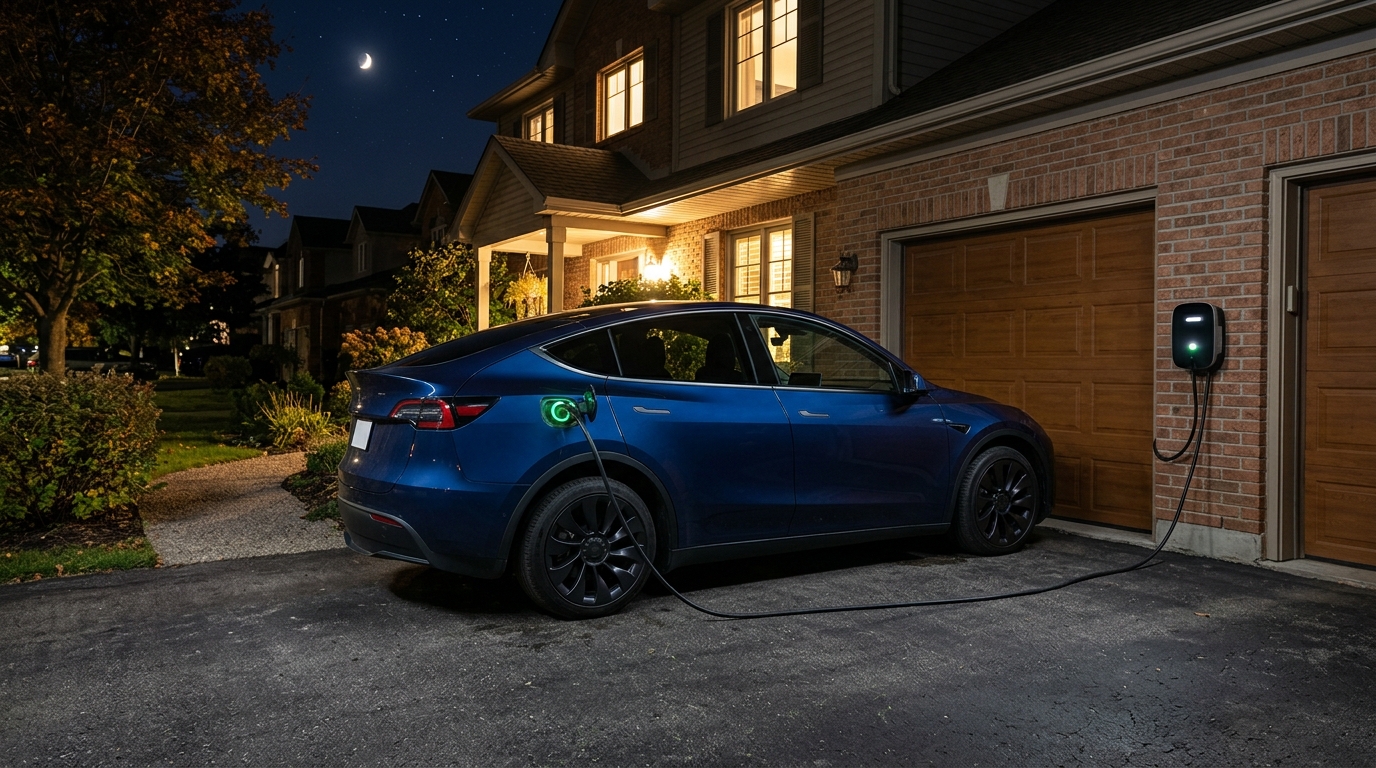
We transported the Tesla to her home address in Sale where a standard 13-amp charge cable could begin overnight charging. The car was undamaged. The motor and battery were unaffected. She was home before 8pm.
What This Callout Taught Us
Three things stood out from this job.
First, the national provider's 90-minute ETA was the real safety risk. A driver sitting on the M60 hard shoulder in the dark for an hour and a half is significantly more exposed than one who is recovered quickly. Fast attendance matters more than brand recognition.
Second, knowing the correct procedure for EV loading is not optional knowledge anymore. EVs now make up a meaningful percentage of vehicles on Greater Manchester roads. Recovery operators who only know how to tow petrol cars are leaving customers stranded or risking damage to expensive vehicles.
Third, local coverage beats national networks in urban motorway situations. The M60 orbital is ringed by our regular work area. We are never far from any point on it. A driver on the M60 near Eccles calling a company based in Birmingham is already at a disadvantage before the conversation starts.
If You Drive an EV in Greater Manchester
Save our number now: 07553 322281. We carry flatbed trucks capable of safely recovering any electric vehicle. We know the loading requirements for Tesla, Nissan Leaf, BMW i3, Audi e-tron, and all other common EV platforms. If you break down on the M60, M62, M56 or any other Greater Manchester road, call us directly. Do not wait for a national provider to dispatch from outside the area.
We also cover roadside situations where the problem is not a dead battery. A puncture, a collision, a software fault that immobilises the car, or any other issue that leaves your EV unable to move safely falls within our breakdown recovery service. The flatbed is always the right answer for an EV that cannot drive under its own power.
EV Recovery Across Greater Manchester in 2025 and 2026
The Tesla case study above is one of hundreds of EV recoveries we have carried out across the Greater Manchester road network. The volume of electric vehicles on local roads has grown consistently each year, and the proportion of our callouts involving EVs has grown with it. In 2026 we are attending EV breakdowns on a daily basis. This is not a niche specialism any more. It is a core part of what a modern recovery company needs to handle competently.
The M60 orbital is our most common motorway callout location for EVs, followed by the M62 and the M56. These three motorways form the main ring and radial routes around Greater Manchester and carry the highest volume of EV traffic. Urban breakdowns are more frequent on the A57, A56, and A6 through the city centre and south Manchester.
Different EVs, Different Recovery Requirements
All EVs share the same fundamental requirement: flatbed recovery with all driven wheels off the ground. But the specifics vary by manufacturer and model, and knowing them matters.
Tesla models require the car to be placed in Transport Mode via the touchscreen before loading. This disables the automatic parking brake and prevents the car from applying its brakes unexpectedly during loading. Our drivers know how to access Transport Mode on Model 3, Model Y, Model S, and Model X. If the car has no power, the frunk (front boot) can be opened with the 12V jump terminals to apply temporary power and access the screen.
Nissan Leaf models have a tow mode that must be activated before the driven wheels are moved. On older Leaf models this involves a sequence with the brake pedal and the park button. Failing to activate tow mode correctly on a Leaf can damage the reduction gear. Our drivers know the correct procedure for first and second generation Leaf models.
BMW i3 and i4 models use a slightly different procedure involving the Electronic Parking Brake release via the vehicle menu. The i3 in particular has a relatively short wheelbase and requires careful ramp angle management when loading to avoid grounding the battery pack underside.
Audi e-tron and Q8 e-tron models are heavy vehicles with large battery packs. They require a flatbed with a sufficient weight rating. Our trucks are rated to carry vehicles up to 3.5 tonnes, which covers all current production EVs comfortably including the heaviest luxury models.
Hyundai Ioniq 5 and Kia EV6 models can be tow-started in limited circumstances according to the manufacturer manual, but this only applies to very specific low-speed situations. In any breakdown scenario where the vehicle needs transporting, flatbed is still the correct method for these models.
Range Anxiety and What to Do When Your Battery Is Low on a Motorway
Range anxiety is real and it produces bad decisions. When an EV driver sees the battery percentage drop rapidly and does not know how far the next charger is, the instinct is often to keep driving and hope to make it. This is one of the most common reasons drivers end up stranded on hard shoulders rather than safely in a service area charging bay.
The practical rule is straightforward: when your remaining range drops to 15 miles on a motorway, take the next junction and find a charger, even if it adds time to your journey. Do not gamble on making the next motorway services. The Zapmap app shows real-time availability of public chargers near any location and is the most reliable tool for finding charging infrastructure quickly.
If you are already in a situation where the car is showing very low range and you are committed to a motorway section, reduce your speed. EV efficiency improves significantly at lower speeds. Dropping from 70 mph to 60 mph on a flat motorway section can add several miles of usable range. Turn off air conditioning and heating. These are meaningful loads on the battery at low charge levels.
If you do not make it and the car stops, pull to the hard shoulder immediately, switch on hazard lights, and call us. Do not try to push the vehicle to the next emergency refuge area unless you are already within rolling distance with the gradient in your favour. Stay in the vehicle on the passenger side if possible, particularly at night, and wait for recovery.
Public Charger Failures in Manchester
Not all EV breakdowns involve a depleted battery. A significant number of our EV callouts involve drivers who planned to charge at a public charger but found it out of service, and who then could not reach an alternative charger before running out of range. This is a real problem with the public charging infrastructure in Greater Manchester at present. Reliability rates for public rapid chargers in the UK remain lower than they should be.
If you are planning a journey in Greater Manchester that relies on a specific public charging location, always have a backup plan. Check Zapmap for the charger status before you set off. If the primary charger is unavailable and you cannot reach an alternative, call us before you run out of charge completely. A recovery from a car park with 8 miles of remaining range is simpler and cheaper than a motorway hard shoulder recovery from 0 miles. Call 07553 322281 any time.
Frequently Asked Questions
Common questions about this topic
No. A Tesla and most other electric vehicles cannot be towed with the driven wheels on the ground. The motor is permanently connected to the wheels and will generate electricity if the wheels are dragged, which risks damage to the motor and battery. The only safe method is a flatbed truck with all four wheels off the ground.
Need Car Recovery in Manchester?
MW Recovery provides fast, professional breakdown recovery and roadside assistance across all of Greater Manchester. One call and we are on our way.