

What Does Breakdown Cover Actually Include? Tiers, Exclusions and When Pay-Per-Use Makes More Sense
Most drivers do not know what their breakdown cover actually includes until they need it. This guide explains the UK tier system, the exclusions that catch people out, and when pay-per-use recovery from a local Manchester operator makes more financial sense.
Table of Contents
Most drivers in Greater Manchester have some form of breakdown cover. It is often bundled with a current account, added onto a car insurance policy as an afterthought, or sold as a standalone product by the AA, RAC, Green Flag, or one of the comparison site own-brands. But very few people actually know what their policy covers until they are already stranded.
That is when the details matter. And the details of breakdown cover are not straightforward.
This guide goes through the standard tier system used by most UK providers, explains what each level actually gets you, covers the exclusions that catch people out most often, and gives a clear picture of when a pay-per-use recovery callout from a local Manchester operator is a simpler and more cost-effective choice than an annual policy.
How Breakdown Cover Is Structured in the UK
All the major UK breakdown providers sell their policies in tiers. The names differ between providers but the structure is almost universal across the market. From the most basic to the most comprehensive:
- Roadside assistance only
- Local recovery (roadside plus towing within a set radius)
- National recovery (roadside plus towing anywhere in the UK)
- Home start (covers breakdowns at or near your registered address)
- Relay and onward travel (continuation of journey, alternative transport, accommodation costs)
These tiers are sold individually or in combinations. The key thing to understand is that each lower tier is the foundation for the one above it. If you only have roadside assistance and your car cannot be fixed at the side of the road, you are not going anywhere unless you pay separately for recovery. The technician will attend, attempt a repair, and then leave. That is where basic cover ends.
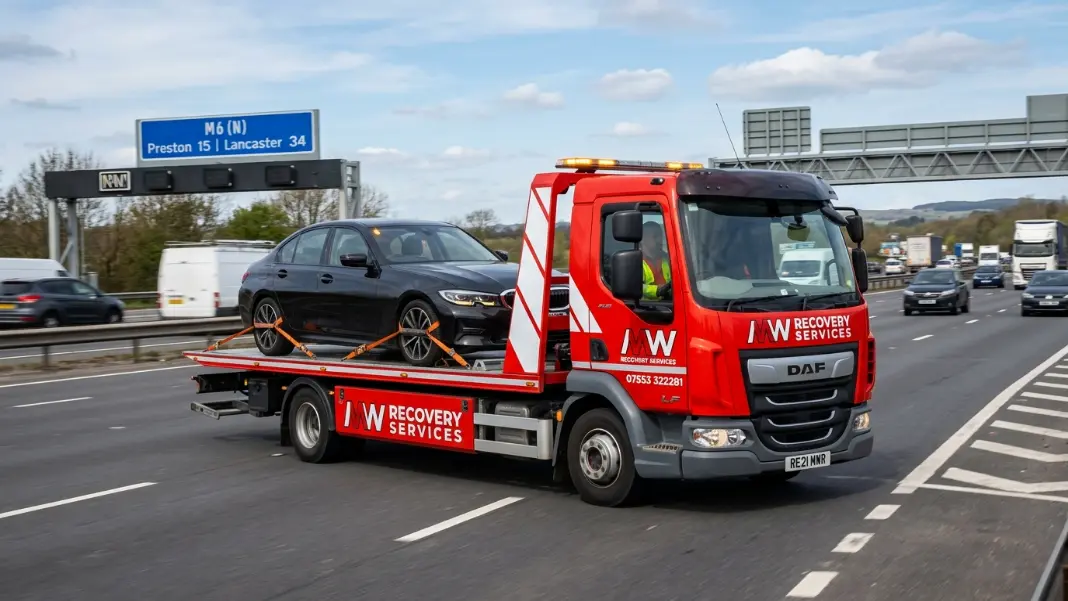
National recovery means your vehicle is towed to any UK destination — but only higher-tier policies include this. Basic roadside cover does not.
Tier 1: Roadside Assistance Only
This is the most basic level of cover and the one most commonly misunderstood. Roadside assistance means a patrol or technician comes to where you have broken down and attempts a repair at the roadside. If they can fix it there and then, fine. If they cannot, that is typically where this level of cover ends.
What roadside assistance includes:
- A technician attending your vehicle at the breakdown location
- Roadside diagnosis and minor repair: battery jump, tyre change if you have a serviceable spare, fuel if you ran out, minor mechanical adjustments
- Attendance time of approximately 30 to 45 minutes for the repair attempt
What it does not include:
- Towing your vehicle to a garage or any other destination
- Getting you or your passengers home if the car cannot be fixed
- In many policies: recovery from private car parks (off-road locations are a common exclusion)
Roadside-only policies are the cheapest tier and the type most commonly bundled with bank accounts or added onto car insurance. They work well when the fault is simple enough to fix in half an hour at the roadside. A flat battery, a dead spark plug, a loose connection. For anything more serious, they leave you stranded without further options.
Tier 2: Local Recovery
Local recovery adds the ability to have your vehicle towed to a destination, but only within a defined radius of the breakdown point. The radius varies by provider but is typically between 10 and 20 miles from where the car stopped.
This level is useful if you break down close to home or near your regular garage. It becomes a significant limitation if you break down further from home, because the tow destination must fall within the local radius rather than wherever you actually need to go. A breakdown on the M62 heading to Leeds while you live in Salford would not be covered for towing all the way home under a local recovery policy.
One important detail many people miss: the recovery destination is typically defined as the nearest appropriate garage, your home address, or one destination of your choice within the radius. The driver does not automatically take you to your preferred garage if there is a closer approved repairer available. Some policies specifically default to the "nearest approved garage" which may not be the one you trust or have an existing booking with.
Tier 3: National Recovery
National recovery is the level most people have in mind when they think of full breakdown cover. It means if your car cannot be fixed at the roadside, it gets towed to any destination in the UK, and you and your passengers are transported as well.
In practice, national recovery includes:
- Your vehicle recovered to any UK address you specify
- You and a set number of passengers transported (usually in the cab or a separate vehicle depending on the provider)
- The destination can be your home, a garage of your choice, or another UK address
This is the level worth having if you regularly travel outside Greater Manchester or take long-distance trips. For drivers who stay within the region most of the time, local recovery at Tier 2 may be sufficient, provided you understand and accept the radius limitation.
Tier 4: Home Start
Home start is the tier that generates the most confusion and the highest volume of policy complaints. The concept sounds clear: if your car will not start at home, they come to you. But the policy detail includes a catch that most policyholders do not know about until they need to use it.
The standard catch is the exclusion zone. Most providers exclude breakdowns within approximately a quarter of a mile of your registered home address from the standard roadside cover, then sell home start as a separate, chargeable tier to fill that gap. This means if you only have roadside cover and your car will not start in your own driveway, you are not covered by default. You either need to have added home start explicitly, or you pay for a private callout.
This matters because a significant proportion of breakdowns happen at or near the home, specifically battery failures overnight in cold weather, flat tyres noticed in the morning, and cars that have been parked up unused for a week or more and will not start on Monday.
When checking your policy for home start, look for:
- Whether home start is included in your tier or costs extra as an add-on
- How "home" is defined (almost always your registered address, not a second property or holiday let)
- The size of the exclusion zone (half a mile, quarter mile, or another distance depending on the provider)
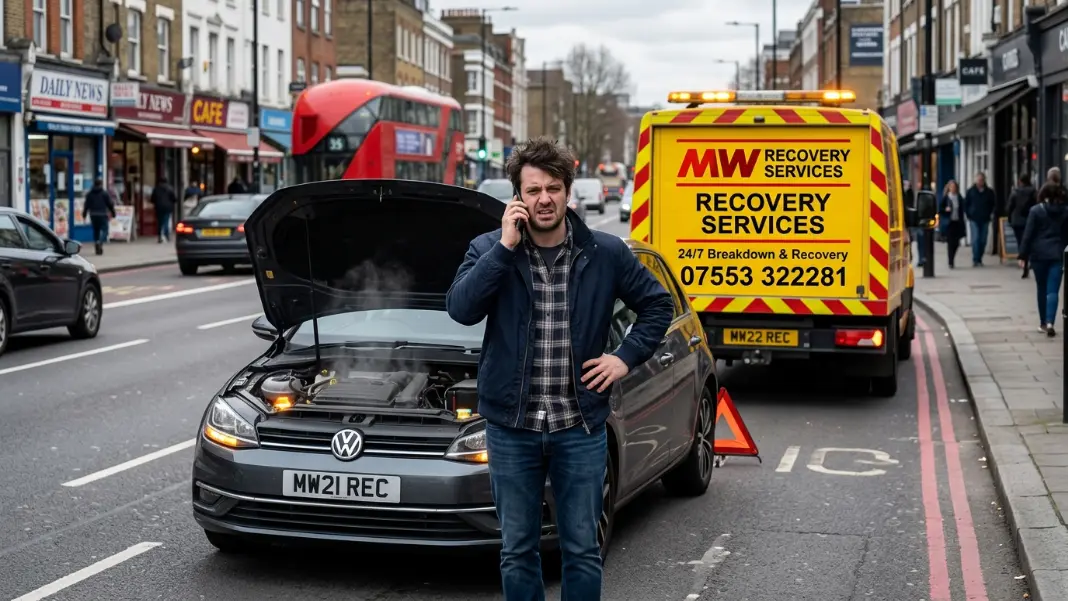
Many drivers discover what their breakdown policy does not cover only when they are already stranded and on the phone.
Tier 5: Relay and Onward Travel
The top tier of breakdown cover adds benefits for when vehicle recovery alone is not enough to complete your journey. This typically includes:
- Overnight accommodation costs if you cannot continue the journey that day
- Alternative vehicle hire subject to availability and policy limits
- Public transport costs or a taxi to your destination
- UK relay: the vehicle and passengers transported the full distance without a stop at an intermediate relay point
These benefits are genuinely valuable if you regularly travel long distances or depend heavily on your vehicle for work. For most local driving within Greater Manchester, they represent a cost premium that few drivers need on a typical year.
What Breakdown Cover Does NOT Include: The Exclusions That Catch People Out
The tier descriptions above cover what policies include when things go to plan. The exclusions are where most of the genuine surprises happen at the roadside. Here are the most common ones to understand before you assume you are covered:
Accident Damage
Breakdown cover does not cover accidents. If you have been in a collision, the recovery of your vehicle is handled through your motor insurance policy, not your breakdown cover. These are entirely separate products designed for different situations. If you have an accident on the M62 at night, your breakdown provider will not dispatch a recovery truck unless your motor insurer also uses them as an appointed contractor.
For accident recovery across Greater Manchester, you can call MW Recovery directly as a private operator rather than waiting on insurer timelines. More detail is on the accident recovery service page.
Misfuelling
Putting the wrong fuel in your car is not covered by standard breakdown policies. Some premium-tier products do include it and there are standalone misfuel insurance products, but the majority of roadside and local cover policies exclude misfuelling specifically. The vehicle needs a specialist drain-and-flush treatment before it can be driven, and this is almost always a chargeable callout regardless of your breakdown cover level.
Vehicle Age and Mileage Limits
Budget breakdown cover policies often include age or mileage restrictions. Common limits are vehicles over 10 to 15 years old being excluded, or vehicles above a mileage threshold (typically 100,000 to 150,000 miles). If your car is older or on higher mileage, check the policy wording carefully before assuming cover applies. Age and mileage exclusions are among the most common reasons claims get declined at the point of need.
Pre-existing Conditions
If your car had a known fault before you took out the policy, a breakdown caused by that fault is unlikely to be covered. This is particularly relevant if you took out a new policy and broke down within the first 24 to 48 hours. Most providers include a waiting period clause to prevent exactly this situation. If your car had a warning light on before you renewed or started your cover, check whether that known fault could be cited as a pre-existing condition that voids the claim.
Tyres
Many roadside-only and local recovery policies include tyre assistance only if you have a serviceable spare in the vehicle. If your car has run-flat tyres, no spare, or a space-saver spare that is itself flat, the callout may result in an attendance that cannot resolve the situation. Full tyre replacement is rarely covered under basic breakdown policies; tyres are treated as wear items. Some premium policies include tyre replacement but it is worth reading the specific wording rather than assuming.
Keys and Lockouts
Getting locked out of your vehicle is not consistently covered across providers. Some include it as a standard benefit, others charge for a locksmith callout separately, and others exclude lockouts entirely. Check your policy for the sections covering keys, lockout, and lost keys specifically before you need to rely on it.
Vans and Commercial Vehicles
Standard personal breakdown cover typically covers private passenger vehicles only. If you drive a van for work or a light commercial vehicle of any kind, you usually need a separate commercial breakdown policy. Using a personal policy to claim recovery for a van used for trade purposes is a common grounds for denial, and one that is enforced consistently by the major providers.
What Budget Breakdown Policies Actually Give You
Comparison sites make it easy to find breakdown cover for under £20 per year. At that price point, the policy almost always covers roadside assistance only, with significant exclusions on vehicle age, mileage, and private land coverage. It will not tow your vehicle anywhere. It may not cover home start. Call-out attendance time targets may be significantly longer than what premium providers advertise.
There is nothing wrong with a budget policy if you understand exactly what it is. The problem arises when drivers assume that any breakdown cover policy means someone will come and sort out the problem and get them where they need to be. That is a premium-tier expectation. A budget policy will not deliver it.
If you are not sure what your current cover includes, call the number on your policy card and ask directly: "If my car cannot be fixed at the roadside and needs to be towed, is that covered? And does my policy include home start?" The answers to those two questions will tell you whether the product matches what you actually need.
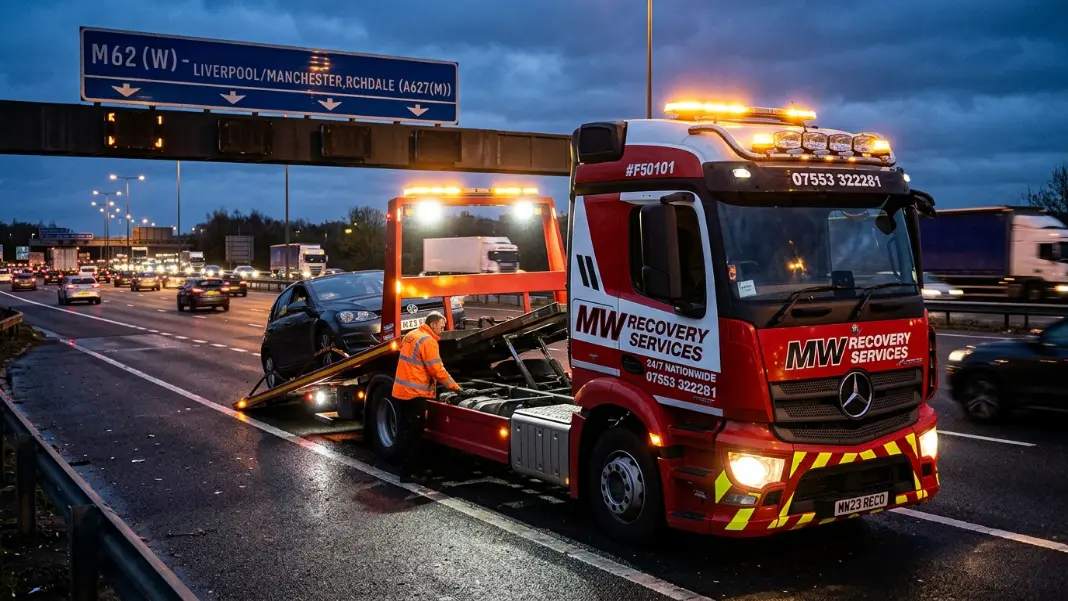
MW Recovery operates across the Greater Manchester motorway network including the M60, M62, M56, and M61 out of hours and at weekends.
What Manchester and Greater Manchester Drivers Should Think About Specifically
Living and driving in Greater Manchester brings specific considerations when it comes to breakdown cover and recovery planning.
The motorway network here is among the busiest in the country outside London. The M60 ring road, the M62 trans-Pennine corridor, the M56 towards Manchester Airport, and the M61 to Bolton all carry heavy traffic across multiple lanes. Breaking down on any of these routes means you are on a managed or smart motorway where the response involves Highways England alongside your breakdown provider. Your provider will attend, but they coordinate with Highways England on lane closures and vehicle clearance timing, which can add significantly to actual wait times compared with what the provider's average attendance figures suggest.
MW Recovery covers the full Greater Manchester motorway network on an out-of-hours and weekend callout basis. Coverage detail for the main routes is on the M60 motorway recovery page and the M62 motorway recovery page.
Manchester city centre presents different challenges. Multi-storey and underground car parks are covered by most breakdown providers, but access for large recovery trucks is often limited. Some policy wordings also exclude private land. If you break down in a city centre car park, confirm with your provider whether they will attend before assuming the cover applies to that location.
For immediate private recovery assistance across Manchester, Salford, Stockport, Bolton, Wigan, and the wider area without a policy, the breakdown recovery near me page covers what MW Recovery provides across these locations.
When Pay-Per-Use Recovery Makes More Financial Sense
Annual breakdown cover makes economic sense primarily if you break down or need roadside assistance more than once a year. Most people do not. Industry data consistently shows average UK drivers using their breakdown cover between 0.3 and 0.5 times per year, meaning the majority of policyholders pay for a full year of cover they do not call upon.
The numbers for Greater Manchester drivers often look like this:
- A mid-range annual policy with home start and national recovery: £80 to £150 per year depending on provider and vehicle
- A pay-per-use roadside recovery callout in Greater Manchester: £75 to £150 depending on the job and distance
If you break down once every two to three years, the total cost of paying per incident when it happens is roughly comparable to or less than accumulating annual premiums over that period, without any of the exclusion risks or contract commitment.
Pay-per-use recovery makes particular sense if:
- Your vehicle is older or higher mileage and would fall outside the eligibility criteria of budget policies anyway
- You drive a van or commercial vehicle that personal policies do not cover
- You need recovery after an accident rather than a mechanical breakdown
- You want the vehicle taken to a specific garage you already trust rather than the nearest approved repairer on the provider's list
- You are not currently covered and need help right now
MW Recovery operates on a pay-per-use basis with no membership required and no waiting period. Callouts cover Greater Manchester including Salford, Oldham, Bolton, Wigan, Stockport, and the full motorway network. Full service coverage is on the breakdown recovery service page.
For area-specific coverage detail, the Salford recovery page and Bolton recovery page cover what is available locally in those areas.
Frequently Asked Questions
Common questions about this topic
At its most basic level (roadside assistance only), standard breakdown cover includes a technician attending your vehicle and attempting a repair at the roadside. If the car cannot be fixed at the scene, basic cover does not include towing it anywhere. Higher tiers add local or national recovery, home start, and onward travel benefits. The specific inclusions depend entirely on which tier you have purchased and with which provider.
Need Car Recovery in Manchester?
MW Recovery provides fast, professional breakdown recovery and roadside assistance across all of Greater Manchester. One call and we are on our way.