
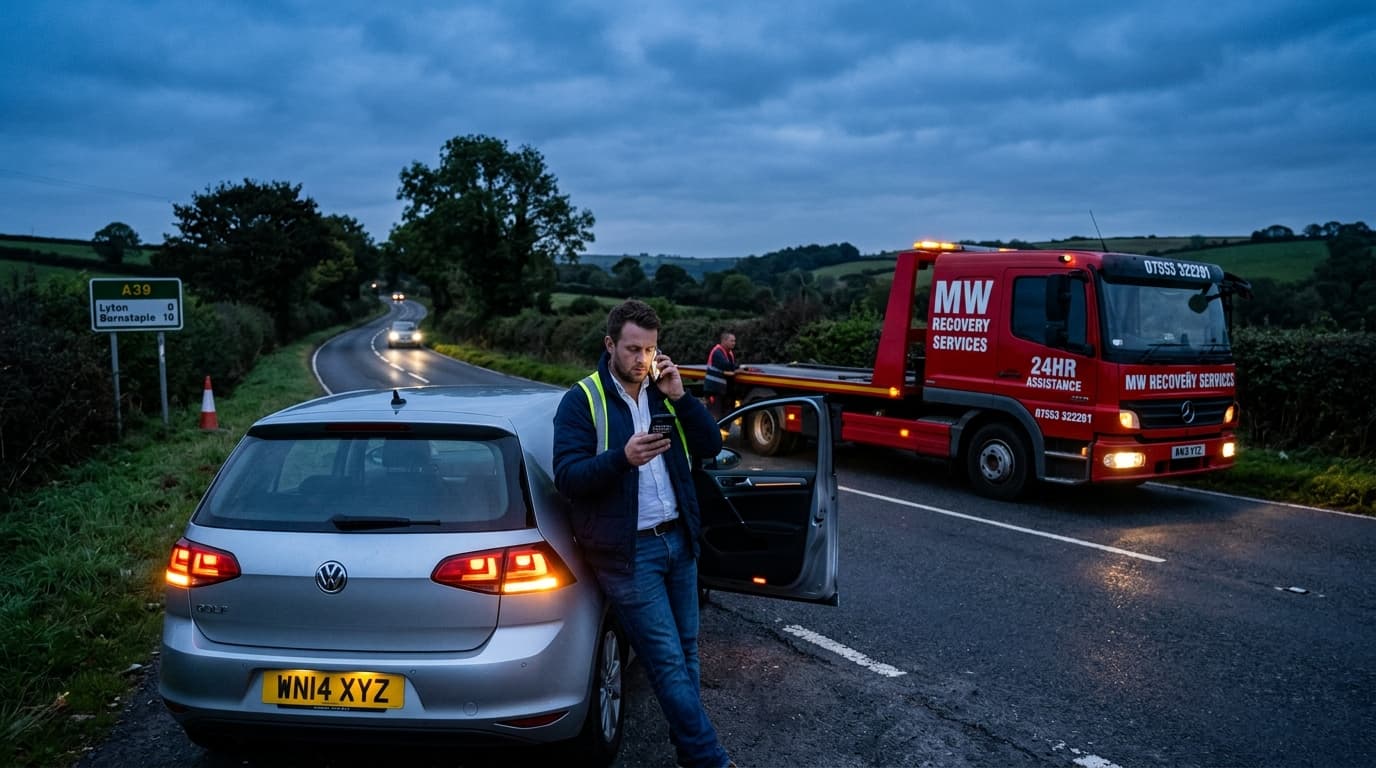
Does Car Insurance Cover Breakdown Recovery in the UK?
Most drivers assume their car insurance covers breakdown recovery. It usually does not. This guide explains exactly what your policy includes, when recovery is covered after an accident, and what to do if you break down without cover.
Table of Contents
Quick Answer: Does car insurance cover breakdown recovery?
Standard third-party car insurance does not cover breakdown recovery. Comprehensive policies sometimes include it as an add-on, but it varies by insurer and policy level. Dedicated breakdown cover from the AA, RAC, or a local provider like MW Recovery is separate. If you are not sure, check your policy schedule under "additional benefits" or call your insurer. For immediate recovery with no policy needed, call 07553 322281.
When your car breaks down at the roadside, one of the first thoughts most drivers have is whether their car insurance will cover the recovery. It is a completely reasonable assumption and one that catches a significant number of drivers off guard every year. The short answer, in the vast majority of cases, is no. Car insurance and breakdown cover are two entirely separate products, and assuming one includes the other is one of the most expensive misunderstandings in UK motoring.
This guide explains in plain terms what car insurance actually covers, why breakdown recovery is usually not part of it, the specific situations where your insurance might cover a recovery, how breakdown cover products work, and exactly what to do if your car stops and you have no recovery policy in place.
What Car Insurance Is Designed to Cover
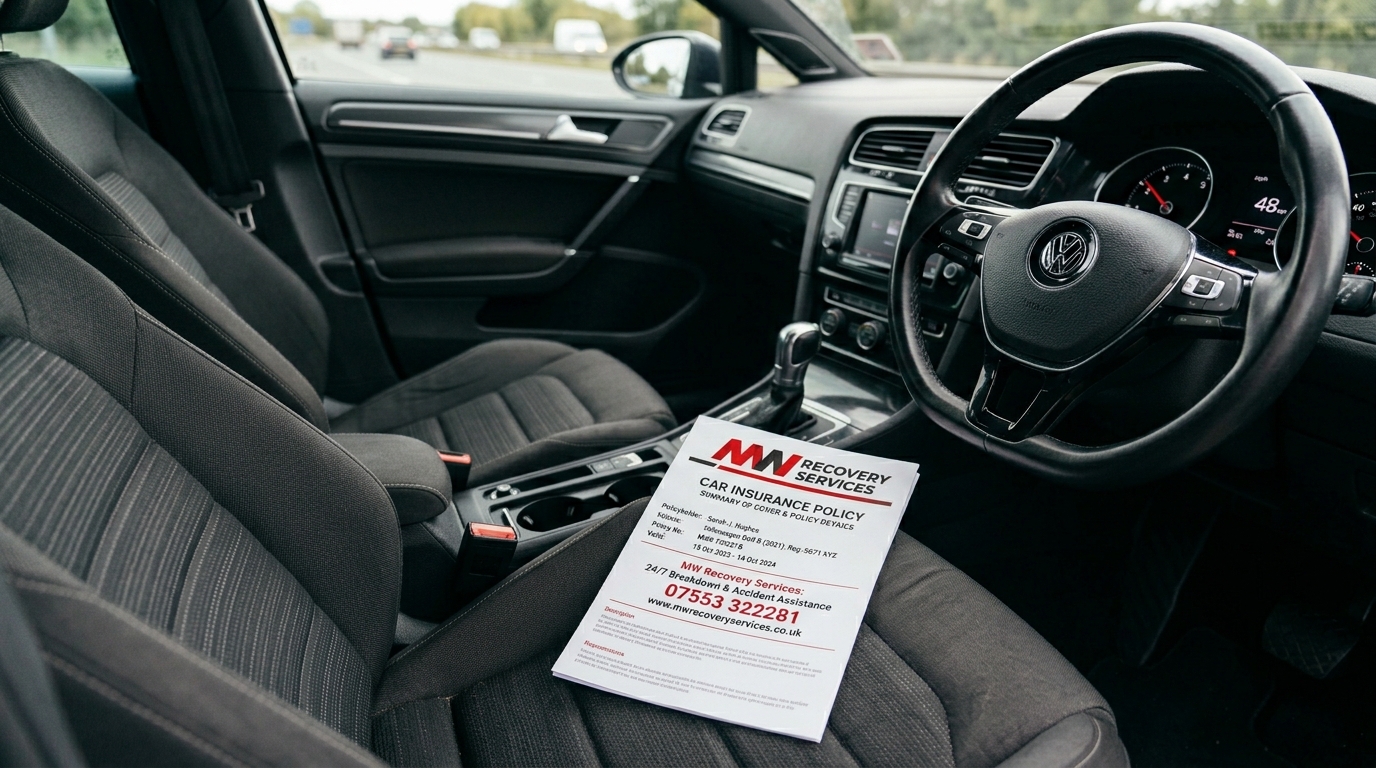
Car insurance is a financial product designed to protect you against the cost of accidents, theft, fire damage, and liability to third parties. It is a legal requirement in the UK under the Road Traffic Act. You cannot legally drive on a public road without at minimum third party insurance in force.
Third party only insurance, the minimum legal level, covers damage you cause to other people's vehicles and property, and compensation for injuries you cause to other people. It covers nothing about your own vehicle. If you break down, third party only insurance is completely irrelevant to your situation.
Third party, fire and theft adds cover for your own vehicle in the event it is stolen or damaged by fire. It still has no bearing on a mechanical breakdown at the roadside.
Comprehensive insurance is the highest tier and the most widely purchased in the UK. It covers your own vehicle for accidental damage as well as the above. It is more expensive than lower tiers because it covers more. However, comprehensive insurance does not automatically include breakdown recovery. This is a common and understandable point of confusion because the word comprehensive implies total cover, but comprehensive in insurance terms refers to the scope of accidental damage protection, not to everything that might happen to your vehicle.
Some comprehensive policies offer breakdown cover as an optional add-on that you can purchase alongside the main policy at the point of renewal or inception. If you selected this when you bought your insurance, you may have it. If you are unsure, check your policy schedule document, which lists everything your policy includes, or call your insurer directly.
Does Comprehensive Car Insurance Include Breakdown Cover?
Comprehensive car insurance does not automatically include breakdown cover as a standard feature. It may include it as an optional extra that you have paid for, but this is separate from the core policy and will be clearly listed as an add-on if it is present.
When breakdown cover is provided through an insurer as an add-on, it is almost always underwritten and delivered by a specialist breakdown provider such as the AA, RAC, Green Flag, or a smaller regional operator. The insurer acts as a reseller. The actual service, when you call for help, is provided by the specialist company on behalf of your insurer.
The level of cover provided through these bundled products varies. Some include roadside assistance only, meaning a recovery operator attends, attempts to fix the fault at the scene, and if they cannot, takes your vehicle to a local garage or repairer. Others include home start cover, which means the operator will attend even if your vehicle will not start at your home address rather than on a public road. More comprehensive tiers include onward travel arrangements, such as hire cars or hotel accommodation, if the vehicle cannot be repaired quickly. The highest tier products include European cover for breakdowns abroad.
Restrictions are common in bundled policies. Many exclude breakdowns within a quarter of a mile of your home address. Some cap the number of callouts per year at two or three. Older vehicles over a certain age may be excluded from some policies. Pre-existing faults that the driver knew about before taking out the policy are also commonly excluded.
Before assuming you are covered, read the breakdown section of your policy schedule carefully. Pay particular attention to the list of exclusions, which is where most drivers find the limits of their cover when they actually need to use it.
When Accident Recovery Is Covered by Your Car Insurance
There is one scenario where your car insurance typically does cover the recovery of your vehicle: when the vehicle is involved in a road traffic accident and is not driveable as a result of that accident.
If you have a comprehensive policy and you are involved in an accident that leaves your car undriveable, your insurer should arrange recovery of the vehicle as part of handling your claim. The cost of that recovery forms part of the overall claim rather than being charged to you separately.
This is an important distinction because it means that in post-accident situations, you have some control over how the recovery is handled, and you should exercise that control carefully. Your insurer will often appoint their own preferred recovery operator and preferred repairer. You are not legally obliged to accept either of these. You have the right to choose your own recovery company and, to a significant degree, your own repairer.
The reason this matters practically is storage charges. When a vehicle is recovered to an insurer-appointed facility, daily storage fees begin immediately. These can reach £40 or £50 per day. If your claim takes three or four weeks to process, the storage charges alone can mount to several hundred pounds and in some cases end up deducted from your settlement. Choosing your own recovery company and directing the vehicle somewhere you control eliminates this problem.
For accident recovery across Greater Manchester, MW Recovery Services attends accident scenes on the M60, M62, M56, and all surface roads. Call 07553 322281. See our full accident recovery service for more details.
Breakdown Cover Products: What Is Actually Available
Once you understand that car insurance does not cover breakdown as a standard feature, the next question is what breakdown cover actually looks like and what it costs.
There are three main types of provider in the UK. National membership organisations such as the AA, RAC, and Green Flag offer annual policies covering the policyholder across any vehicle they are in, regardless of whether they are driving or a passenger. These tend to be the most recognised names and carry large nationwide networks. They are also among the more expensive options at the higher cover tiers.
Insurance-linked add-ons, as described above, are breakdown products sold alongside car insurance. These are typically cheaper than standalone national membership policies but are tied to a specific vehicle and may have more restrictions.
Local and regional recovery companies offer one-off callout services without any subscription or annual commitment. You call when you need help, receive a quote, and pay for that specific job. There is no annual fee to maintain and no policy to renew. For drivers who rarely break down, this approach is often the most cost-effective option overall.
The cost comparison between annual membership and one-off recovery is worth doing honestly. A mid-level AA or RAC policy covering a single vehicle runs to approximately £80 to £130 per year. Over five years, that is £400 to £650 in subscription fees. If you break down twice in those five years and each callout costs £90 on a one-off basis, you have saved significantly by not having the policy. The calculation shifts if you drive high mileage, own an older vehicle with a higher probability of mechanical failure, or commute on motorways where a breakdown is more consequential.
What Is Not Covered Even With Breakdown Cover
It is worth being clear that even a comprehensive breakdown cover policy has limits. Most policies do not cover the cost of parts or repairs, only the callout and transport. If your battery fails and needs replacing, the recovery operator will attend and assess, but the battery replacement cost is separate. If your clutch fails and needs a workshop repair, the recovery is covered but the repair bill is not.
Vehicles that have been modified significantly from manufacturer specification may not be covered under some policies. Commercial vehicles, including vans used for business purposes, are excluded from personal breakdown policies and require a separate commercial vehicle breakdown product.
Tyres are a specific exclusion worth noting. Some policies do not cover punctures or tyre-related callouts at all. Others cover the callout but not the cost of a replacement tyre if yours is beyond repair. Read the tyre section of any breakdown policy carefully before assuming a flat tyre is fully covered.
What to Do If You Break Down With No Breakdown Cover
If your car stops and you have no breakdown cover in place, your options are straightforward. You call a local recovery company directly and pay for a one-off callout. No advance registration, no membership number, no waiting list. You describe your situation, receive a quote, agree to it, and a driver comes to you.
MW Recovery Services operates across all of Greater Manchester on exactly this basis. We quote before dispatch and the price you agree on the phone is the final price. Call 07553 322281 at any hour. Response times across the Greater Manchester area are typically 30 to 60 minutes.
If you break down on a motorway without cover, the process is the same but your immediate safety steps are more important. Move to the hard shoulder if one is present, or an Emergency Refuge Area on a smart motorway. Switch on your hazard lights. Exit from the left-hand side of the vehicle. Stand behind the nearside barrier, away from the lane edge. Call 07553 322281 for motorway recovery and give your direction of travel and the last junction number you passed. On the M60, M62, and M56, we reach most locations within 30 to 45 minutes.
On residential roads, pull over as far from moving traffic as possible. Switch on your hazard lights. If your car has stopped in a position that blocks traffic, call the police on 101 to report the obstruction as well as calling for recovery.
How to Check Whether Your Existing Policy Includes Breakdown
Rather than assuming, take five minutes to check your current situation clearly. Find your motor insurance policy schedule document. This is the document that lists exactly what your policy includes, not just the summary or the quote email. It is usually several pages long and lists all inclusions and exclusions in detail.
Look for a section titled Breakdown Assistance, Recovery Cover, or something similar. If this section exists, read the details carefully to understand the level of cover, the restrictions, and the provider. If this section does not exist, you do not have breakdown cover through your insurance.
If you cannot find your policy documents, log in to your insurer's online portal. Most insurers now provide full policy documentation digitally. Alternatively, call your insurer and ask directly whether breakdown cover is included and, if so, who provides it and what number to call in an emergency.
Doing this now, before you break down, is far better than trying to work it out at the roadside in the dark with traffic passing. Knowing the answer in advance means you can either add breakdown cover, find a local company to use if needed, or simply know what to do when the situation arises.
Recovery Costs Without Cover in Greater Manchester
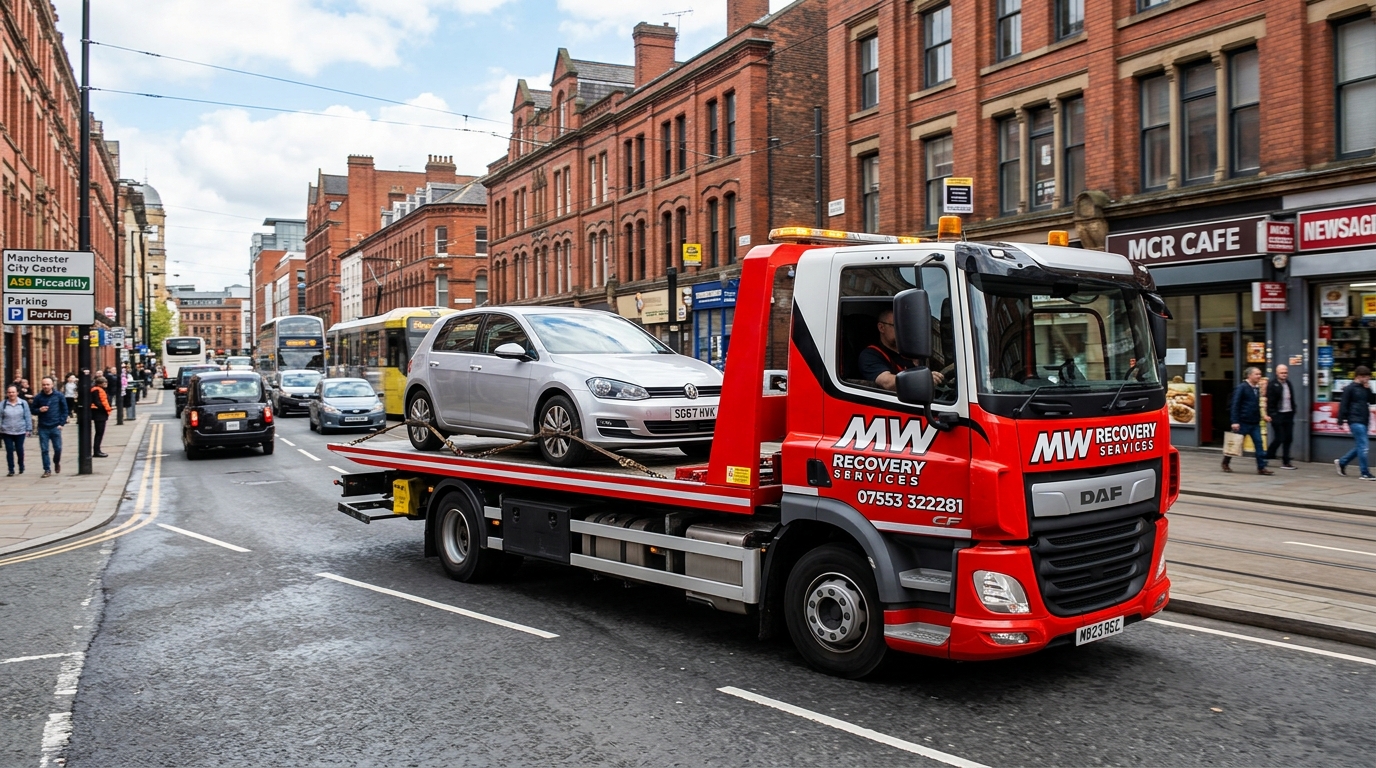
For drivers in and around Greater Manchester who find themselves needing recovery without a policy, the cost of a one-off callout is transparent and agreed in advance. Local recovery jobs within the Greater Manchester area typically start from around £50 for short distances and straightforward situations such as a jump start or a roadside wheel change.
Standard breakdown recovery within the region, involving loading onto a flatbed and transporting to a garage or our Salford workshop, starts from around £75 to £100 depending on the pickup location and destination. Motorway recoveries and longer-distance jobs are priced on the specifics of each job and quoted before any driver is dispatched.
Our Salford workshop is available for same-day repairs after recovery for many common faults, which means a single call can resolve both the recovery and the underlying mechanical problem without needing a separate garage appointment. For a full breakdown of pricing, see our car recovery prices guide.
Frequently Asked Questions
Common questions about this topic
No. Breakdown cover is not a standard inclusion in any tier of car insurance, including comprehensive. Some policies offer it as a paid add-on. Check your policy schedule or call your insurer to confirm whether you have it.
Need Car Recovery in Manchester?
MW Recovery provides fast, professional breakdown recovery and roadside assistance across all of Greater Manchester. One call and we are on our way.