
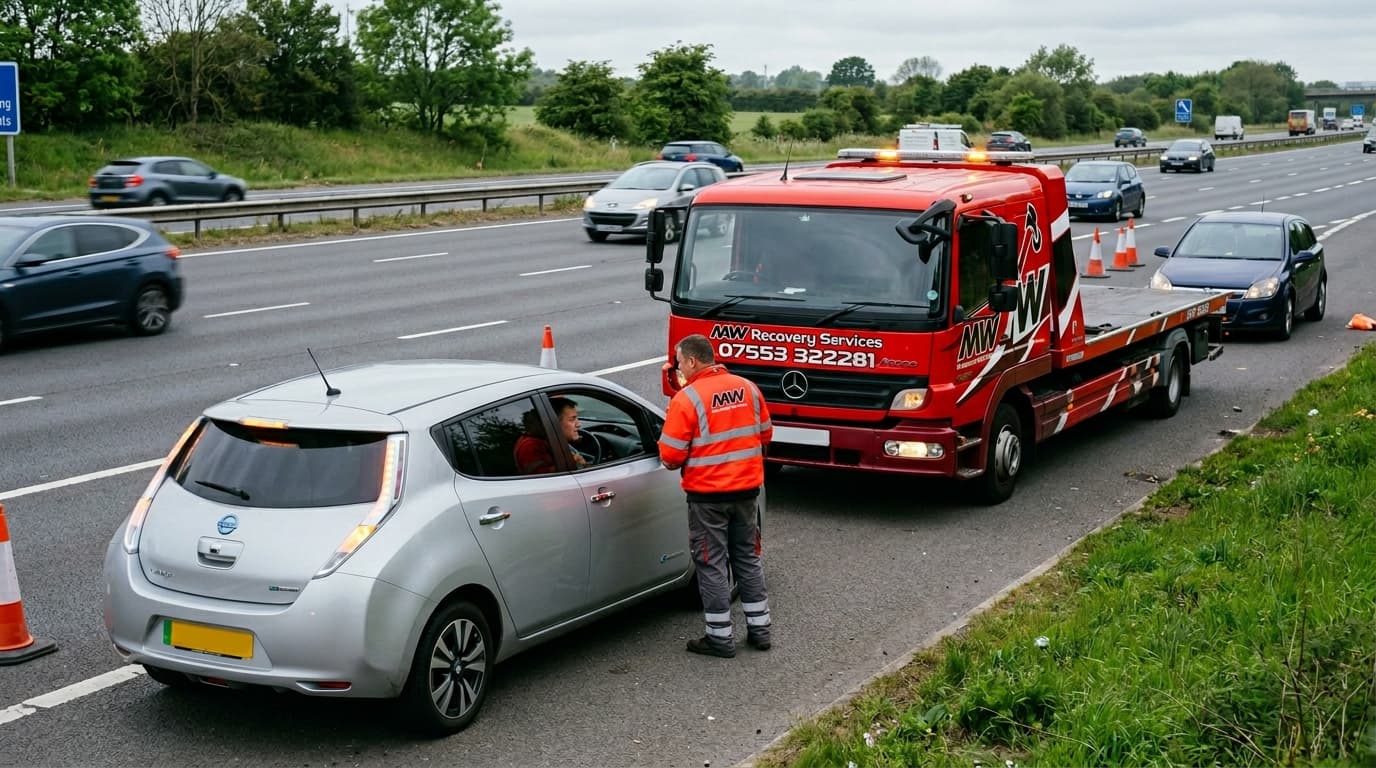
What Happens When Your Electric Car Runs Out of Charge on the Motorway?
Running out of charge on the motorway in an EV is nothing like running out of petrol. There is no roadside top-up. Here is exactly what happens, why you cannot be towed conventionally, and how specialist EV recovery works.
Table of Contents
The number of electric vehicles on UK roads has grown faster than almost anyone predicted five years ago. Alongside that growth has come a rapid increase in EV-specific breakdown callouts, and the most common of those callouts is also one of the most distinctive: the driver who runs out of charge on the motorway and discovers that their situation is nothing like running out of petrol in a conventional car.
This guide covers in detail what happens when an EV reaches zero charge on the motorway, why the standard breakdown solutions do not apply, the correct immediate response, how specialist EV recovery works, what to tell the recovery company, and practical steps to avoid finding yourself in this situation in the first place.
What Happens When an EV Runs Out of Charge
In a petrol or diesel car, running out of fuel is inconvenient and avoidable, but the fix is simple. A recovery driver brings a small amount of fuel in a can, fills the tank enough to get you moving, and you reach the nearest filling station under your own power. The entire roadside resolution takes minutes.
An electric vehicle works completely differently. The main traction battery, which stores the energy that powers the drive motors and accounts for the vast majority of the vehicle's energy storage, cannot be topped up at the roadside. There is no portable charging solution that a recovery driver can bring to give you enough range to reach a charging station. When the traction battery reaches zero, the vehicle stops and cannot move under its own power. The only resolution is to transport the vehicle to a charging point.
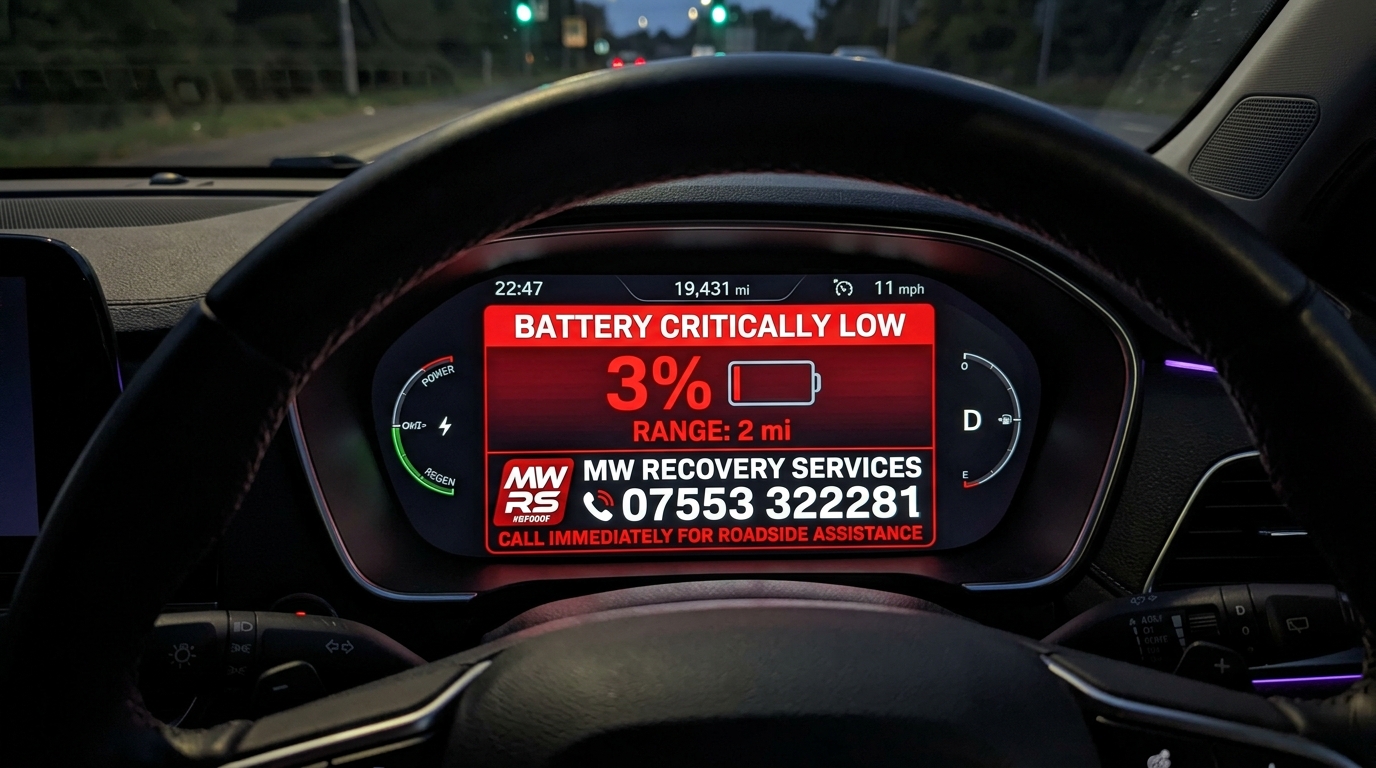
Most modern EVs manage this situation proactively. As charge drops below 20 percent, range warnings appear and the vehicle may begin making suggestions about nearby charging locations. Below 10 percent, warnings become more frequent and urgent. At very low charge levels, many models automatically reduce maximum speed and power output to extend the remaining range as far as possible. The purpose of this is to give drivers time to reach a charger before the vehicle stops.
If you see these warnings on a motorway, take them seriously and act immediately. Do not assume the range estimate will prove optimistic, do not push on to the next services assuming you will make it. Motorway speeds, headwinds, cold weather, and a fully loaded car all reduce EV range below the figure the dashboard shows. It is better to stop at the next services with 12 percent charge and plug in than to carry on and discover the range estimate was not conservative enough.
Understanding the Two Battery Systems in an EV
One source of confusion in EV breakdowns, and one that catches both drivers and some recovery operators off guard, is that electric vehicles actually contain two separate battery systems that fail independently of each other.
The main traction battery is the large, high-voltage battery pack that powers the drive motors. It is what provides range and is charged by plugging in. It is also what depletes to zero when you run out of charge. In most EVs this battery pack runs at several hundred volts and stores energy in the tens of kilowatt-hours.
The 12V auxiliary battery is a conventional low-voltage battery similar in principle to the 12V battery in a petrol car. It powers the vehicle's secondary systems: door locks, windows, interior lighting, dashboard displays, infotainment, and the onboard control modules. It is charged by the main traction battery management system while the car is in normal operation.
If the 12V auxiliary battery fails independently, the vehicle can appear completely dead even when the main traction battery has plenty of charge remaining. The doors may not unlock electronically, the dashboard may not light up, and the car may give no response at all when you try to start it. This can be genuinely alarming because it presents exactly like total battery failure when it is actually a much more manageable problem.
A 12V auxiliary battery failure can often be addressed at the roadside with a conventional jump start applied to the 12V battery terminals, which on most EVs are located under the bonnet and clearly marked. This is separate from the high-voltage system and does not involve the traction battery at all. MW Recovery Services drivers understand this distinction and arrive prepared for both scenarios. Call 07553 322281 and describe exactly what the vehicle is doing and we will arrive with the right equipment.
Why You Cannot Tow an Electric Vehicle Conventionally
This is one of the most important pieces of information any EV driver can have, and it is information that some recovery operators are still not aware of. The vast majority of electric vehicles must not be towed on their wheels over any meaningful distance.
When a traditional recovery vehicle lifts the front wheels of a petrol car and tows it with the rear wheels on the ground, the rear wheels simply roll freely. There is no mechanical connection between the rolling wheels and the engine when the car is in neutral. The same is not true for an electric vehicle.
In most EVs, the electric drive motor is mechanically connected to the wheels at all times through a single fixed-ratio gearbox. When the wheels turn, the motor turns. When the motor turns without power being supplied, it acts as a generator and attempts to push current back into the battery. This regenerative effect was not designed for the kind of sustained, uncontrolled rotation that happens during conventional towing, and on many models it causes overheating and damage to the motor, inverter, or drivetrain after even relatively short distances.
Some manufacturers, notably Tesla, specify in their owners manuals that towing on the wheels is only permitted for very short distances at very low speed under specific conditions. Others prohibit it entirely. If you are unsure about your specific vehicle, assume flatbed is required and do not allow any recovery operator to tow your EV on its wheels over any significant distance.
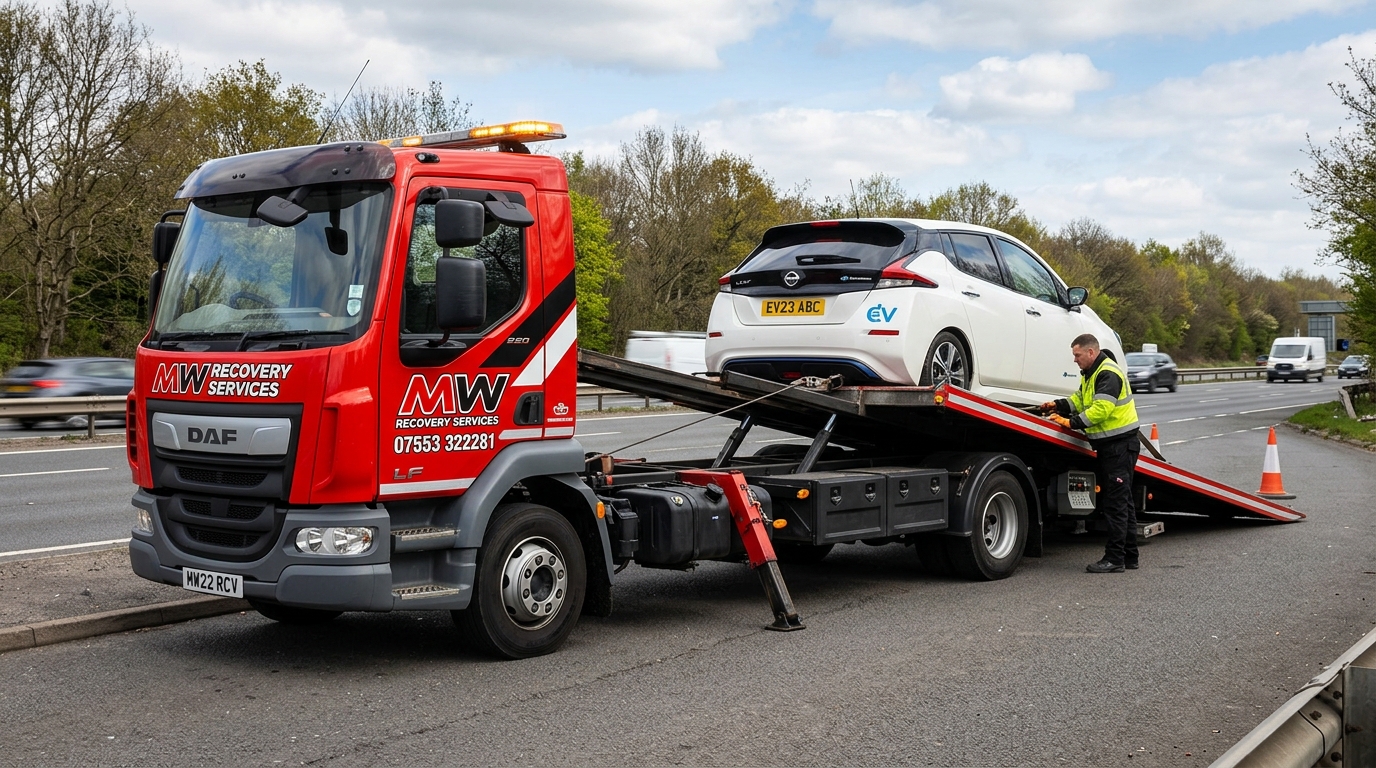
All EV callouts attended by MW Recovery Services use flatbed trucks with all four wheels off the ground as standard. This is not optional and not something we leave to driver preference. It is the only correct method for transporting any electric vehicle over a meaningful distance. See our EV recovery Manchester service for more details.
The Immediate Steps When Your EV Stops on the Motorway
Your immediate safety priorities are identical to any motorway breakdown, regardless of whether the vehicle is electric or petrol. Get to safety first. Deal with everything else after.
If the vehicle is losing power but still moving, use whatever forward movement remains to reach an Emergency Refuge Area. ERA signs show the distance to the next one. Coast if you have to. Every metre of movement towards an ERA is a metre closer to a safe stopping point. Do not brake unnecessarily; maintain as much forward momentum as the vehicle will allow and aim for the leftmost position.
If the vehicle stops in a live lane before you can reach an ERA, put on your hazard lights immediately. On a smart motorway section without a permanent hard shoulder, this is the most important action you can take. Hazard lights alert other drivers and are the visual cue that triggers camera detection systems in the control centre.
Exit from the left-hand side of the vehicle. Make no attempt to cross lanes or reach the central reservation. Get to the nearside barrier and put it between you and the live lanes. Stay there. Many EV models will still allow you to exit the vehicle even when the main traction battery is depleted because door release operates on the 12V system. If the 12V battery has also failed and the doors will not open electronically, your vehicle's owners manual will show you the mechanical emergency release, usually a small lever or pull cord in the door card.
Once you are behind the barrier, call 999 to report the hazard. Then call MW Recovery Services on 07553 322281. We provide motorway recovery on the M60, M62, M56, and all major routes around Manchester, and our typical response time is 30 to 45 minutes from your call.
How EV Recovery Works: What Happens When the Driver Arrives
When our recovery driver arrives at an EV callout, the first assessment is which of the two battery systems has failed. If it is a 12V auxiliary battery failure with the main traction battery intact, a jump start to the auxiliary terminals may resolve the situation and allow the vehicle to be driven or at least safely manoeuvred onto the flatbed.
If the main traction battery is depleted, the vehicle is loaded onto the flatbed. Our drivers are briefed on the specific loading procedures for common EV models including where to locate the tow attachment points, how to put the vehicle in transport mode or neutral for loading, and what high-voltage safety protocols to follow.
High-voltage safety is relevant in post-accident EV recovery scenarios where battery damage is suspected. A damaged lithium-ion traction battery pack carries a risk of thermal runaway, a process where heat builds up within the battery and can lead to fire. When a battery is suspected of being damaged following a collision, we follow manufacturer guidance on safe transport, typically maintaining clear space around the vehicle during transit and monitoring for signs of thermal event. We do not attempt to access, cut, or modify any high-voltage component under any circumstances.
For non-accident charge depletion callouts, the process is straightforward. The vehicle goes onto the flatbed and we take it to the nearest suitable rapid charger, to your home address, or to another destination you specify. The most common destination request is the nearest rapid charger that is compatible with your vehicle, so it is helpful to know your vehicle's charging standard before you call.
Rapid Charging on the Motorway Network
If your EV runs low on charge on the motorway, rapid chargers at motorway services are the obvious first port of call. The UK motorway services network has seen significant investment in rapid and ultra-rapid charging infrastructure over the past three years, and coverage has improved substantially from the patchy situation that existed in 2021 and 2022.
However, not all chargers are compatible with all vehicles. Rapid chargers on the UK network primarily use CCS (Combined Charging System) connectors, which are compatible with most modern European and American EVs. CHAdeMO connectors, used by older Nissan Leaf models and some Japanese vehicles, are less commonly available at motorway services and disappearing from new installations. Tesla Superchargers, which are increasingly being opened to non-Tesla vehicles, use a different connector again.
Before a long motorway journey in an EV, check that the rapid chargers on your route are compatible with your vehicle. Apps including Zap-Map and the National Highways electric vehicle map show real-time charger availability and connector types. Download one of these before you travel rather than trying to find this information at the roadside with a critically low battery.
Practical Steps to Avoid Running Out of Charge on the Motorway
Prevention is considerably less stressful than recovery. The following habits significantly reduce the risk of finding yourself stranded.
Never start a motorway journey with less than 30 percent charge unless you have confirmed that a compatible rapid charger is within comfortable range. The 30 percent buffer gives you room to manage unexpected range reduction from motorway speeds, headwinds, or a temperature drop that reduces battery output.
Understand that motorway driving at 70mph uses EV energy at a much higher rate than combined or city driving. Range estimates shown by most EV dashboards are based on mixed driving cycles. At constant 70mph in cold weather, actual range can be 25 to 30 percent lower than the displayed estimate. Factor this in before deciding whether to press on or stop at the next services.
Use pre-conditioning features if your vehicle has them. Most modern EVs allow you to set the battery and cabin to a target temperature while the vehicle is still plugged in at home or at a public charger. Starting a journey with a warm battery in cold weather means the battery operates closer to its full capacity from the moment you pull out, rather than spending the first few miles warming up at reduced efficiency.
On long motorway journeys, plan charge stops as you would plan fuel stops in a petrol car. Build them into the route proactively rather than treating them as emergencies. A 20-minute rapid charge stop every 90 to 120 miles is now practical on most rapid-charging compatible EVs and is far less disruptive than a 45-minute recovery wait on the hard shoulder.
Frequently Asked Questions
Common questions about this topic
No. There is no portable equivalent of a fuel can for an EV traction battery. The only resolution when the main battery is depleted is to transport the vehicle to a compatible charging point. Some specialist EV recovery providers carry small mobile charging units that may add a few miles of range in a very limited emergency, but this is not standard equipment and cannot fully replace a proper charge stop.
Need Car Recovery in Manchester?
MW Recovery provides fast, professional breakdown recovery and roadside assistance across all of Greater Manchester. One call and we are on our way.