
Fleet Manager's Guide to Commercial Vehicle Breakdown in Manchester
A practical guide for fleet managers: how to handle commercial vehicle breakdowns in Manchester, choose the right recovery provider, set SLAs, and keep costs under control across the M60, M62 and wider Greater Manchester network.
Table of Contents
A commercial vehicle breakdown costs more than the recovery bill. When a van or HGV goes off the road in Manchester, there is lost revenue from delayed deliveries, driver downtime, possible cargo spoilage, and the knock-on impact on other fleet vehicles covering the gap. Fleet managers who plan their breakdown response in advance spend far less per incident than those who scramble for a solution at the roadside.
This guide covers everything a fleet manager needs to know about commercial vehicle breakdowns in Manchester, from choosing the right recovery provider and setting up service level agreements, to managing costs and understanding what your drivers should do at the roadside.
Why Commercial Breakdowns Are Different
A private car breakdown is inconvenient. A commercial vehicle breakdown is a business incident. The differences start at the roadside: a van driver carrying time-critical freight has a very different set of pressures to a private motorist stuck on a country road. The driver may have a delivery window to meet, passengers expecting them, or perishable cargo. Every minute the vehicle is off the road has a traceable cost.
Commercial vehicles also have different recovery requirements. A transit van cannot always be wheel-lifted safely, particularly if it is loaded. An HGV, a refrigerated vehicle, or a specialist commercial vehicle needs equipment and expertise that most general recovery operators do not carry. Using the wrong recovery method on a loaded commercial vehicle can damage the cargo, the vehicle, or both.
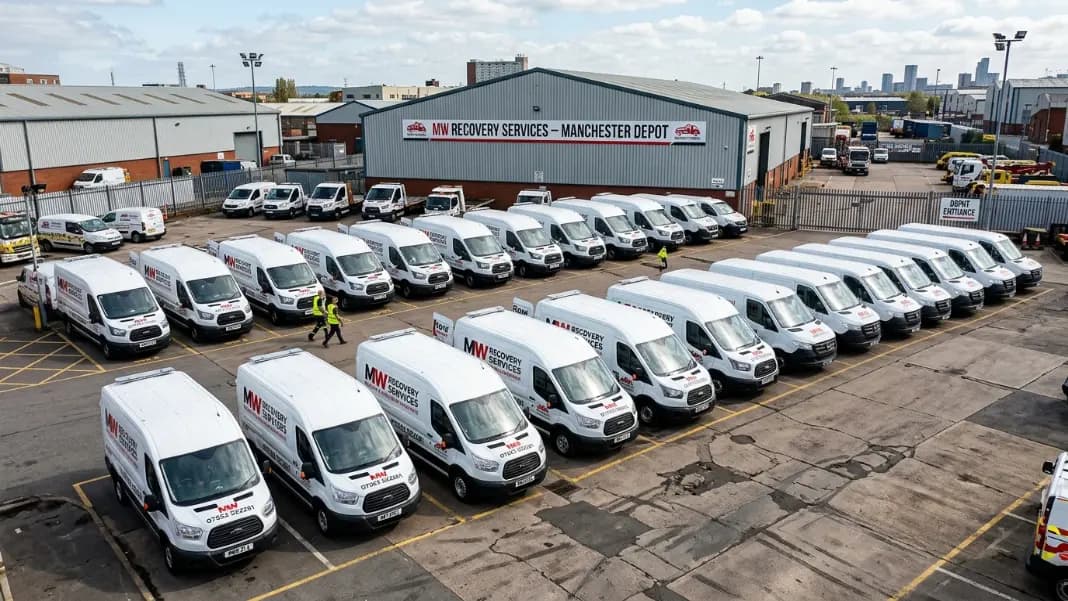
For Manchester-based fleets, the road network adds further complexity. The M60 ring motorway, the M62 trans-Pennine route, and the A57 Snake Pass corridor are all high-pressure commercial routes where breakdowns cause significant disruption. A recovery provider who knows these routes and maintains positioning across Greater Manchester provides a measurably faster response than a national operator dispatching from a distant depot.
Types of Commercial Vehicles and Their Recovery Needs
Different commercial vehicle types require different recovery approaches, and choosing a provider means confirming they can handle your specific fleet composition.
Vans (up to 3.5 tonnes): Most light commercial vans can be recovered on a standard flatbed. Loaded vans need careful loading and securing. If the van has cargo that cannot be transferred, the entire vehicle including its load may need to move together. Our van recovery Manchester service covers all light commercial vehicles across the city.
Medium commercial vehicles (3.5 to 7.5 tonnes): These need a larger flatbed or heavy recovery truck. Many general recovery operators cannot handle vehicles in this class without specialist equipment. Confirm capability before signing any contract.
HGVs and articulated lorries: These require specialist HGV recovery equipment, trained operators, and often Highways England notifications if the incident is on a motorway. Our HGV recovery Manchester team handles heavy goods recoveries across the motorway network surrounding Manchester.
Refrigerated vehicles: Temperature-sensitive cargo adds a time dimension to every recovery. The faster the vehicle is recovered and the cargo transferred or the refrigeration unit reconnected, the less spoilage occurs. Agree protocols for refrigerated vehicles specifically in any fleet recovery contract.
Key Manchester Routes for Fleet Operators
Understanding where your vehicles are most likely to experience issues helps you plan your recovery response. The highest-frequency commercial breakdown routes in and around Manchester are:
- The M60 orbital motorway, particularly the heavily trafficked southern arc between junctions 1 and 12
- The M62 between Manchester and Leeds, one of the busiest freight corridors in the north of England
- The M56 toward Manchester Airport, used heavily by airport logistics and courier fleets
- The M61 northbound toward Bolton and Preston
- The A580 East Lancashire Road, a primary route for distribution vehicles moving between Manchester and Liverpool
- The A6 corridor through Stockport and toward the Peak District
A recovery provider with established response positioning across these corridors will consistently outperform a national operator dispatching from a single regional depot. When a vehicle goes down on the M62 at peak hour, every minute of response time matters for your delivery windows.
What Your Drivers Should Do After a Commercial Breakdown
The first minutes after a commercial breakdown determine how the rest of the incident plays out. Fleet managers who brief their drivers in advance see significantly better outcomes than those who leave it to the driver to improvise. A simple laminated card in the cab covering the following steps is one of the highest-return investments a fleet manager can make.
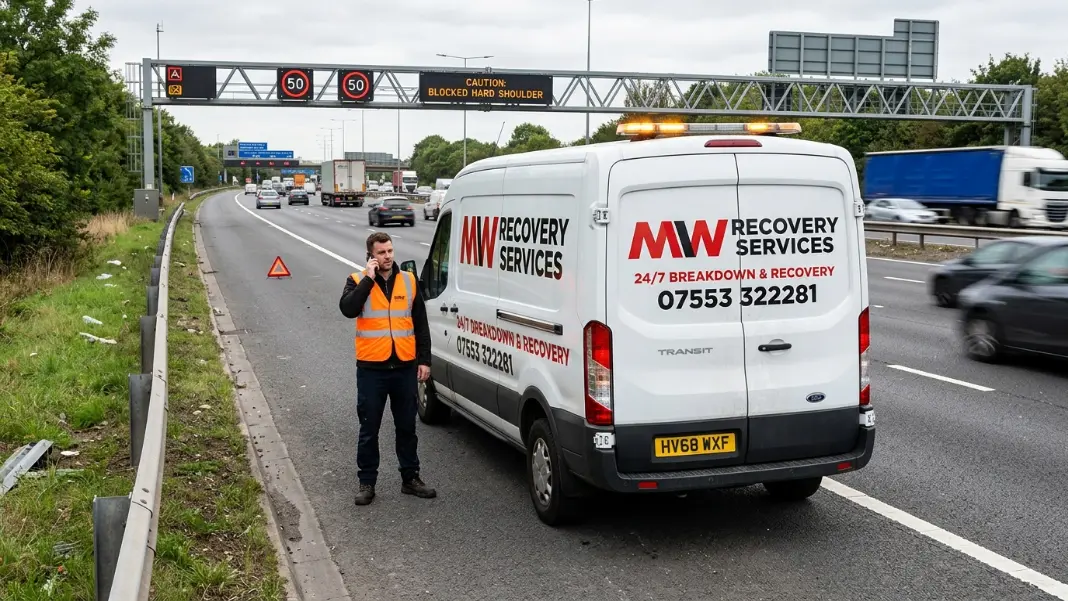
On a motorway: move the vehicle to the hard shoulder or an emergency refuge area if possible, switch on hazard lights, exit the cab from the nearside door, move behind the safety barrier, and call the recovery number. Do not remain in the cab. On a smart motorway without a hard shoulder, reaching an Emergency Refuge Area is the priority. If the vehicle cannot move, activate hazard lights, call 999 to report the obstruction, and then call recovery.
On a non-motorway road: move the vehicle as far off the carriageway as safely possible, switch on hazards, place a warning triangle at least 45 metres behind the vehicle on a conventional road (never on a motorway), and call recovery. Document the vehicle's location using GPS or a map reference, as this significantly speeds up dispatch.
Choosing the Right Recovery Provider for Your Fleet
Fleet recovery contracts come in two main structures: pay-per-incident and a fixed-rate agreement covering an agreed number of vehicles and call-outs per year. Pay-per-incident is appropriate for smaller fleets where breakdown frequency is low and unpredictable. Fixed-rate agreements suit larger fleets where the volume of incidents justifies the contractual overhead.
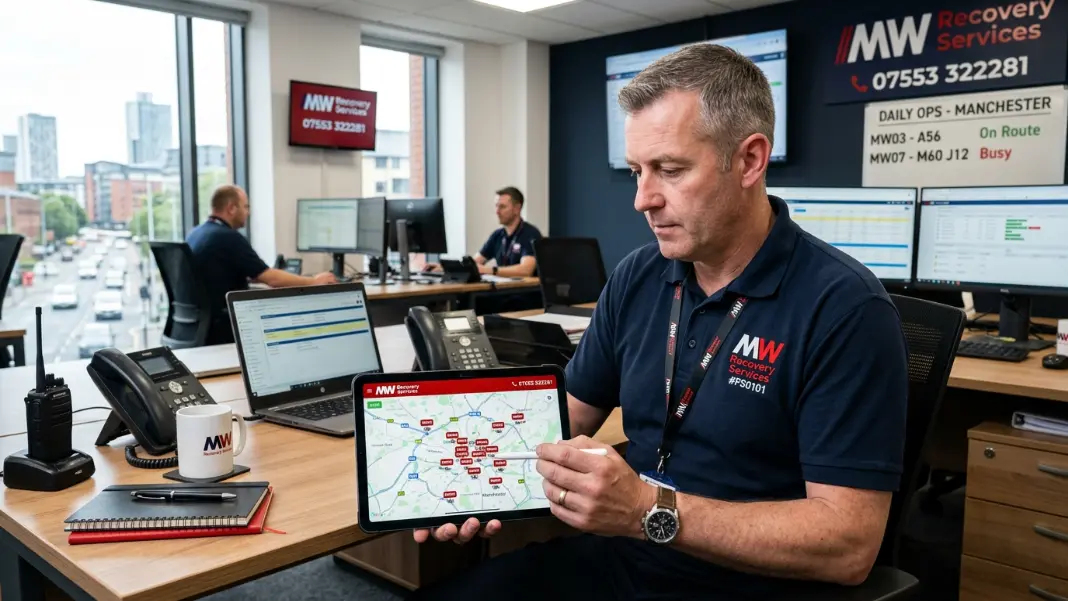
When evaluating a recovery provider for your fleet, the criteria that matter most are: average response time on the specific routes your vehicles use, capability to handle the heaviest vehicle in your fleet, 24-hour availability including weekends and bank holidays, ability to provide a written incident report after each recovery, and pricing transparency with no hidden surcharges. National breakdown clubs provide broad coverage but often outsource to local operators in areas like Manchester, adding a layer that slows response.
For fleet operators based in or regularly running through Manchester, using a local specialist with fixed positioning across the motorway network removes the outsourcing delay. Our breakdown recovery and motorway recovery services cover all major routes, with vehicles positioned across the Greater Manchester area around the clock.
Service Level Agreements: What to Insist On
An SLA with a recovery provider should specify response time targets, not just coverage areas. A provider who says they cover the M62 but cannot commit to a maximum response time is not providing a meaningful service guarantee. Realistic SLA targets for Greater Manchester are 30 to 45 minutes for motorway incidents during standard hours and 45 to 60 minutes out of hours.
The SLA should also specify what happens if a vehicle cannot be recovered to the agreed destination in a single move, how relay recovery is managed and charged, what documentation is provided after each incident, and how billing is structured for jobs that exceed the standard scope. Build in a dispute resolution process and a review clause, so you can exit or renegotiate if performance targets are not met consistently.
For accident recovery situations, where liability and insurance considerations add complexity, look for a provider with experience in accident management as well as standard recovery. Having one provider handle the recovery, the documentation, and the initial accident management process reduces the number of parties involved and speeds up your insurance claim.
Managing Fleet Recovery Costs
The largest single lever for reducing fleet recovery costs is preventive maintenance. A well-maintained fleet breaks down less frequently, and when a vehicle does fail, it is often a minor mechanical issue rather than a serious failure requiring specialist recovery equipment. Regular tyre checks, battery testing, and fluid maintenance address the most common causes of commercial vehicle breakdown.
When breakdowns do occur, cost discipline means: confirming the total price before agreeing to any recovery job, keeping records of every incident and its cost to identify patterns, reviewing the incident report to determine whether the breakdown was preventable, and comparing per-incident costs against your SLA targets quarterly. If your average recovery cost is consistently higher than market rates for the Manchester area, it is time to renegotiate or switch providers.
You can compare our current pricing on our car recovery prices page and contact us directly for a fleet rate discussion via our contact page.
MW Recovery Fleet Services in Manchester
MW Recovery provides commercial vehicle recovery across the Manchester motorway network and city roads, covering vans, light commercials, and HGVs. Our vehicles are positioned across Greater Manchester to provide rapid response to the M60, M62, M56, M61, M66, and the major A-road network. We provide written incident reports on request, operate 24 hours a day, and give fixed prices before any vehicle is moved.
For fleet operators based in Manchester, Salford, Trafford, Stockport, or anywhere across Greater Manchester, our Manchester recovery hub and Salford coverage are available around the clock. To discuss a fleet recovery arrangement, use our contact page or call directly for an immediate response.
Frequently Asked Questions
Can a standard car recovery operator recover a loaded van?
A loaded van often requires a flatbed truck rather than a wheel-lift, particularly if the load affects the vehicle's balance or if the cargo cannot be safely removed at the roadside. Always confirm that your recovery provider can handle loaded commercial vehicles before signing a contract.
Does fleet breakdown cover work differently to private car breakdown cover?
Yes. Fleet breakdown cover is typically a contract that covers a number of named vehicles or an unlimited fleet for a fixed annual fee, with agreed response time targets. Private car breakdown cover is per-vehicle and per-driver. Fleet contracts also usually include account management and incident reporting that standard consumer policies do not.
What documentation should I get after a commercial vehicle recovery?
You should receive a written incident report covering the date, time, location, vehicle registration, nature of the breakdown, recovery destination, and the total charge. This documentation is important for insurance purposes, fleet maintenance records, and if the incident occurred on a motorway, potential Highways England records.
How quickly should a commercial vehicle be recovered from a motorway?
Highways England targets vehicle clearance from motorways within 60 minutes of the incident being reported. A recovery operator positioned across Greater Manchester can realistically attend a motorway incident within 30 to 45 minutes during standard hours. If your current provider consistently exceeds 60 minutes, your SLA targets are not being met.
Can a driver refuse to use a recovery operator sent by the police?
Yes. If police direct a recovery vehicle to your incident, you are not obliged to use that operator. You can contact your preferred or contracted recovery provider instead. You will still owe any attendance charge to the police-directed operator if they have already attended, but you are not required to allow them to move your vehicle.
Commercial vehicle breakdowns in Manchester are a business cost that can be planned for and managed. Fleet managers who choose a local specialist with strong coverage of the Manchester motorway network, who set clear SLAs, and who brief their drivers on the correct roadside procedure will consistently outperform those who treat recovery as an afterthought. The cost of preparation is a fraction of the cost of a poorly managed incident.
Need Car Recovery in Manchester?
MW Recovery provides fast, professional breakdown recovery and roadside assistance across all of Greater Manchester. One call and we are on our way.