
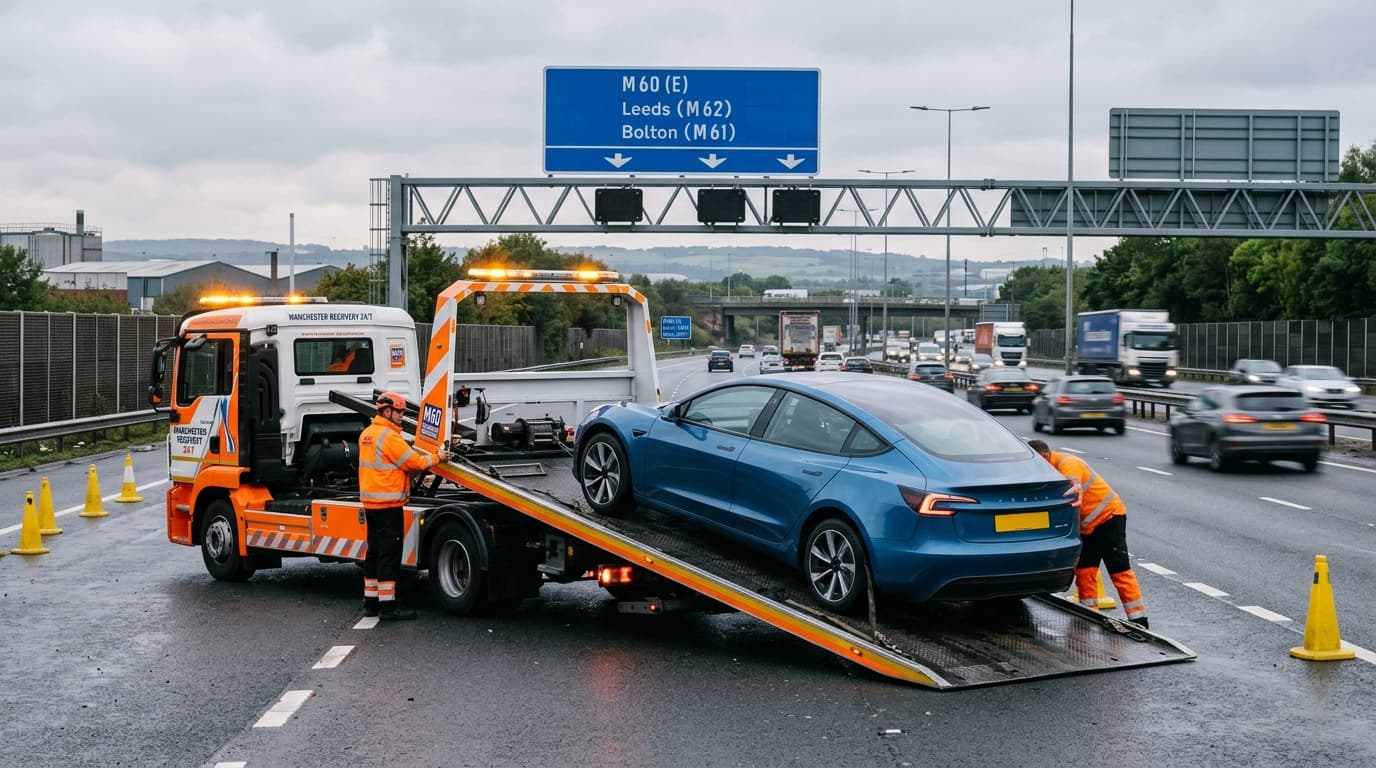
How We Recovered a Tesla Model 3 from the M60 at Midnight
A Tesla ran out of charge on the M60 at midnight. Here is what electric vehicle recovery in Manchester actually involves, why EVs cannot be towed normally, and what every EV driver needs to know about winter range loss.
Table of Contents
Electric vehicles are changing the roads of Greater Manchester. But what happens when a Tesla breaks down on the M60 at midnight? This is the story of one of the most unusual recovery callouts our team has handled and what it taught us about EV recovery in the UK.
The Situation: A Tesla Model 3 Stranded on the M60
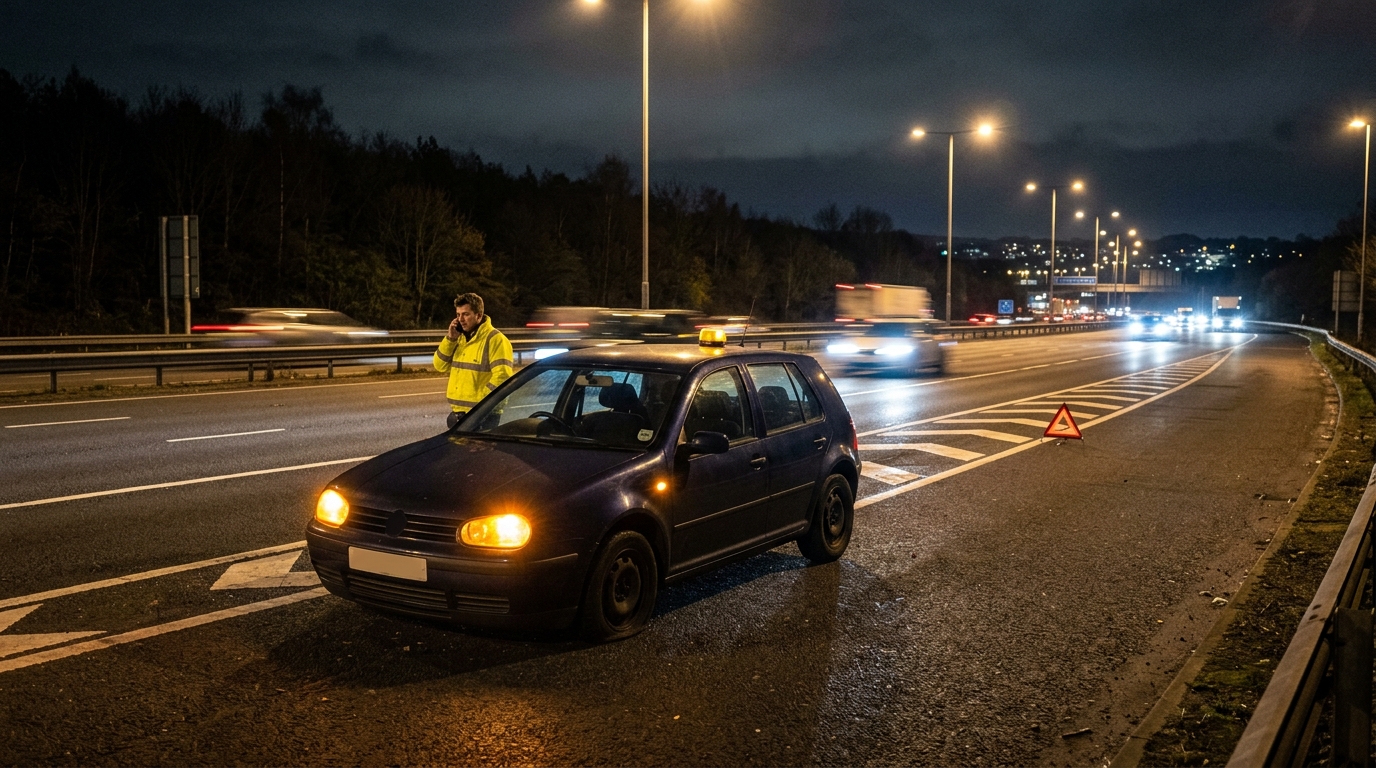
It was just after midnight on a wet Tuesday in November when the call came in. A Tesla Model 3 driver had run out of charge on the M60 near junction 12 at Eccles. The car had given repeated low-battery warnings but the driver, unfamiliar with how quickly range drops in cold wet weather, had pressed on hoping to reach a charging point at a nearby supermarket.
The car had rolled to a stop on the hard shoulder with zero percent charge showing. The driver was alone, it was raining, and the hazard lights were draining what little residual power remained. With the electric motor providing no engine braking and the car in a fixed position, safety was the immediate priority.
MW Recovery received the call at 00:14. Our driver was dispatched within five minutes from our Salford base and arrived on scene at 00:48. In difficult conditions on an active motorway, speed matters. Every minute on a hard shoulder carries risk.
Why Electric Vehicle Recovery Is Different
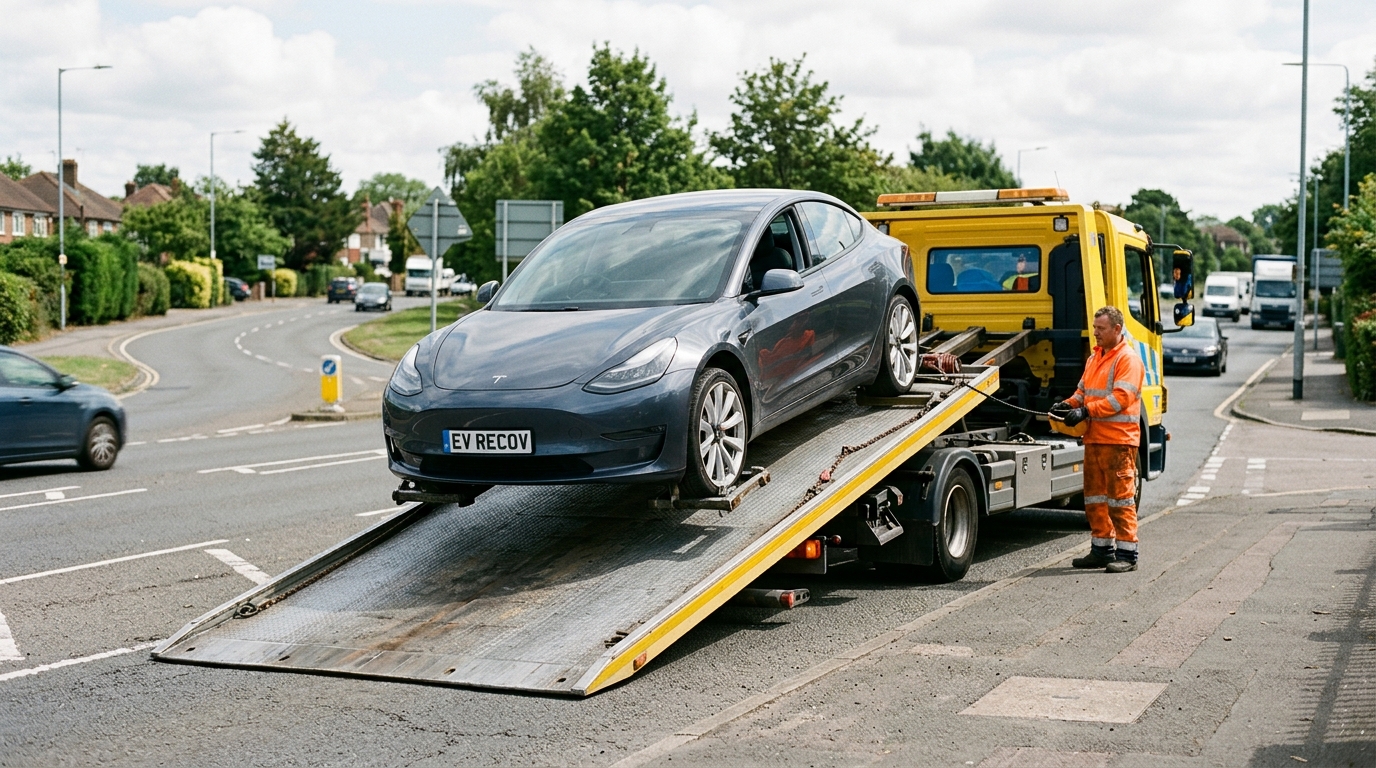
EVs cannot simply be towed with the front wheels down or dragged on a dolly the way many petrol or diesel vehicles can. Towing a Tesla or any modern electric vehicle with the driven wheels on the road can cause serious damage to the electric motor and the inverter. This is because the motor acts as a generator when the wheels turn, and if the high-voltage system is not in a safe state, back-EMF can cause component damage.
There are also additional risks to consider:
- High-voltage battery pack: Damage or impact to an EV battery pack creates a fire risk that is significantly harder to extinguish than a conventional vehicle fire. Our driver is trained in identifying signs of battery damage before approach.
- Traction motor damage: If the wheels on the driven axle rotate while the car is being moved, the motor can generate electricity even with the car switched off, potentially causing inverter damage costing thousands of pounds.
- Air suspension and ground clearance: Some Tesla configurations have air suspension that defaults to a lower ride height when powered down. Loading onto a flatbed requires careful technique to avoid grounding the underside.
- Key card and proximity entry: Many EV owners are unaware that when battery is fully depleted, the standard key card entry may not work. Recovery teams need to know manual entry procedures.
For all of these reasons, we used our flatbed recovery truck for this job. A flatbed means all four wheels come off the road, the motor is never rotated by the recovery vehicle, and the car is handled safely from point A to point B.
How Our Team Handled It
On arrival, our driver's first action was to position the recovery truck safely upstream of the Tesla with the amber beacons active, giving maximum warning to approaching traffic. The driver approached the vehicle to assess the situation and check the driver was safe and uninjured.
Next came the loading process. With a Tesla on a flatbed, you use a set of loading ramps and guide the car onto the truck bed. Because the car has no engine to run, and the electric park brake was still engaged (it holds even with zero battery on a Tesla in most versions), our team used the Model 3's tow mode. This is a setting accessible via the touchscreen that disables the park brake and puts the car into a neutral-equivalent state, allowing it to be pushed or pulled without motor engagement.
The Tesla was loaded, secured with wheel chocks and tie-down straps at four points, and transported to a Tesla Supercharger location in Trafford where the driver was able to wait safely and recharge. We offered to take the vehicle to our workshop in Salford as well, but in this case no damage had been caused and the driver simply needed charge.
Total time from call to completion: under two hours. The driver was on his way home by 02:30.
Cold Weather and EV Range: What Drivers Need to Know
This callout could have been avoided with one piece of knowledge: electric vehicle range drops significantly in cold weather. Here is what causes it and how to plan around it:
- Battery chemistry: Lithium-ion cells operate less efficiently in cold temperatures. A Tesla Model 3 Long Range might achieve 330 miles in ideal conditions, but in temperatures below 5 degrees Celsius with the heater running, real-world range can drop to 200 miles or even lower on motorways.
- Cabin heating: Petrol cars use waste heat from the engine to warm the cabin. EVs have no waste heat, so the heater draws directly from the battery. On a cold night this can consume 3 to 5kW continuously, equivalent to adding around 15 to 20 miles of equivalent drain per hour.
- Motorway speeds: Aerodynamic drag increases with the square of speed. Driving at 70mph uses significantly more energy per mile than city driving. EVs are most efficient in stop-start traffic, which is the opposite of petrol vehicles.
- Pre-conditioning: Tesla and most modern EVs allow you to pre-heat or pre-cool the battery and cabin while still plugged in. Doing this before a long journey means you start with a warm battery and cabin without drawing from the onboard charge.
Our advice: in winter, add a 25 to 30 percent safety margin to any planned EV journey. If the sat nav says you will arrive with 15 percent battery, plan an earlier charging stop. EV range anxiety is real but entirely manageable with forward planning.
Where to Charge in Greater Manchester
Greater Manchester has a growing network of rapid and ultra-rapid chargers. Key locations include:
- Trafford Centre (Instavolt rapid chargers in the car park)
- Manchester city centre (Pod Point on street and in car parks)
- Salford Quays (several council-installed chargers)
- Motorway services: Birch services M62, Charnock Richard M6
- Supermarkets: multiple Tesco and Sainsbury's stores with Ubitricity or Osprey chargers
We recommend the Zap-Map app for real-time charger availability, including whether a specific charger is in use or out of service.
MW Recovery and EV Callouts
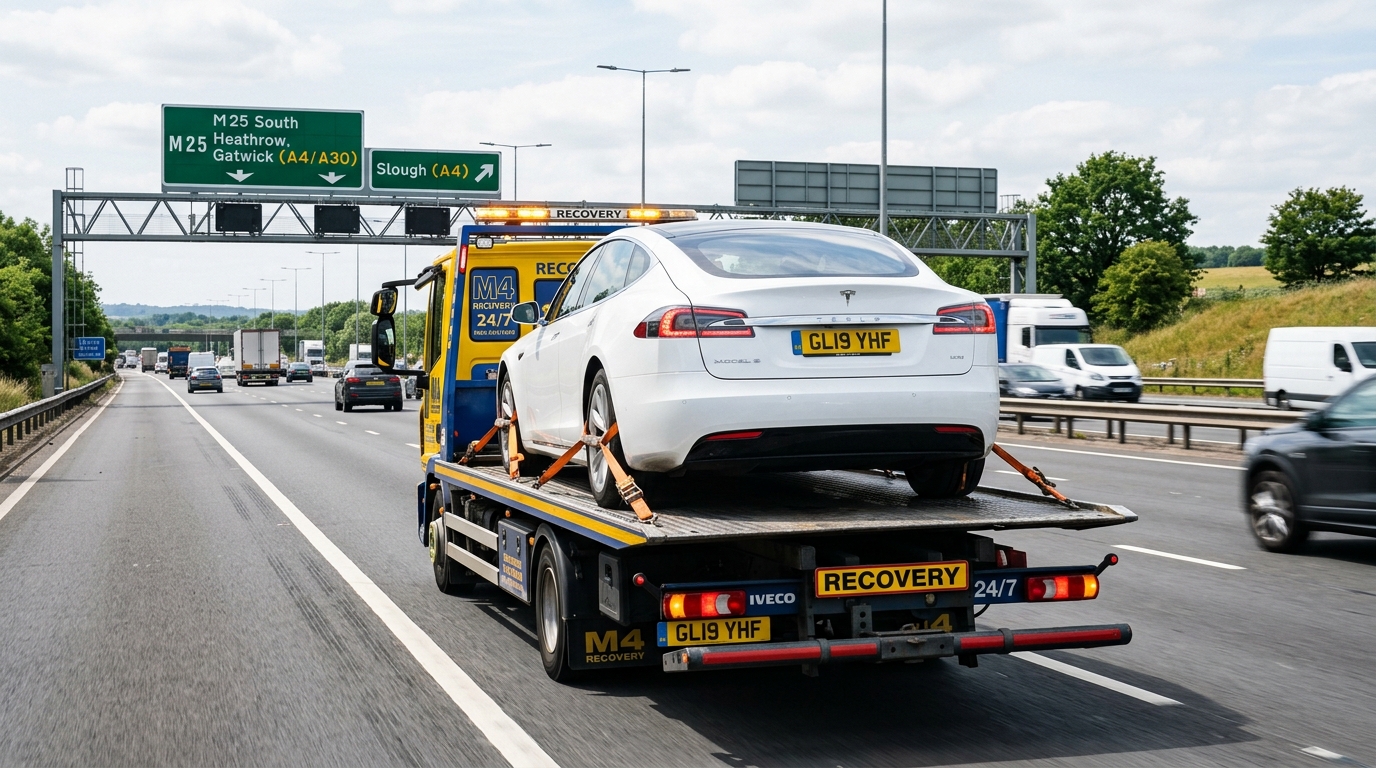
As more drivers in Manchester and Salford switch to electric vehicles, our team has invested in understanding EV recovery properly. We handle Tesla, Nissan Leaf, Renault Zoe, BMW i3, Kia EV6, Hyundai Ioniq, and other EV makes. Our flatbed trucks are the right tool for EV recovery, and our drivers know the procedures for safe loading without motor engagement.
If you drive an EV and break down anywhere across Greater Manchester, call us on 07553 322281. We will send a flatbed and a driver who knows exactly how to handle your vehicle safely. Learn more about our breakdown recovery service or our motorway recovery service.
We also cover car recovery in Eccles, Salford, Trafford, and all areas across Greater Manchester.
The Cost of Getting It Wrong
A common mistake drivers make is asking a general breakdown company or roadside assistance service to recover their EV using a standard tow dolly or rear-wheel tow. If the driven wheels rotate during transport, the motor generates electricity through a process called regenerative braking. Without the inverter in a safe state, this can cause expensive damage.
Tesla motor replacements can cost between 5,000 and 12,000 pounds depending on the model. Inverter repairs can add several thousand more. In most cases, insurance does not cover damage caused by improper recovery methods. The driver must prove negligence on the part of the recovery company, which is a complex legal process.
The safest position: always request a flatbed when recovering an EV. Any reputable recovery company should know this without being asked.
Frequently Asked Questions
Frequently Asked Questions
Common questions about this topic
No. Tesla and most other EVs must be transported on a flatbed with all four wheels off the road. Towing with the wheels on the ground rotates the electric motor and can cause serious damage to the drivetrain and inverter. Always request a flatbed recovery for any EV.
Need Car Recovery in Manchester?
MW Recovery provides fast, professional breakdown recovery and roadside assistance across all of Greater Manchester. One call and we are on our way.