
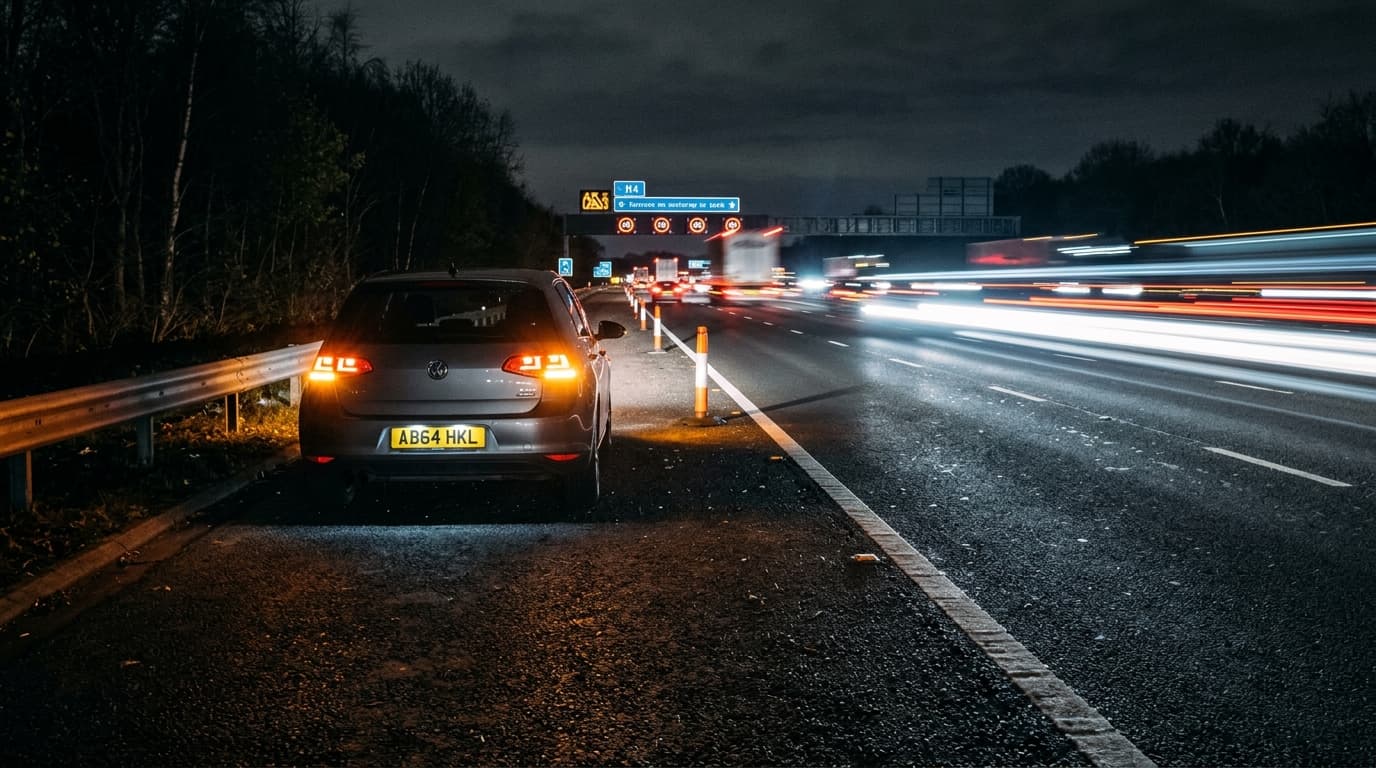
What to Do If Your Car Breaks Down on a Motorway at Night
Breaking down on a motorway at night is more dangerous than in daylight. This step-by-step guide covers exactly what to do, from smart motorway rules to staying safe while you wait.
Table of Contents
Breaking down on a motorway is stressful enough in daylight. At night, with limited visibility and traffic still moving at speed, the stakes are higher and the decisions you make in the first few minutes matter more. Knowing what to do before it happens is genuinely useful, because it is hard to think clearly when you are on the hard shoulder of the M60 at 2am with headlights flashing past.
This guide covers exactly what to do step by step if your car breaks down on a motorway at night, with specific guidance on smart motorways and the Greater Manchester motorway network.
Step 1: Get Off the Carriageway Without Delay
The moment something goes wrong, the priority is to get the car off the live carriageway. Signal left and begin moving toward the hard shoulder smoothly and progressively, without braking sharply. If you are on a section of motorway with a hard shoulder, pull as far left as you can, ideally with your tyres on the verge if there is one.
On a smart motorway where the hard shoulder has been converted to a running lane, aim for the nearest emergency refuge area (ERA). These are marked with blue signs showing an orange SOS telephone symbol and are spaced roughly every 1.5 miles. If you cannot reach an ERA, stop as far left as possible in the lane you are in.
If you have any doubt about making it to the hard shoulder or an ERA, stop where you are and switch hazard lights on immediately. Highways England's cameras and radar systems monitor for stationary vehicles and should close the lane using overhead gantry signs, though this takes some time.
Step 2: Make Yourself Visible Immediately
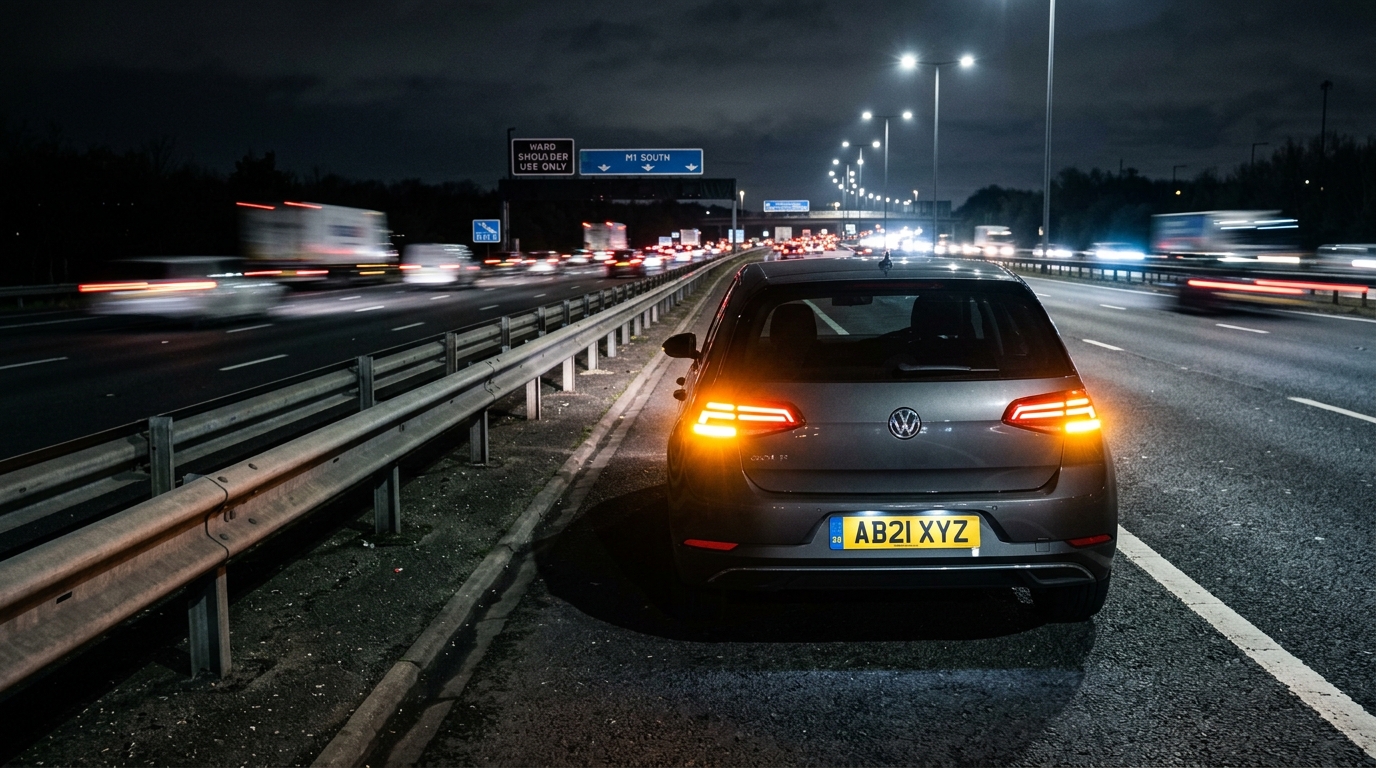
As soon as the car stops, hazard warning lights on. Do not wait until you are fully stopped. Activate them the moment you realise you are in trouble. At night, visibility is reduced and other drivers need as much warning as possible that a stationary vehicle is ahead.
Do not get out of the car to place warning triangles behind the vehicle. On a motorway hard shoulder, the Highway Code is clear: warning triangles should not be used on motorways. The risk of walking along the hard shoulder at night outweighs any benefit the triangle provides. Hazard lights are sufficient and are what other drivers will see.
If you have a high-visibility vest in the car, locate it before you get out. It takes a few seconds now and makes a real difference once you are outside in the dark.
Step 3: Exit the Vehicle the Right Way
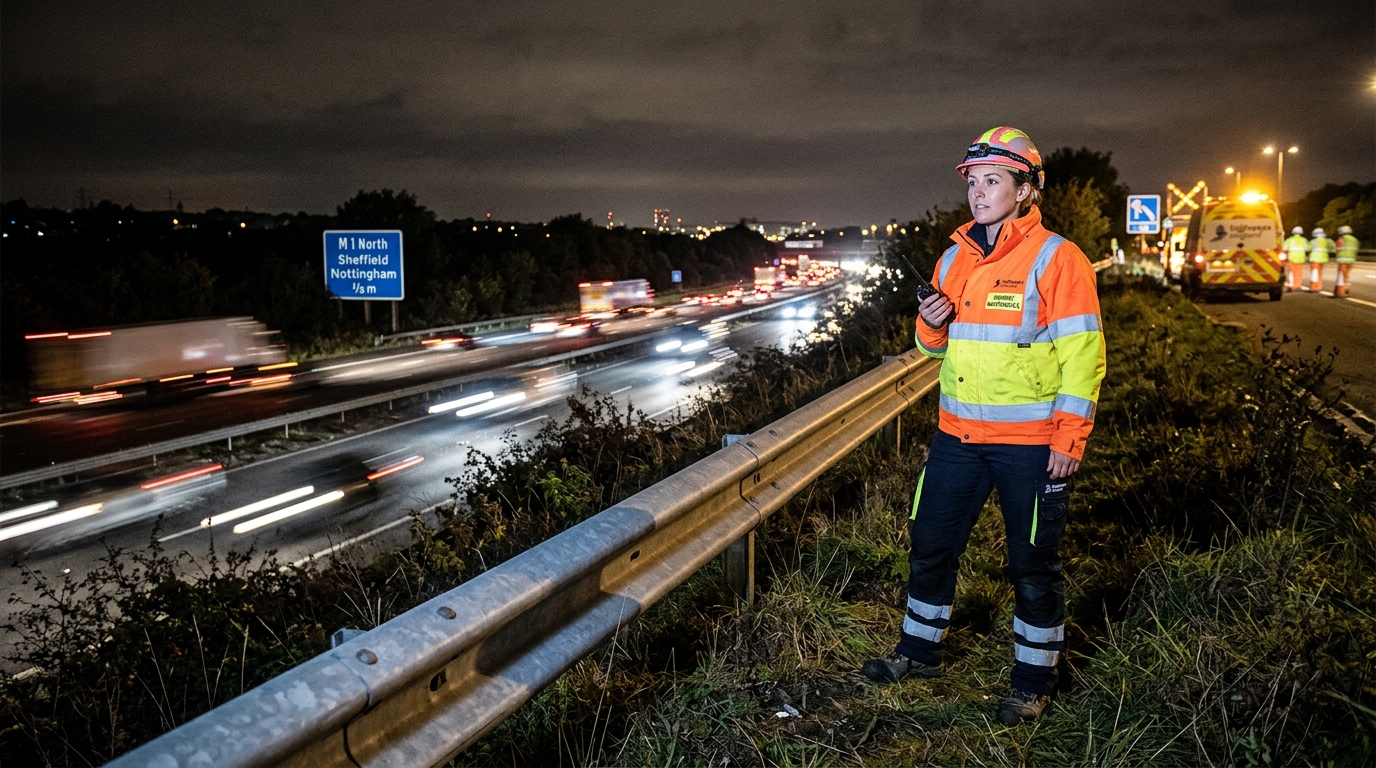
Once the car is stopped and hazard lights are on, exit via the passenger side doors, away from passing traffic. This applies even if it means climbing over seats. The driver's door opens directly toward the live carriageway or hard shoulder lane, which is dangerous at any time and particularly so at night.
Move well behind the barrier and up the embankment or verge if there is one. The barrier is designed precisely to protect people from vehicles that drift off the carriageway. Being behind it reduces the risk significantly compared to standing next to the car.
Step 4: Call for Recovery Straight Away
Once you and your passengers are safely behind the barrier, call for recovery. Do not wait to see whether the car might start again or whether a passing vehicle will stop. Call immediately.
Give the recovery operator your exact location using:
- The nearest blue motorway marker post number. These small posts are spaced every 100 metres along the hard shoulder and show the motorway number and your exact position
- The motorway number and the junction you last passed or are approaching
- The direction of travel
- Your ERA number if you are in one
MW Recovery provides 24/7 motorway recovery across Greater Manchester including the M60, M62, M56, M61, and M66. Night callouts are handled with the same urgency as daytime ones.
What If You Cannot Get Out of the Car Safely?
In some situations, particularly on smart motorways where you may be stopped in a live lane, it may not be safe to exit the vehicle at all. If you have stopped in a live lane and traffic is still flowing around you, stay in the car, keep hazard lights on, call 999 to report the situation, and stay low in your seat away from the windows on the traffic side.
This is the exception rather than the rule. On sections with a hard shoulder, getting out and behind the barrier is almost always safer than staying in a car that could be struck from behind.
Staying Safe While Waiting at Night
While waiting for recovery, a few things keep you and your passengers safer:
- Stay behind the barrier and do not return to the car unless conditions make it absolutely necessary. Most motorway injuries involving breakdowns happen because people stand next to or near the vehicle
- Keep children and pets behind the barrier with you and do not allow them near the carriageway
- Keep your phone charged. If the battery is low, reduce screen brightness and close background apps to conserve it
- If it is cold, stay warm. In winter, temperatures on exposed motorway verges drop quickly and waiting times, even with a fast local operator, can be 30 to 60 minutes
- If you feel unsafe at any point, call 999 as well as your recovery operator
M60 Night Breakdown: What to Expect
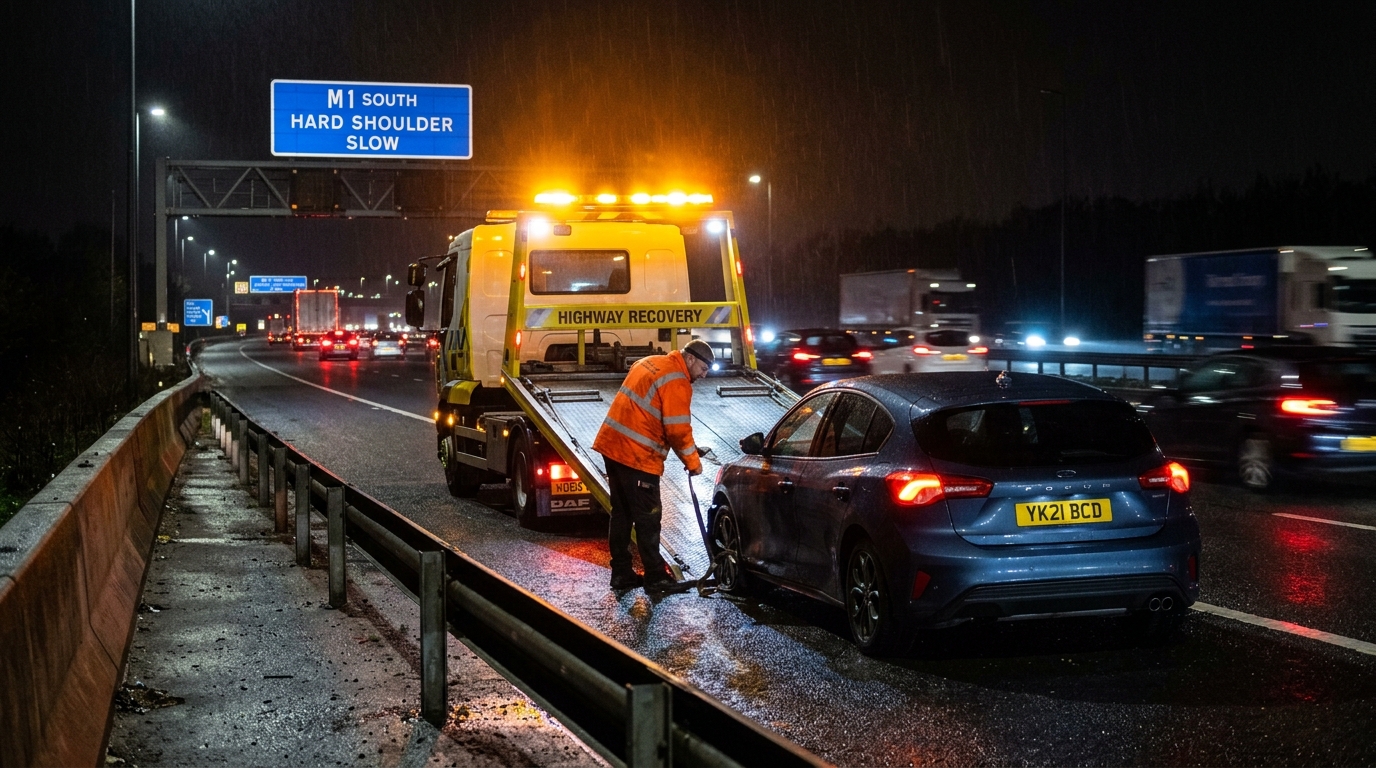
The M60 orbital motorway around Greater Manchester runs 24 hours and carries significant traffic even in the early hours, particularly freight and commercial vehicles. Breaking down on the M60 at night means you are never far from moving traffic.
The M60 has a mix of standard motorway sections with hard shoulders and smart motorway sections without. The stretch between junctions 8 and 12 through Trafford is particularly busy overnight. ERAs on the smart sections are your target if you cannot reach a hard shoulder.
MW Recovery covers all junctions of the M60 and can typically reach most locations within 30 to 45 minutes of your initial call. If you have broken down on the M60 and need immediate help, visit our M60 motorway recovery page for direct contact details.
M62 and M56 Night Breakdowns
The M62 through Greater Manchester carries a large volume of overnight freight traffic between Liverpool, Manchester, Leeds, and the east coast. Visibility on the M62 at night can be affected by fog and rain in winter, which makes early hazard light activation even more important.
The M56 between Manchester Airport and the M6 junction is another route where night breakdowns carry specific risks, particularly around the airport approach where traffic patterns are unpredictable. MW Recovery covers the full lengths of the M62 and M56 through Greater Manchester and is available for night callouts on both routes.
Prepare Before You Drive at Night
A few simple preparations significantly reduce the consequences of a night motorway breakdown:
- Keep a high-visibility vest and a torch in the car. Both are inexpensive and fit in the door pocket
- Keep a phone charger or power bank in the car for long journeys
- Save a recovery operator's number before you need it. Police-arranged motorway recovery consistently costs more than arranging your own, and having a number ready avoids searching while stressed at night
- Check the car before long night journeys: tyre pressures, fuel level, and any warning lights that have appeared
For immediate night-time recovery across Greater Manchester's motorway network, MW Recovery is available 24 hours a day. Visit our breakdown recovery near me page or call directly for the fastest response.
Frequently Asked Questions
Common questions about this topic
Signal left and move to the hard shoulder or emergency refuge area, switch hazard lights on immediately, exit via the passenger side door, move well behind the barrier, and call for motorway recovery. Do not stand between the car and the carriageway and do not place warning triangles on a motorway.
Need Car Recovery in Manchester?
MW Recovery provides fast, professional breakdown recovery and roadside assistance across all of Greater Manchester. One call and we are on our way.