
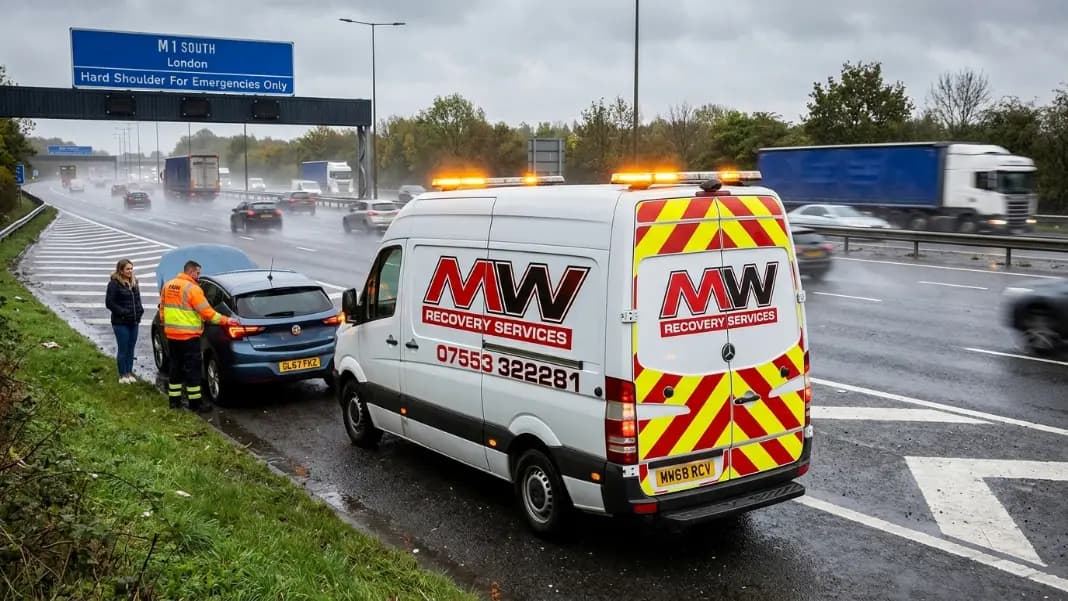
What to Do If You Run Out of Fuel: Motorways, A Roads and Manchester City Streets
Running out of fuel is manageable on a side street and genuinely dangerous on the M60. This guide covers what to do before and after the engine cuts, what your breakdown cover actually provides, and where to find fuel near the M60, M62, and M56 in Greater Manchester.
Table of Contents
The fuel warning light in most cars gives you roughly 30 to 50 miles of range before the tank hits empty. On a clear road on a quiet Sunday morning that feels comfortable. On the M60 westbound at 5:15pm on a Wednesday with traffic backed up from junction 12 past junction 9, that same 30 to 50 miles feels like the gauge is dropping faster than you are moving.
Running out of fuel carries a certain embarrassment that other breakdowns do not. But it is also one of the more dangerous situations to be in if you handle the immediate moments badly. The mechanics of running dry are simple. What people do in the seconds after they realise what is happening is where things go wrong.
This guide covers what to do the moment you realise the tank is nearly empty, how the situation differs between a motorway, an A road, and a Manchester side street, and what your breakdown cover actually provides in this situation versus what most people assume.
Is It Illegal to Run Out of Fuel in the UK?
The short answer is: not directly, but it can lead to something that is.
Highway Code Rule 97 states that before setting out on any journey, you should confirm the vehicle has sufficient fuel. That rule does not carry a direct fixed penalty in isolation. But if running out of fuel causes your vehicle to stop and obstruct traffic on a motorway, that is where the legal exposure begins.
Stopping unnecessarily on a motorway is an offence under the Motorways Traffic Regulations 1982. If a police officer or National Highways traffic officer attends and concludes the stop was avoidable (which running out of fuel generally is), you can face a minimum £100 fine and three penalty points. In more serious cases where the stopped vehicle causes a collision or significant danger, the charge can escalate toward careless or dangerous driving, with fines up to £5,000 and a potential disqualification.
In practice, most attendances end with the driver being helped and sent on their way with a warning. But the legal exposure is real, and it is worth knowing.
What to Do the Moment You Realise You Are About to Run Out
The critical window is before you stop. Here is what to do while the car is still moving:
- Switch off anything drawing extra power. Air conditioning, the rear heated window, heated seats. On a very low tank, reducing electrical load on the engine can make a real difference to how far you get.
- Reduce speed smoothly. Higher speed burns more fuel. Dropping from 70mph to 55mph increases range measurably. Avoid braking sharply or accelerating.
- Look ahead for an exit, service area, or Emergency Refuge Area. Getting off the motorway or reaching an ERA is far safer than stopping on the carriageway.
- Move left progressively, early. Get into the left lane and signal well in advance of pulling onto the hard shoulder or ERA. Do not make sudden moves.
If the engine cuts while you are still in a live lane, use the remaining momentum to coast left. Even moving off the main carriageway by a few metres significantly reduces the risk to you and every other vehicle behind.
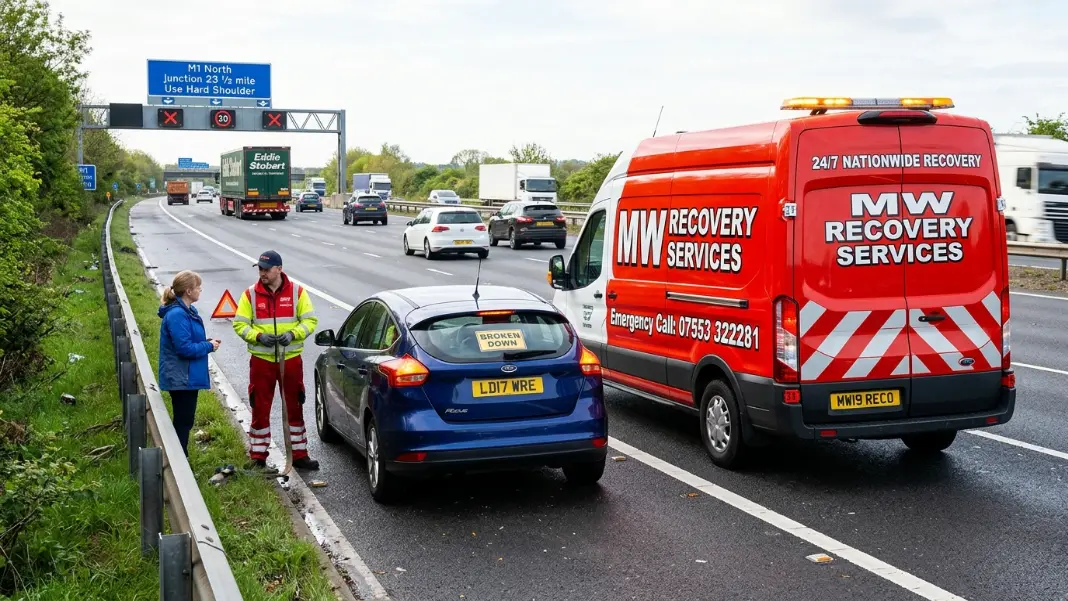
If you can reach a hard shoulder or Emergency Refuge Area before the engine cuts, do it. Getting off the live carriageway is the single most important thing.
Stopping on a Traditional Hard Shoulder
If you are on a motorway section with a permanent hard shoulder (some sections of the M62 and M56 through Greater Manchester still have these), the process is:
- Pull as far left as possible and stop on level ground away from bends where possible, so you are visible to traffic from further back.
- Switch on hazard lights immediately.
- All passengers should exit through the left-side doors and stand behind the barrier. Not behind the car, not beside it.
- Leave the car unlocked with the front wheels turned slightly left. If a vehicle strikes the rear, this deflects the car away from where you are standing rather than into you.
- Call your breakdown provider or MW Recovery, or use the nearest orange SOS emergency phone.
Do not walk along the hard shoulder toward a service area. The hard shoulder feels separate from the motorway but vehicles travel very close to its edge. At 70mph, any lateral movement from a vehicle gives you essentially no reaction time.
Smart Motorways and the M60: No Permanent Hard Shoulder
This is where running out of fuel on a Greater Manchester motorway becomes specifically more dangerous. The M60 ring road operates as a smart motorway across most of its length. The left lane (what was the hard shoulder) is a live running lane during peak hours. There is no permanent shoulder to pull onto.
If you run out of fuel on a smart motorway section of the M60:
- Your first target is an Emergency Refuge Area. These are the blue-signed lay-bys with orange SOS phones, spaced roughly every mile to mile and a half. Look ahead for the blue ERA signs as early as you can.
- If you cannot reach an ERA, stop as far left as possible. National Highways cameras monitor continuously. A stopped vehicle triggers an automatic alert and overhead gantry signs begin displaying a red X above that lane within minutes.
- Stay in the vehicle with your seatbelt on if you cannot get beyond the barrier. On a smart motorway where the left lane is live traffic, staying inside the car is safer than standing in or beside it.
- Use the ERA SOS phone or call 999 if you are in immediate danger. Give your location using the nearest distance marker, junction number, or overhead sign you can see.
The M62 still has traditional hard shoulders on most sections through Greater Manchester, which makes running out of fuel on that road less immediately dangerous than the M60. The same principles apply, but you have a shoulder to pull onto rather than having to reach an ERA.
For recovery assistance across both routes, MW Recovery covers the M60 and M62 corridors. If you need a fuel delivery or vehicle recovery from a motorway location, the team operates around the clock and can coordinate alongside National Highways attendance.
What About Running Out of Fuel on A Roads or in Manchester City Streets?
On an A road, the situation is much more manageable. Running out of fuel on the A57 through Salford or the A6 through Stockport is inconvenient but not an immediate safety emergency in the way a motorway stop is. Pull to the left, activate hazard lights, and call for assistance. Try to reach a side street, lay-by, or any off-road space if the car will travel a short distance further, to avoid becoming a live road obstruction.
In Manchester city centre, the risk profile is entirely different. Stop safely, hazards on, call. Recovery and fuel delivery response times in the city tend to be faster than anywhere else in Greater Manchester because of how many operators are active in that area during working hours.
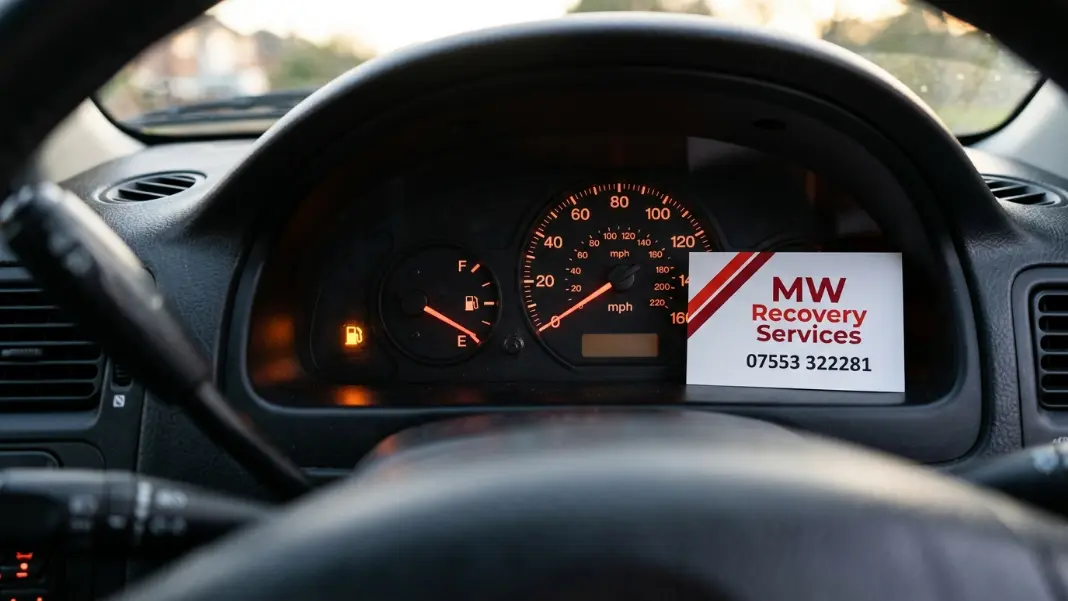
The fuel warning light gives you roughly 30 to 50 miles in most cars. In slow motorway traffic in winter, treat that number as significantly lower than the dashboard estimate suggests.
What Breakdown Cover Actually Does When You Run Out of Fuel
This is the question most people do not check until they are already on hold. The answer is: usually yes, your policy covers fuel delivery, but with important limits most drivers are not aware of.
Most major UK breakdown providers (AA, RAC, Green Flag) include fuel delivery as part of standard roadside assistance. What that typically means in practice:
- A technician attends with enough fuel to start the engine and get you to the nearest petrol station, typically around 10 litres. This is not a full tank, and it is not designed to be.
- You pay for the fuel itself at the time of the callout, usually at a slightly above-pump rate.
- The callout counts as a standard attendance under your policy and toward any annual callout limit your policy includes.
Where it gets complicated:
- Budget and bundled policies sometimes exclude fuel delivery entirely. Policies bundled with bank accounts or added as an insurance add-on often strip out this benefit. Check the wording for the word "fuel" specifically.
- Home start cover usually does not cover running out of fuel at home, as this is categorised as a maintenance issue rather than a mechanical breakdown.
- If you run out of fuel multiple times in a year, some policy terms allow the provider to flag or review the policy at renewal.
For a full breakdown of what UK policies include and exclude across all tiers, our guide on what breakdown cover actually includes goes through each level in detail.
If you do not have cover and need a fuel delivery or breakdown recovery across Greater Manchester, MW Recovery operates on a pay-per-use basis with no membership required.
What Happens When the Fuel Delivery Technician Arrives
The process is quicker than most people expect. The technician arrives with a sealed fuel container and will confirm the vehicle make, model, and fuel type before adding anything. Modern vehicles have an anti-misfuelling insert in the filler neck that only accepts the correct nozzle, so the right container has to be brought for petrol or diesel.
Roughly 10 litres is added to start the engine. On most petrol or diesel cars, 10 litres gives 15 to 25 miles of range, enough to reach the nearest station. The engine is tested. On diesel vehicles where the tank ran completely dry, there is a risk that air has been drawn into the fuel lines. The pump may need to be primed before the engine fires, which adds a few minutes. If the engine still will not start after priming, the car needs proper recovery to a garage for the fuel system to be bled.
Average response time for a fuel delivery callout across Greater Manchester is 30 to 60 minutes depending on your location and current traffic.
Fuel Stations Near the M60, M62, and M56 in Greater Manchester
One thing that regularly catches people out is the lack of motorway services on the M60 itself. There are no services directly on the M60 ring road. The petrol stations you can access from the M60 are off-junction, typically within half a mile to a mile of the slip road. There are around 26 accessible from various M60 junctions.
Some of the most practical off-M60 fuel stops:
- Junction 12 (A57, Eccles/Salford direction): Multiple stations within one mile including supermarket forecourts, which tend to be cheaper than branded forecourts
- Junction 4 (A34, heading toward Cheadle/Didsbury): Several stations accessible from the A34 within a short distance
- Junction 17 (A56, Bury New Road toward Whitefield): Stations accessible northbound from the junction
On the M62, Birch Services sits between junctions 18 and 19, accessible from both directions, and is the main fuel stop for the stretch of M62 through Greater Manchester. The next services east are Hartshead Moor between junctions 25 and 26.
On the M56, Lymm Services is at the M6/M56 junction. Within Greater Manchester on the M56, the off-junction stations at junction 6 (A538 toward Hale) and junction 5 (A5103 toward Wythenshawe) are the most convenient options.
The key point: motorway services charge 10 to 15 pence per litre more than off-junction supermarket forecourts. If the gauge is low but not critical, exiting and finding a supermarket forecourt is almost always the right call financially.
Running Out of Fuel vs Putting In the Wrong Fuel: Two Different Problems
Running out of fuel is resolved by adding the correct fuel and starting the engine. Misfuelling (putting petrol in a diesel or diesel in a petrol) requires draining the tank and flushing the fuel system before the engine can be run safely. If you fill the tank on top of wrong fuel you make the problem significantly worse and significantly more expensive.
If you suspect you have put the wrong fuel in, stop the engine immediately and do not turn it back on. Our guide on wrong fuel recovery in Manchester covers the full process and what to expect from a specialist drain and flush callout.
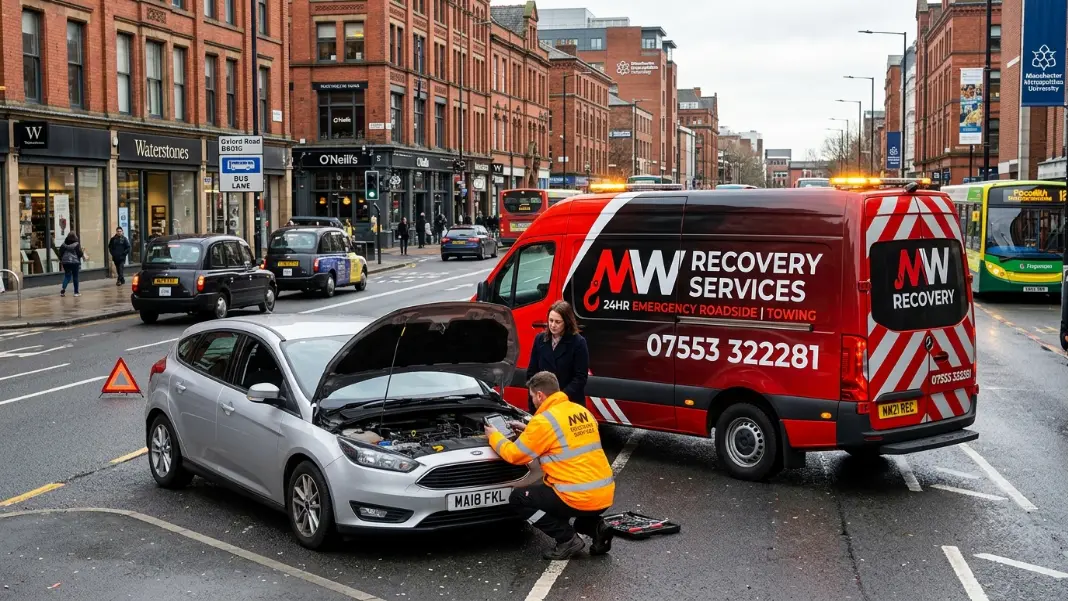
MW Recovery provides fuel delivery callouts across Greater Manchester. Response time is typically 30 to 60 minutes depending on location and current traffic conditions.
One Thing Worth Knowing About the Fuel Range Estimate on Your Dashboard
The range figure on your dashboard (the one that says "47 miles remaining" or similar) is calculated from your recent driving pattern. It is an average, not a guarantee. If you have been driving mostly on clear motorways and the estimate says 40 miles, but you then hit heavy stop-start traffic on the M60 in winter, the real remaining range is less than that figure suggests.
Cold weather increases fuel consumption on most petrol and diesel vehicles. Stop-start traffic burns more fuel per mile than the rolling speed the estimate was based on. The rule of thumb: treat the range estimate as an optimistic number and plan fuel stops before the warning light comes on, not after.
Frequently Asked Questions
Common questions about this topic
Not directly. There is no specific offence of running out of fuel, but stopping on a motorway unnecessarily is an offence under the Motorways Traffic Regulations 1982. If a traffic officer decides the stop was avoidable, you can receive a £100 fine and three penalty points. In cases where the stopped vehicle contributes to a collision, more serious charges can apply. Highway Code Rule 97 requires drivers to check they have sufficient fuel before any journey.
Need Car Recovery in Manchester?
MW Recovery provides fast, professional breakdown recovery and roadside assistance across all of Greater Manchester. One call and we are on our way.