
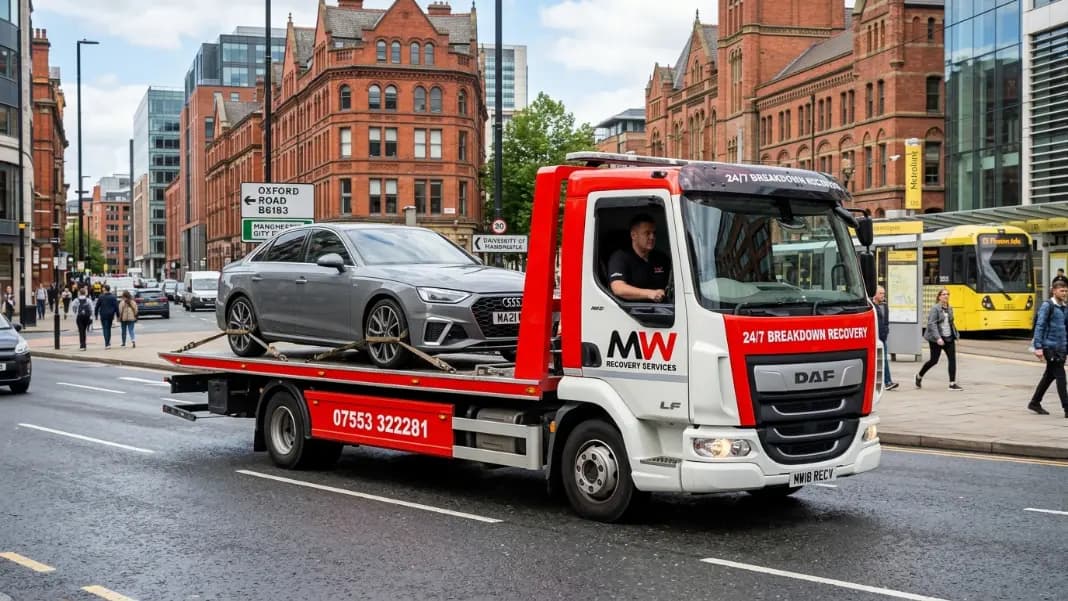
Automatic Gearbox Car Recovery: Why You Must Use a Flatbed
Automatic cars cannot be safely towed on a wheel-lift. This guide explains what happens to an automatic gearbox when flat-towed, which transmission types are at risk, and why flatbed recovery is the only safe option for automatic vehicles.
Table of Contents
Automatic gearbox vehicles now make up the majority of new car sales in the UK, yet a significant proportion of drivers still do not know that their automatic car cannot be towed in the conventional sense without risking serious gearbox damage. Recovery operators who do not use flatbed equipment for automatic vehicles, and drivers who accept a wheel-lift tow on an automatic car, are setting up an expensive repair bill that could have been entirely avoided.
This guide explains exactly why automatic gearbox vehicles require flatbed recovery, what happens mechanically when an automatic car is flat-towed, which types of automatic transmission are affected, and what to do when you break down to make sure your car is recovered correctly.
Why Automatic Gearboxes Are Different from Manual Gearboxes
In a manual gearbox car, the transmission is mechanically disconnected from the drivetrain when the car is in neutral. Towing a manual car in neutral with its drive wheels off the ground is generally safe, because the engine is not turning and the gearbox internals are not being driven by road speed.
An automatic gearbox does not work the same way. The transmission on an automatic vehicle relies on pressurised fluid to lubricate the moving components. This pressure is generated by a pump driven directly by the engine. When the engine is off and the car is being towed with the driven wheels on the ground, the wheels turn the output shaft of the transmission, which turns internal components, but the pump that should be keeping everything lubricated is not running. The result is those components rotating without adequate lubrication at speed.
Think of it like running a car engine without oil. The initial damage may not be immediately apparent, but it is happening with every metre the car is towed on its driven wheels. On a short tow of a few hundred metres at low speed, the damage may be minimal. On a recovery tow of several miles at normal road speed, the gearbox can be destroyed.
What Happens When You Flat-Tow an Automatic Car
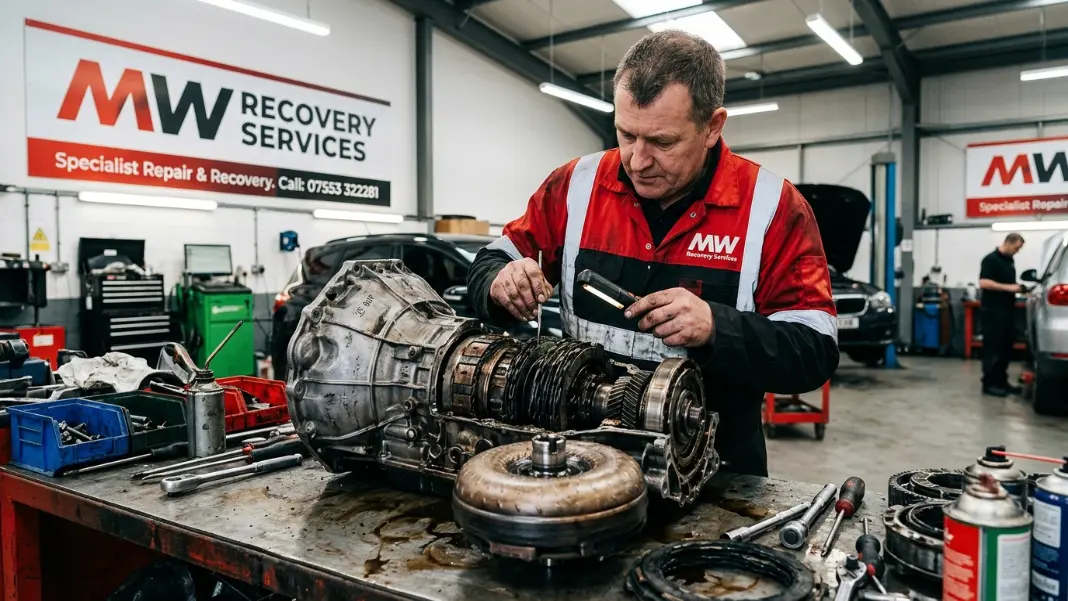
The specific damage from towing an automatic car on its driven wheels depends on the transmission type and the distance and speed of the tow, but the general progression is as follows. The transmission fluid, which is not being circulated by the pump, overheats from the friction of unlubricated components. At a certain temperature threshold, the fluid breaks down and loses its lubricating properties. The clutch packs, bands, and planetary gear sets that make up the automatic transmission then wear against each other without protection.
On a shorter tow, the driver may notice nothing immediately. The gearbox continues to function for days or weeks. Then, as the degraded fluid and wear particles circulate, the transmission begins to slip between gears, hesitate on upshifts, or fail to engage certain gears. By this point, a full transmission rebuild or replacement is often the only viable repair. These are repairs that routinely cost between 1,500 and 4,000 pounds on a standard automatic car, more on performance or luxury vehicles.
If the recovery that caused the damage happened weeks earlier, linking the failure to the recovery becomes difficult. Many drivers only discover the connection when a mechanic identifies towing damage as the cause of a gearbox failure. At that point, the recovery operator is unlikely to accept any liability. The only protection is ensuring the correct equipment is used from the start.
Which Types of Automatic Transmission Are at Risk
The rule that automatic cars should not be flat-towed applies to the majority of automatic transmission types on the road in the UK today. The main types affected are:
Traditional torque converter automatics: The most common type on the road. These have the pump-dependent lubrication issue described above and should always be transported on a flatbed. This includes the vast majority of automatic saloons, estates, and SUVs sold over the past three decades.
Dual-clutch transmissions (DCT): Found on many modern mainstream vehicles from brands including Volkswagen Group, Ford, and others. DCTs share similar flat-tow restrictions to torque converter automatics and should be treated as requiring flatbed recovery unless the manufacturer explicitly states otherwise in the owner's manual.
Continuously Variable Transmissions (CVT): Common on Japanese-brand vehicles including many Toyotas, Nissans, and Subarus. CVTs use a belt-and-pulley system that is highly sensitive to lubrication interruption. These should never be flat-towed.
Electric vehicle single-speed transmissions: EVs have their own towing restrictions. Some can be flat-towed short distances in specific conditions, but many cannot due to regenerative braking system implications. For EV-specific guidance, see our EV recovery Manchester service page. Always check the owner's manual for the specific restriction.
Manual Automatics and Vehicles That CAN Be Flat-Towed
There is a limited category of vehicles designed to be flat-towed. These are primarily used in motorhome touring, where the vehicle being towed behind a motorhome needs to be flat-towed for convenience. The manufacturer specifies in the owner's manual whether a specific model can be flat-towed and under what conditions. If your car manufacturer has approved flat-towing for your specific model, a wheel-lift recovery in the correct configuration may be acceptable.
For all other automatic vehicles, flatbed is the only safe recovery method. If in doubt, the owner's manual is the definitive reference. A recovery operator telling you at the roadside that your automatic car can be wheel-lifted is not a substitute for the manufacturer's specification.
How to Confirm Your Recovery Operator Has the Right Equipment
When you call for recovery on an automatic car, tell the operator upfront that the vehicle is automatic and ask specifically whether they are sending a flatbed. This is a reasonable question that any professional recovery operator will answer directly. An operator who says they will send a wheel-lift for an automatic vehicle is either unaware of the issue or does not have a flatbed available and is not being transparent about it.
If a recovery vehicle arrives and it is not a flatbed, confirm with the driver that they understand the vehicle is automatic before agreeing to any loading. Do not allow your automatic vehicle to be loaded onto a wheel-lift for a road tow covering more than a few hundred metres at walking pace. The risk to your gearbox is real and the repair cost is significant.
Our flatbed towing Manchester service uses flatbed vehicles for all automatic car recoveries across Manchester. Our team confirms vehicle type at the time of booking and dispatches appropriate equipment. For any breakdown across Greater Manchester, our breakdown recovery and motorway recovery services use the correct equipment for your vehicle type.
Does Your Breakdown Cover Include a Flatbed?
Annual breakdown policies vary significantly in what they include. Some policies cover basic attendance and on-road towing but do not guarantee a flatbed. If you drive an automatic car and you have annual breakdown cover, it is worth checking whether your policy covers flatbed recovery and whether it has a distance or mileage limit on flatbed tows.
If your policy does not guarantee flatbed recovery for your automatic vehicle, you face a choice between accepting a wheel-lift tow, which risks your gearbox, or paying separately for flatbed recovery. For drivers of automatic cars without explicit flatbed cover, the maths on paying for appropriate recovery out-of-pocket versus the cost of a gearbox rebuild strongly favours paying for the right equipment.
Our car recovery prices page shows current flatbed recovery rates for Manchester, giving you a realistic expectation of the cost before you call. For a specific quote, use our contact page or call directly.
The Cost of Getting It Wrong
The cost of a flatbed recovery in Manchester for a standard automatic car for a typical distance is a few hundred pounds at most. The cost of an automatic gearbox rebuild or replacement on the same car ranges from 1,500 to 4,000 pounds for a standard vehicle, and significantly more on premium brands. The argument for using a flatbed is financially overwhelming.
Beyond the direct repair cost, a damaged automatic gearbox means weeks without your vehicle while it is in a workshop, the inconvenience of arranging alternative transport, and potentially a lower resale value for a vehicle with transmission repair history. Getting the recovery right the first time eliminates all of these downstream costs.
For locations across Manchester and Greater Manchester, our flatbed recovery is available 24 hours a day. Whether you are on the M60, the M62, a city centre road, or a residential street in Stockport, Manchester, or anywhere across the region, we send the right vehicle for the job. Use our car recovery near me page or our 24-7 emergency car recovery Manchester service for immediate assistance.
Frequently Asked Questions
Can you tow an automatic car in neutral?
Not safely, in most cases. Putting an automatic car in neutral does not disengage the transmission. The internal components still rotate when the wheels turn, but without the engine-driven pump running, lubrication is absent. Towing in neutral over any significant distance or speed risks gearbox damage. Flatbed recovery is the correct method.
How far can you tow an automatic car before causing damage?
There is no safe guaranteed distance for flat-towing most automatic vehicles. Manufacturer specifications vary, and some specify that no flat-towing is acceptable under any circumstances. A short push at very low speed may cause no damage, but there is no reliable threshold after which damage is certain. The only risk-free method is flatbed transport.
How do I know if my car has an automatic gearbox?
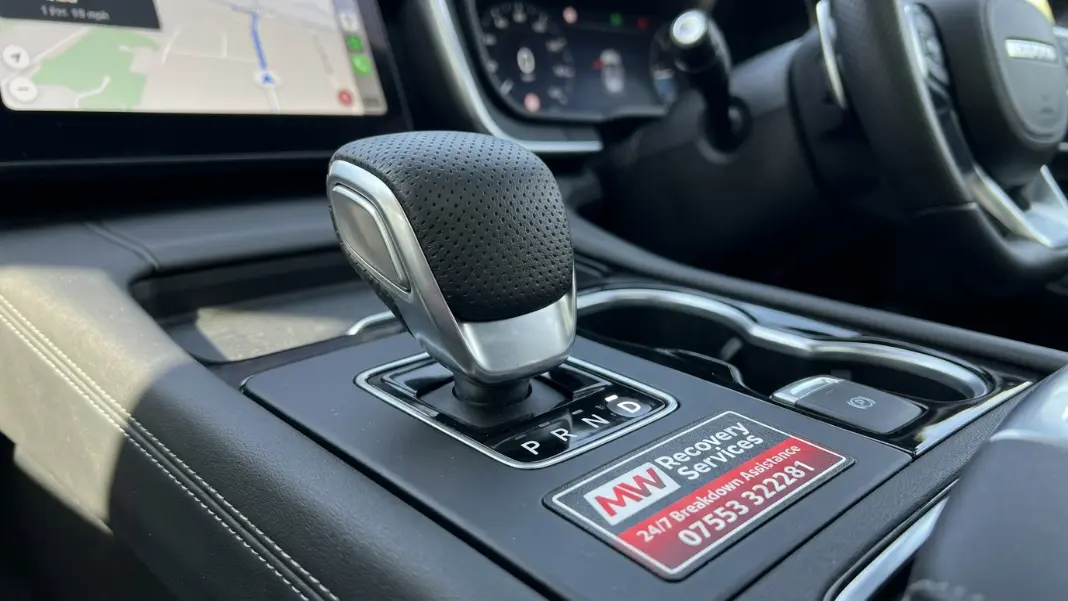
If your car has no clutch pedal and two or three pedals rather than three, it has an automatic gearbox. The gear selector will typically show P (Park), R (Reverse), N (Neutral), and D (Drive) rather than numbered gears. If you are unsure, check the owner's manual or look for a gear selector diagram on or near the gearstick.
Does this rule apply to electric cars?
Electric cars have their own specific towing restrictions that vary by make and model. Many EVs can cause similar transmission or regenerative braking damage when flat-towed. Always check the owner's manual for your specific EV. As a general rule, arrange flatbed recovery for an EV unless the manufacturer explicitly states flat-towing is acceptable.
What if a recovery operator arrives with a wheel-lift and I have an automatic car?
Do not allow your automatic car to be loaded onto a wheel-lift for a road tow without first confirming the operator understands the vehicle is automatic and confirming the method is safe for your specific model. If the operator insists a wheel-lift is fine and you are uncertain, request a flatbed instead. The cost of a second recovery callout is far less than the cost of a gearbox rebuild.
Automatic gearbox vehicles need flatbed recovery. This is not optional, it is not a matter of preference, and it is not a sales pitch from recovery operators who happen to own flatbeds. It is a mechanical reality that applies to the majority of automatic cars on UK roads. For drivers in Manchester, knowing this before your next breakdown means you can give a confident instruction when you call recovery, and your car arrives at its destination with an intact gearbox. For more on what goes into recovery pricing and how to compare options, see our guide to what is included in a car recovery quote.
Need Car Recovery in Manchester?
MW Recovery provides fast, professional breakdown recovery and roadside assistance across all of Greater Manchester. One call and we are on our way.