
Car Battery Dead? What to Do & How to Start Your Car Fast in Manchester
Car battery dead in Manchester? Learn the symptoms of a dead battery, why it happens, how to jump start safely, and when to call for professional help. Instant advice from MW Recovery.
Table of Contents
Dead battery in Manchester? Our jump start near me service reaches you in 30 to 60 minutes across Greater Manchester. Battery health check included. Call 07553 322281.
You are about to leave for work. You turn the key or press the start button. Nothing. Or a series of fast clicks. Or the engine turns over so slowly it barely moves. Your car battery is dead.
A dead car battery is one of the most common reasons drivers need roadside help across Greater Manchester. It happens in car parks, on driveways, outside supermarkets, and on the road. It happens on cold mornings when you least expect it and on hot summer afternoons when the battery has been quietly failing for months.
This guide tells you exactly what to look for, why it happens, what to do right now, and how to get your car started again. If you need immediate help in Manchester, call us on 07553 322281. We attend dead battery callouts across Greater Manchester 24 hours a day.
Signs Your Car Battery Is Dead
Knowing how to tell if your car battery is dead saves you time and stops you chasing the wrong problem. Dead car battery symptoms are usually clear once you know what to look for.
The car makes no sound when you try to start it. You turn the key and get absolute silence. No clicking, no cranking, no sound at all. This usually means the battery is completely flat and has no charge left whatsoever.
Rapid clicking when you turn the key. A fast, repetitive clicking sound means the starter solenoid is engaging and disengaging quickly because the battery does not have enough power to turn the starter motor. The battery has some charge but not enough. This is one of the clearest signs of a dead or dying battery.
The engine cranks very slowly. A slow, laboured cranking sound when you try to start means the battery is delivering power but not enough to spin the starter motor at the speed needed to fire the engine. The car may eventually start, or it may give up. Either way, the battery is failing.
Lights and electronics work but the car will not start. The radio plays, the interior lights come on, the dashboard lights up, but the car will not start. This is a classic sign of a battery that has enough charge for low-draw accessories but not enough for the high-draw starter motor. See our guide on why your car won't start for more on this pattern.
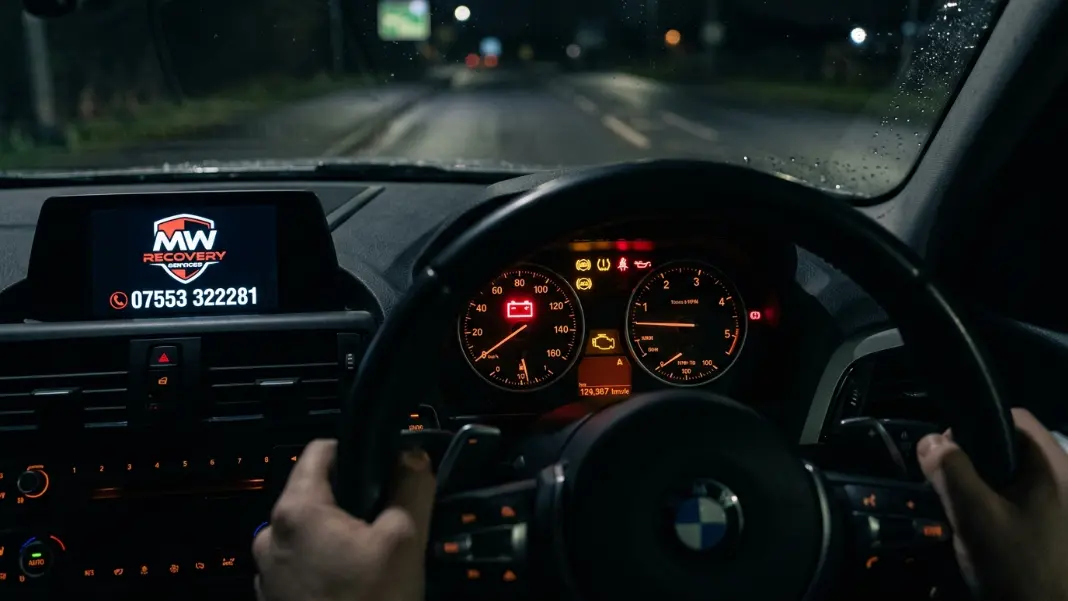
The battery warning light is on. A battery or alternator warning light on the dashboard does not always mean the battery is flat right now, but it does mean something in the charging system is wrong. If you ignore it, a flat battery is almost always the result.
Signs of a dead car battery that you may have noticed in the days before:
- The car takes longer to start than usual, especially on cold mornings
- Headlights seem dimmer than normal, particularly at idle
- Electrical accessories behave oddly, such as windows moving slowly or the radio resetting
- The car starts fine when driven regularly but struggles after sitting overnight
These are all early warnings. A battery showing these symptoms will eventually go flat completely. Getting it tested now is far better than dealing with it dead on a cold morning.
Why Car Batteries Die
Understanding why car batteries die helps you prevent it happening again after you fix the immediate problem.
Age. This is the most common reason. Car batteries have a lifespan of roughly three to five years under normal use. After this point the internal chemistry deteriorates and the battery can no longer hold or deliver charge reliably. A battery that is four years old or older is living on borrowed time regardless of how healthy it seems.
Leaving the car unused for an extended period. Modern cars draw a small amount of power continuously even when switched off. This is called parasitic drain and it powers things like the alarm system, the clock, and the keyless entry receiver. Over a week or two of sitting unused, this drain is enough to flatten a battery completely. This is why cars left parked during holidays or lockdowns so often need a jump start when the owner returns.
Short journeys. A car battery recharges while the engine runs via the alternator. Short journeys do not give the alternator enough time to fully recharge the battery, particularly in winter when you are using headlights, heating, and rear demisters. Drivers who only do short trips gradually drain their battery over weeks and months without realising it.
Something left on overnight. Interior lights, a phone charger left plugged in, a boot light that did not switch off, a dashcam drawing power continuously. Any of these can drain a battery flat overnight. If your battery went dead after leaving the car parked, check whether anything was left on.
A faulty alternator. The alternator charges the battery while the engine runs. If the alternator fails, the battery runs down gradually during driving and eventually goes flat. The battery warning light almost always illuminates when the alternator fails. If your battery keeps going flat despite being relatively new, get the alternator tested.
Extreme cold. Cold temperatures dramatically reduce the capacity of a car battery. A battery at freezing point has roughly half the capacity it has at room temperature. A battery that is borderline healthy will often fail completely on the first cold morning of winter.
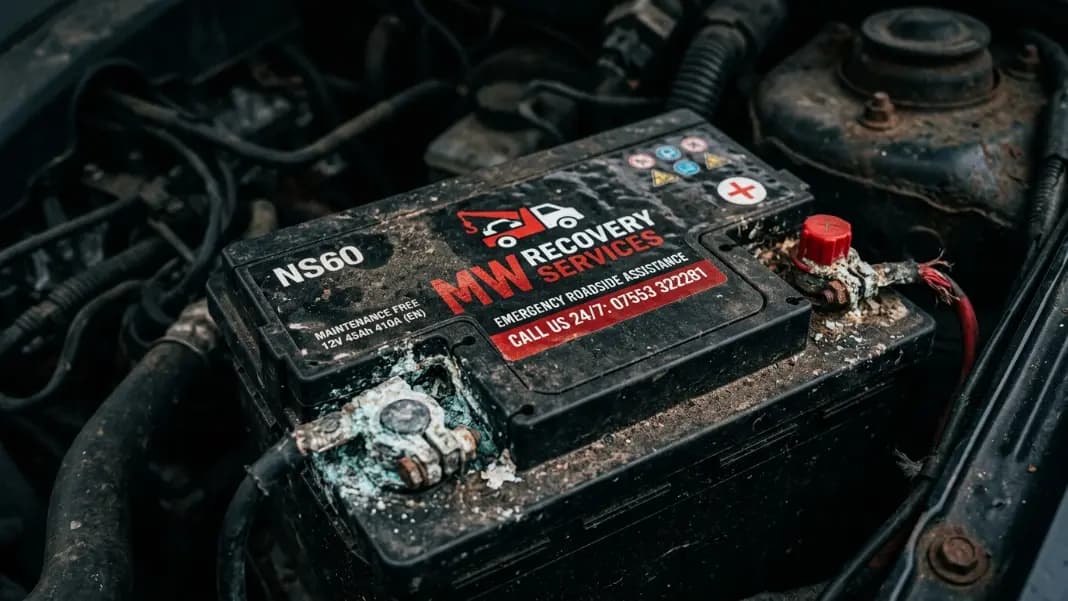
Old or corroded connections. Corrosion on battery terminals restricts the electrical connection. The battery may have charge but it cannot deliver it efficiently. White or blue powdery buildup on the terminals is a sign of this. Clean the terminals and apply petroleum jelly to prevent further corrosion.
What to Do When Your Car Battery Is Dead
Your car battery is completely dead. Here is what to do step by step.
Step 1: Confirm it is the battery. Check whether you get silence, rapid clicking, or very slow cranking when you try to start. All three point to the battery. If the car cranks at normal speed but will not fire, the battery probably has enough charge and the problem lies elsewhere. Check our guide on car won't start causes for that scenario.
Step 2: Check whether anything obvious is draining the battery. Look for interior lights left on, a boot that is not fully closed, or accessories left plugged into the charging ports. If something obvious is draining the battery, switching it off and waiting a few minutes is worth trying before anything else.
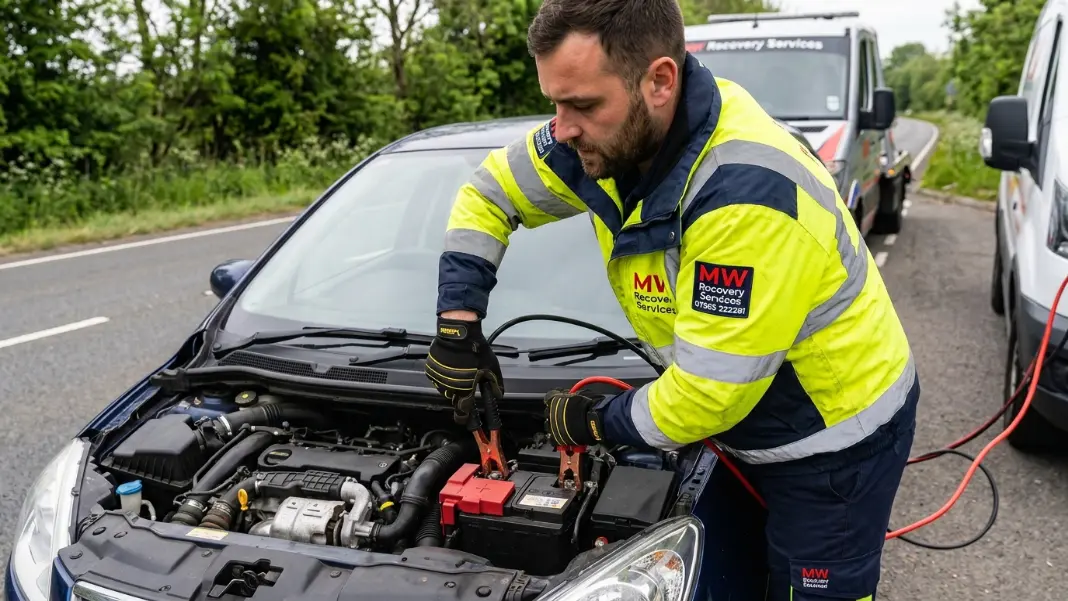
Step 3: Try a jump start if you have access to another vehicle or a jump pack. Jump starting is the fastest way to get moving again with a dead battery. See the full step-by-step guide below.
Step 4: If jump starting does not work or you have no way to jump start, call for help. Our jump start and battery service covers all of Greater Manchester 24 hours a day. We carry professional jump equipment and a range of common replacement batteries. We will either jump start the vehicle at the roadside or replace the battery on the spot in most cases.
Step 5: Once the car is running, get the battery tested. A jump start gets you moving but it does not fix the underlying problem. Drive straight to a garage and get the battery load tested. A load test costs nothing at most garages and tells you whether the battery can hold charge or needs replacing. Do not leave this until later. A battery that went flat once will go flat again.
How to Start a Car With a Dead Battery
Jump starting a car with a dead battery is straightforward if you follow the correct steps. Doing it wrong can damage your car's electronics or cause an injury.
What you need:
- A set of jump leads in good condition (cheap leads with thin cables are not reliable)
- A second vehicle with a working battery, or a portable lithium jump starter pack
Jump start steps:
- Park the working vehicle close enough for the jump leads to reach both batteries. Do not let the two vehicles touch each other.
- Switch both vehicles off.
- Connect the red cable to the positive (+) terminal on the dead battery.
- Connect the other end of the red cable to the positive (+) terminal on the good battery.
- Connect the black cable to the negative (-) terminal on the good battery.
- Connect the other end of the black cable to an unpainted metal surface on the engine block or chassis of the car with the dead battery. Do not connect it to the dead battery's negative terminal directly. Connecting to bare metal away from the battery reduces the small risk of igniting hydrogen gas near the battery.
- Start the working vehicle and let it run for two to three minutes.
- Attempt to start the car with the dead battery. If it starts, great. If it does not, wait another five minutes and try again.
- Once the car with the dead battery is running, remove the jump leads in reverse order: black from the engine block, black from the good battery negative, red from the good battery positive, red from the previously flat battery positive.
- Drive the recovered car for at least 20 to 30 minutes to allow the alternator to recharge the battery. Do not switch the engine off immediately.
Can you jump start a car with a completely dead battery? Yes, in most cases. A completely flat battery can usually accept a charge from jump leads if it is not physically damaged. The exception is a battery that has been deeply discharged repeatedly or has suffered internal damage. In this case the battery may not accept a charge at all and needs replacing.
Using a portable jump pack: Portable lithium jump starter packs work the same way as jump leads but do not require a second vehicle. They are compact, store in a glovebox, and can start a car multiple times on a single charge. If you break down regularly or drive in isolated areas, a portable jump pack is a worthwhile investment of around 30 to 60 pounds.
Safety tips:
- Never connect positive to negative. This causes a short circuit and can damage both vehicles' electronics.
- Never lean over the battery when connecting or disconnecting leads.
- If the battery looks cracked, bulging, or is leaking fluid, do not attempt to jump start. Call for professional help.
- If the car does not start after two or three attempts, stop. Repeated cranking drains both batteries and risks overheating the starter motor.
How to Fix a Dead Car Battery
How you fix a dead car battery depends on why it went flat.
If the battery went flat because something was left on: Jump start it, let the alternator recharge it fully during a decent drive, and get it tested. If it holds charge and tests healthy, you may not need to replace it. Check the thing that drained it and make sure it cannot happen again.
If the battery went flat because the car was left unused: Jump start it and take it for a proper drive of at least 30 minutes. Then get it tested. Batteries that have been deeply discharged multiple times have a shorter remaining lifespan even if they seem to recover. If the battery is more than three years old, replace it rather than trusting it.
If the battery went flat for no obvious reason: Get both the battery and the alternator tested. The alternator may not be charging the battery correctly. A battery that keeps going flat despite regular driving almost always means the alternator is failing.
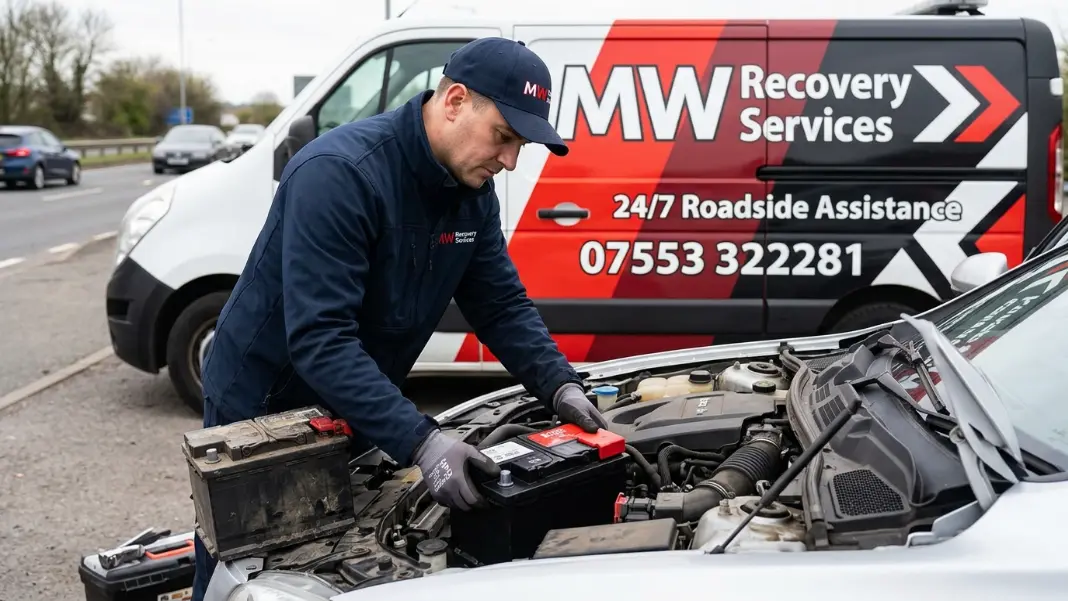
If the battery is old or failed the load test: Replace it. A battery that cannot pass a load test will go flat again regardless of how many times you charge it. Replacement batteries for most common cars cost between 60 and 150 pounds fitted. This is considerably less than the cost of a recovery callout caused by a battery that fails at the worst possible moment.
We carry common replacement batteries on our recovery vehicles and can replace your battery at the roadside in most cases. Call us on 07553 322281 and we will confirm whether we carry the right battery for your vehicle before we attend.
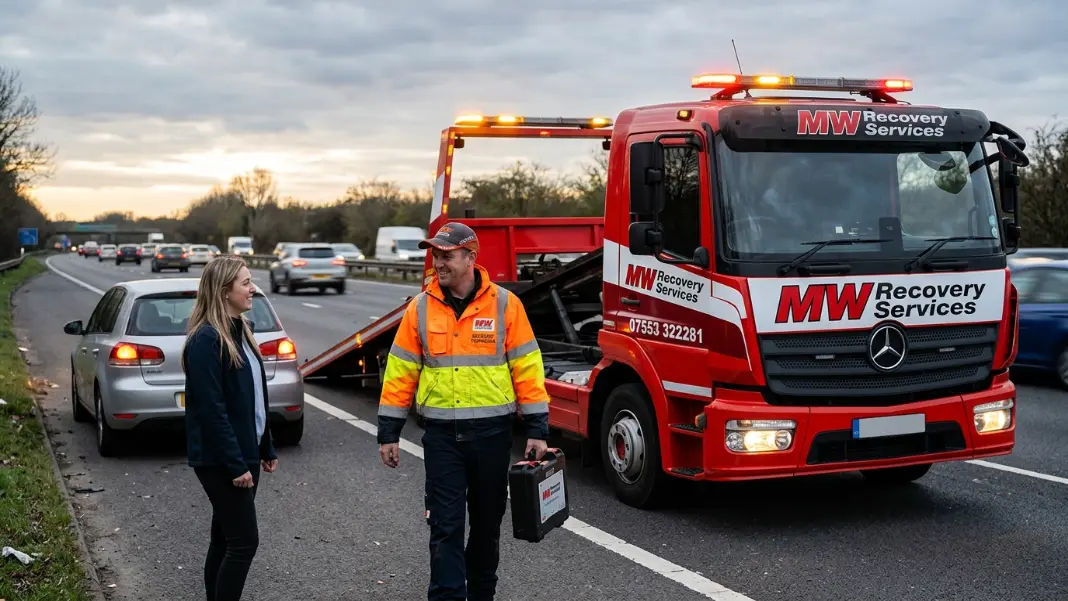
When to Call Breakdown Recovery in Manchester
Some dead battery situations are straightforward self-help jobs. Others need professional help. Here is when to call us instead of trying to manage it yourself.
- You have no way to jump start the vehicle. You are parked somewhere without access to another car, you do not have a portable jump pack, and there is nobody nearby who can help. Call us. We will be with you in 30 to 45 minutes with professional jump equipment.
- Jump starting has not worked after two attempts. If the car will not start despite correctly connected jump leads and a running donor vehicle, the battery may be beyond recovery or there may be another problem. Do not keep trying. Call us for a proper diagnosis at the roadside.
- You are in a dangerous location. If the car has died on a busy road, in a live traffic lane, or in a position that creates a hazard for other road users, call for recovery rather than trying to sort it yourself. Safety first.
- The battery is physically damaged. A cracked, bulging, or leaking battery is a safety risk. Do not attempt to charge or jump start a damaged battery. Call for help.
- You are not confident jump starting the vehicle. Jump starting done incorrectly can damage expensive electronics. If you are not comfortable doing it, call us. It takes minutes and costs far less than an ECU replacement.
- The battery keeps going flat repeatedly. If this is not the first time your battery has died recently, there is a deeper problem. An alternator fault or a parasitic drain needs proper diagnosis. Our team can help identify the cause at the roadside.
For immediate help with a dead battery anywhere in Greater Manchester, call 07553 322281. Our jump start service covers Manchester, Salford, Stockport, Bolton, Wigan, Oldham, Rochdale, Bury, Tameside, and Trafford, 24 hours a day. We will get you moving as fast as possible.
If your car battery has completely given up and the car needs collecting rather than jump starting, our breakdown recovery service handles that too. One call covers everything.
You can also find your local area recovery page by visiting our car recovery near me page or our breakdown recovery near me page.
Frequently Asked Questions
Common questions about this topic
The quickest way to tell is to listen when you try to start the car. Silence or rapid clicking almost always means the battery. Normal cranking speed but no start points to fuel or ignition issues rather than the battery. If your lights and electronics work but the car will not start, the battery may have some charge but not enough for the starter motor. Try a jump start. If it starts immediately, the battery was the problem.
Need Car Recovery in Manchester?
MW Recovery provides fast, professional breakdown recovery and roadside assistance across all of Greater Manchester. One call and we are on our way.