
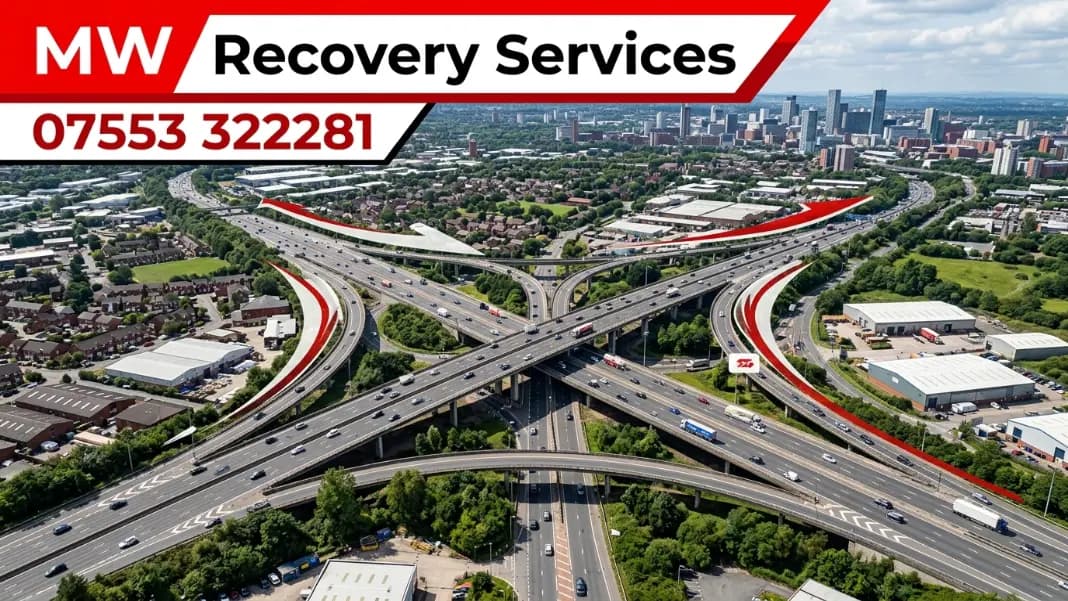
When and Where Greater Manchester Drivers Break Down in 2026
July and August are the peak months for UK breakdowns, and the M60 and M62 are among the most incident-heavy routes in the North West. Here is what the data shows about when and where Manchester drivers are most at risk.
Table of Contents
Every July and August, UK breakdown providers report a significant increase in callouts. For most drivers, this is counterintuitive because winter feels like the risky period. But the data points consistently to summer as the most demanding stretch of the year. In Greater Manchester, that pressure falls hardest on the M60 orbital and the M62 trans-Pennine corridor, and the timing coincides with school holidays when those roads carry their highest traffic volumes of the calendar year.
This piece draws on national breakdown data, National Highways incident records, and regional traffic patterns to build a picture of when and where Greater Manchester drivers are most likely to need recovery assistance, and what it means practically if you find yourself on the wrong end of those statistics.
Where Are the Breakdown Hotspots on Greater Manchester's Road Network?
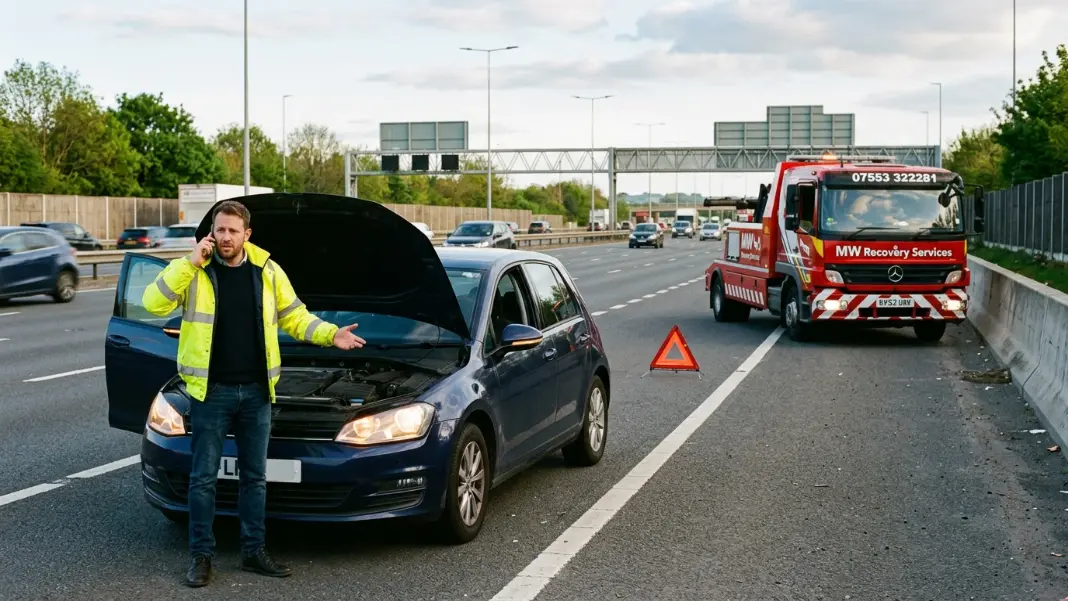
The M60 orbital motorway is the busiest single stretch of road in Greater Manchester. Carrying well over 100,000 vehicles per day on its heaviest sections, it also generates a high volume of breakdown incidents through the sheer density of traffic. Incidents concentrate around junction approaches, particularly junctions 12 to 18 on the south-western arc through Stretford and Salford, where merging traffic and repeated acceleration and deceleration cycles put additional strain on cooling systems, tyres, and transmission components.
The M62 corridor east of Manchester generates a different pattern. Higher sustained speeds and the gradient changes between junctions 17 and 22 produce more tyre and drivetrain incidents than the urban orbital. Long runs at motorway speed on underinflated tyres accelerate structural fatigue in the sidewall, which is one of the most common preventable causes of incidents on this route.
The M56 south of Manchester is notable for its airport-approach traffic profile. A disproportionate number of drivers on this road are unfamiliar with the route, carrying heavy luggage, and running later than planned. Deferred maintenance, unfamiliar vehicles, and time pressure combine to produce a breakdown pattern concentrated between junctions 4 and 7.
The A580 East Lancashire Road is the highest-incident A-road in the region, running through Salford, Eccles, and Leigh. The A57 and the Glossop approach from the east produce a profile weighted toward older vehicles and mechanical failures rather than the tyre and cooling incidents that dominate on the motorway network.
Smart Motorways and the Specific Risk They Create for Manchester Drivers
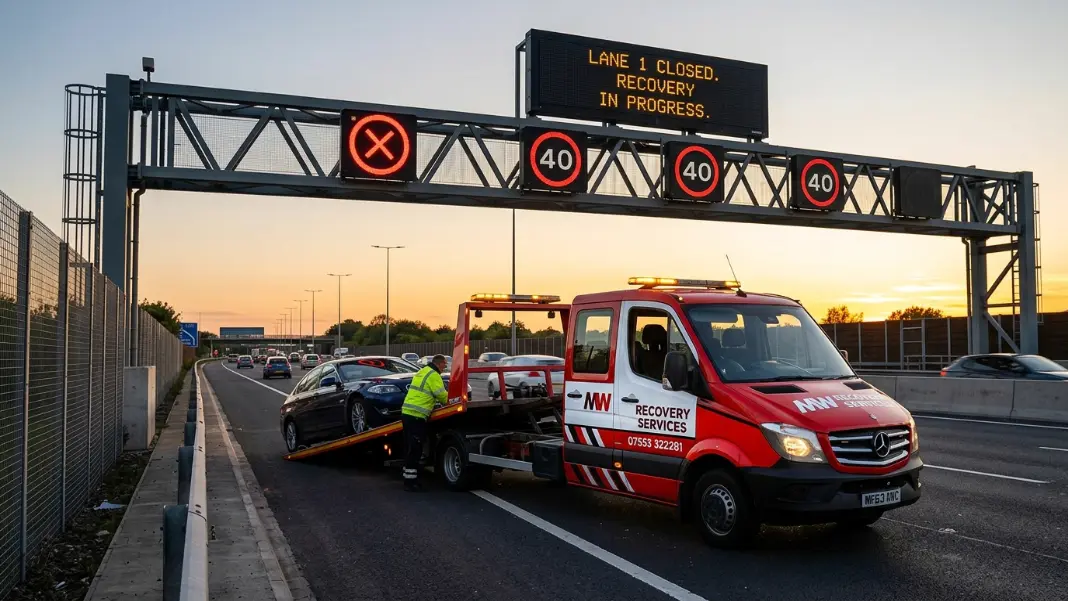
National Highways' own incident data shows that all-lane-running smart motorway sections are disproportionately represented in serious breakdown incidents compared with conventional motorways. Both the M60 and the M62 include all-lane-running sections in the Greater Manchester area.
On a conventional motorway with a continuous hard shoulder, breaking down means moving out of live traffic into a protected space before calling for help. On an all-lane-running section, a stopped vehicle in a running lane creates an immediate hazard until traffic management systems detect and respond to it. Detection relies on CCTV operators or the vehicle triggering overhead radar sensors. In normal operating conditions, the average time between a vehicle stopping in a live lane and the overhead variable message signs displaying a red X is under two minutes. That is still two minutes with a stationary vehicle in active traffic.
Emergency refuge areas on the M60 are spaced at approximately 1.5-mile intervals. They are marked with blue signs carrying an orange SOS telephone symbol and are visible from around 300 metres. If you see a warning light appear while on a smart motorway section, the correct response is to head for the next ERA or exit junction immediately, not to continue driving and see whether the light goes out.
If you cannot reach an ERA and come to a stop in a live lane, keep your seatbelt fastened, activate your hazard lights, and call 999. Do not stand outside on the carriageway. Call for recovery at the same time so a vehicle is already in transit.
For motorway incidents across Greater Manchester, MW Recovery's motorway team covers the M60, M62, M56, and the M61 and M66 corridors.
When Are You Most Likely to Break Down?
Breakdown data from the RAC, AA, and fleet management operators show consistent time and date patterns that apply across the UK, including Greater Manchester.
By Month
July and August are the peak months for breakdown callout volumes nationally. The causes are different from the winter failures most drivers expect: it is not cold starts and dead batteries that dominate in summer, but cooling system failures from overheating engines, tyre damage from hot road surfaces, and the higher mileage associated with summer holiday driving. Many vehicles are covering more miles in a single August fortnight than they do in any other comparable period, often without a recent service.
January and February represent the second peak, dominated by battery failures in cold weather, fuel system issues in older vehicles, and the first genuinely cold weeks after the relatively mild December period when marginal batteries and worn tyres that scraped through autumn finally give up.
By Day of the Week
Friday is consistently the worst day for breakdowns across UK regions. The combination of higher vehicle volumes from weekend getaway traffic, the tendency to defer a warning light until after work, and the peak commuter pressure in the late afternoon all contribute to an outsized Friday incident rate. Friday afternoon between 3pm and 7pm is the single busiest window for breakdown callouts in most UK areas, and the Greater Manchester motorway network reflects this precisely.
By Time of Day
A breakfast-time peak occurs between 7am and 9am, driven by cold-start battery failures and the high volume of vehicles starting journeys in a short window. The evening rush between 5pm and 8pm produces a second peak from sheer volume. The quietest period is between 2am and 5am, though callouts in this window often involve longer response times since recovery traffic on the road network is thinner.
What Actually Causes Most Breakdowns in Greater Manchester?
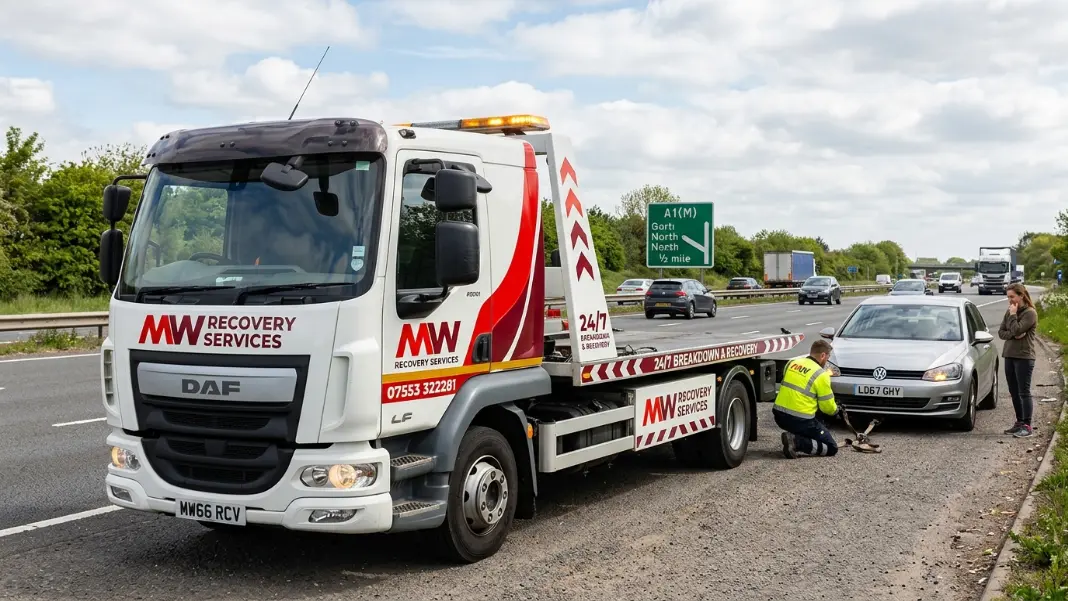
The causes are broadly consistent with national patterns, but there are regional factors specific to Manchester worth understanding.
Tyre failures are the single most common cause of breakdown callouts in the UK, accounting for roughly one in three incidents. In Manchester's urban environment, where pothole density is significantly above the national average and kerb strikes from tight parking are frequent, sidewall damage and slow punctures occur at a higher rate than on rural routes. A tyre that looks intact at a visual check may have internal structural damage that only becomes apparent under sustained motorway speed.
Battery failures are the second most common cause and are concentrated in the October to February period. Manchester's combination of cold winters, a high proportion of short urban journeys, and older vehicle stock in some areas produces battery failure rates above the average for major UK cities.
Fuel-related issues, specifically running out of fuel, have increased as a share of total callouts over recent years. Higher fuel prices have led more drivers to push their fuel level further before filling up, and the anxiety around fuel cost has paradoxically increased the number of drivers who run out entirely. Running out of fuel on the M60 in an active lane is a preventable incident that carries real risk beyond the inconvenience.
Engine overheating from coolant loss or thermostat failure peaks in summer and accounts for a significant portion of the July and August uplift in callouts. Older vehicles and those that have been driven harder during holiday journeys without a pre-trip inspection are most susceptible. A coolant system that holds pressure adequately on short urban runs may fail under sustained motorway-speed driving in 25-degree heat.
How Response Times Vary Across Greater Manchester
Recovery response times in Greater Manchester are not uniform across the region. Urban areas including Salford, Manchester city centre, Stockport, and Stretford see the fastest average response times because recovery vehicles can reach most locations within 30 to 45 minutes. Urban density means shorter distances but more traffic to navigate.
Motorway incidents on the M60, M62, and M56 carry a different dynamic. Traffic management requirements mean that some live-lane recoveries require a Traffic Officer escort or a contraflow setup before the recovery vehicle can work safely. This extends the total clearance time even if the recovery vehicle itself arrives quickly after being dispatched.
The outer fringes of Greater Manchester, including parts of Wigan, the Saddleworth approaches, and the Glossop corridor, have longer response windows given the lower density of recovery resources in those zones. Drivers who regularly use these routes should have a direct recovery number saved rather than relying on a national provider's system to locate a local asset in real time.
What to Do If You Break Down on a Greater Manchester Road
The sequence matters and getting it right reduces both your personal risk and the time before recovery arrives.
On a motorway or dual carriageway: signal left and move out of the running lane as early as possible. Reach the hard shoulder or the nearest emergency refuge area. Switch off the engine, activate hazard lights, and exit via the passenger-side door. Move behind the safety barrier where one is present. Call for recovery and give your exact location using the yellow marker posts visible every 100 metres on motorways.
On an A-road or urban road: move the vehicle as far off the carriageway as possible before stopping. Apply the handbrake, activate hazard lights, and if it is safe to do so, place a warning triangle at least 45 metres behind the vehicle. Call for recovery and give your location using street names, landmarks, or the what3words app for precise positioning.
MW Recovery responds to breakdown callouts across Greater Manchester around the clock, covering motorways, A-roads, and urban streets. Our breakdown recovery service is based in the region, which means we know the access points, the contraflow patterns, and the fastest routes to reach your location quickly.
Frequently Asked Questions
Common questions about this topic
The two peak periods are July to August, driven by overheating, tyre failures, and higher holiday mileage, and January to February, dominated by cold-start battery failures. Friday afternoon between 3pm and 7pm is the busiest single time window for callouts throughout the year.
Need Car Recovery in Manchester?
MW Recovery provides fast, professional breakdown recovery and roadside assistance across all of Greater Manchester. One call and we are on our way.