
Smart Motorway Breakdown: What the New Rules Mean for UK Drivers
Smart motorways have removed the hard shoulder from large sections of the UK motorway network. Breaking down on one is more dangerous than a standard motorway. Here is exactly what to do and what the current rules say.
Table of Contents
Smart motorways have fundamentally changed the experience of breaking down on a UK motorway, and not in a way that makes drivers safer. For many years, a breakdown on a standard motorway meant pulling onto the hard shoulder, a clearly defined refuge at the side of the road that separated you from live traffic. On a significant proportion of UK motorway mileage, that option no longer exists.
Understanding how smart motorways work, what types exist, where the refuges are, and exactly what to do if your vehicle stops is now essential knowledge for any driver who uses motorways in the UK. This guide covers all of it, along with what the current position on smart motorway safety reform actually is and what it means for drivers using the motorway network around Manchester.
What Is a Smart Motorway?
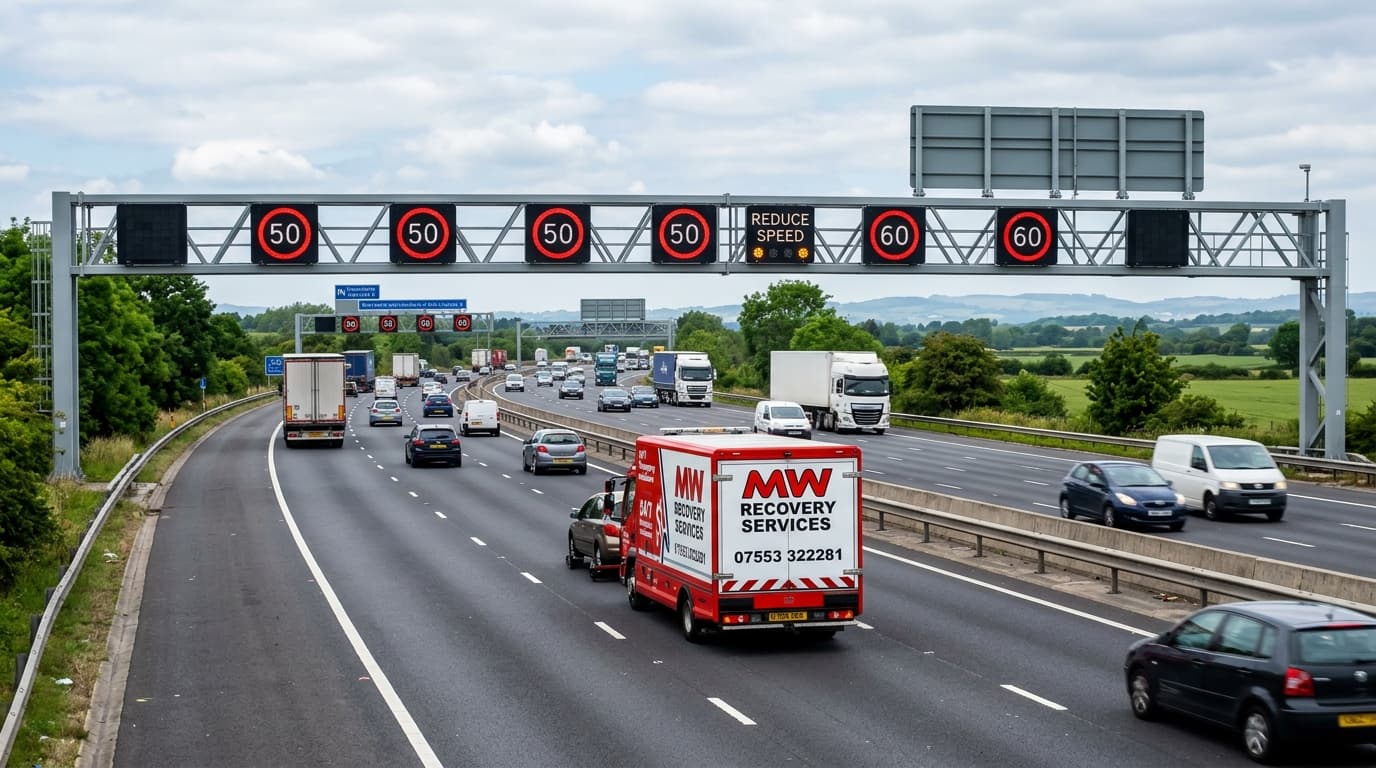
A smart motorway is a motorway that uses active traffic management technology to vary speed limits and, in some configurations, open the hard shoulder as a running lane. The technology is controlled from a Regional Traffic Control Centre where operators monitor the motorway via overhead cameras and can respond to incidents by changing speed limits, displaying warnings, or closing lanes using overhead electronic signs.
The rationale for smart motorways was to increase motorway capacity without building additional lanes. Converting a hard shoulder into a running lane during busy periods effectively adds a lane of traffic without physical construction. The cost saving compared to widening the road was significant, and this drove widespread rollout across the motorway network from around 2006 onwards.
The M60 Manchester Ring Road includes sections operating under smart motorway technology. Parts of the M62, M56, and M61 also use smart motorway systems. Any driver regularly using these routes needs to understand how they work before a breakdown makes the question urgent.
The Three Types of Smart Motorway
Not all smart motorways are the same, and the type determines what options you have if your vehicle stops. There are three distinct configurations currently in use on the UK network.
Controlled motorways retain a permanent hard shoulder but use variable speed limits displayed on overhead gantry signs above each lane. If you break down on a controlled smart motorway, you can move to the hard shoulder exactly as you would on a traditional motorway. Controlled motorways are the least dangerous of the three types for breakdown scenarios because the refuge is always available.
Dynamic hard shoulder motorways allow the hard shoulder to be used as a running lane during busy periods. When the hard shoulder is open as a traffic lane, a speed limit is shown on the gantry sign above it. When it is closed as a running lane and reverts to emergency use, a red X is shown above it. The problem arises when your vehicle stops during a period when the hard shoulder is operating as a live lane. In that situation, you are in moving traffic with no immediate refuge available unless an Emergency Refuge Area is close enough to reach.
All Lane Running motorways have no permanent hard shoulder whatsoever. The former hard shoulder is a live running lane at all times, 24 hours a day. There is no option to move left out of traffic when your vehicle breaks down unless you can reach an Emergency Refuge Area. All Lane Running motorways have been at the centre of virtually all of the safety criticism and fatality data connected to smart motorways in the UK. They represent the highest risk scenario for any breakdown.
Emergency Refuge Areas: What They Are and Where to Find Them
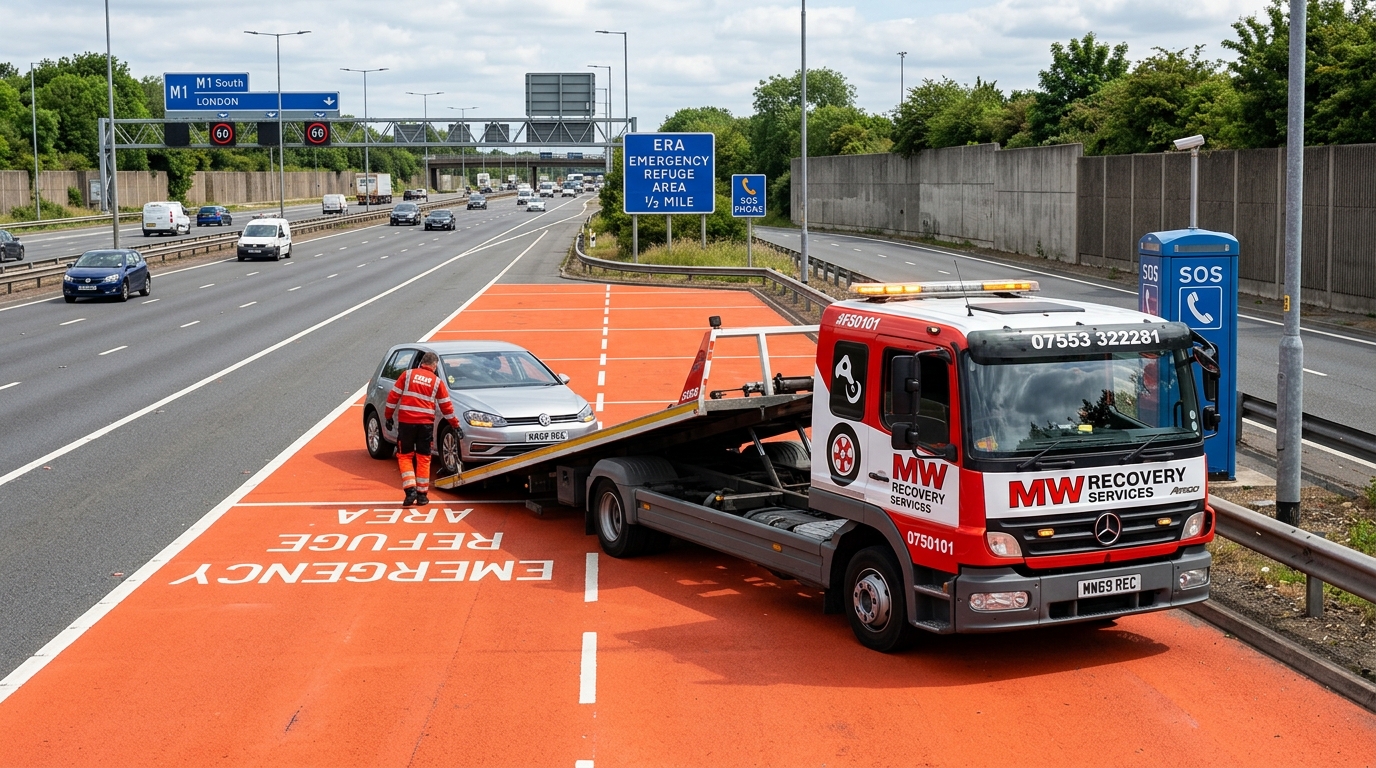
Emergency Refuge Areas are the replacement for the hard shoulder on All Lane Running and dynamic hard shoulder motorways. They are lay-by areas built into the motorway barrier at intervals along the carriageway. They are identified by orange surfacing and marked with signs showing the distance to the next ERA and an ERA symbol.
Inside an ERA, there is an SOS emergency telephone connected directly to the Regional Traffic Control Centre. There are CCTV cameras. When a vehicle enters an ERA, the camera operators can see it, and they should close the lane running alongside the ERA using a red X on the overhead gantry sign, creating a buffer of protection from passing traffic.
The spacing between ERAs was set at a maximum of one mile on early smart motorway projects, but this guideline was not consistently followed during rollout. On some sections, the gap between ERAs reaches 1.5 miles and on older sections up to 2.5 miles. This is significant because a vehicle losing power at motorway speed on a downhill section may be able to coast over a mile to safety. The same vehicle losing power on a flat or uphill section, or losing power suddenly, may not reach the ERA in time and will stop in a live lane.
National Highways has committed to reducing ERA spacing to a maximum of three-quarters of a mile on problematic sections as part of the safety improvement programme announced following Government review.
What to Do When Your Vehicle Breaks Down on a Smart Motorway
The moment your vehicle shows signs of difficulty on a smart motorway, the correct response is to act immediately rather than waiting to see if the problem resolves. Every second of forward movement while the vehicle still has some power or momentum is a second you can use to reach safety.
Step one: look for an Emergency Refuge Area. ERA signs indicate the distance to the next one. If your vehicle is still moving and an ERA is within reach, get to it. Do not worry about indicators, lane changes, or other traffic at this point. Signal, move left as safely as you can, and get into the ERA. Every effort should go towards reaching it before the vehicle stops completely.
Step two: if you cannot reach an ERA and your vehicle stops in a running lane, put your hazard lights on immediately. This is the most important action you can take in the first seconds after stopping. Hazard lights give other drivers a visible warning and are the trigger for camera operators to detect the situation and deploy a red X above your lane.
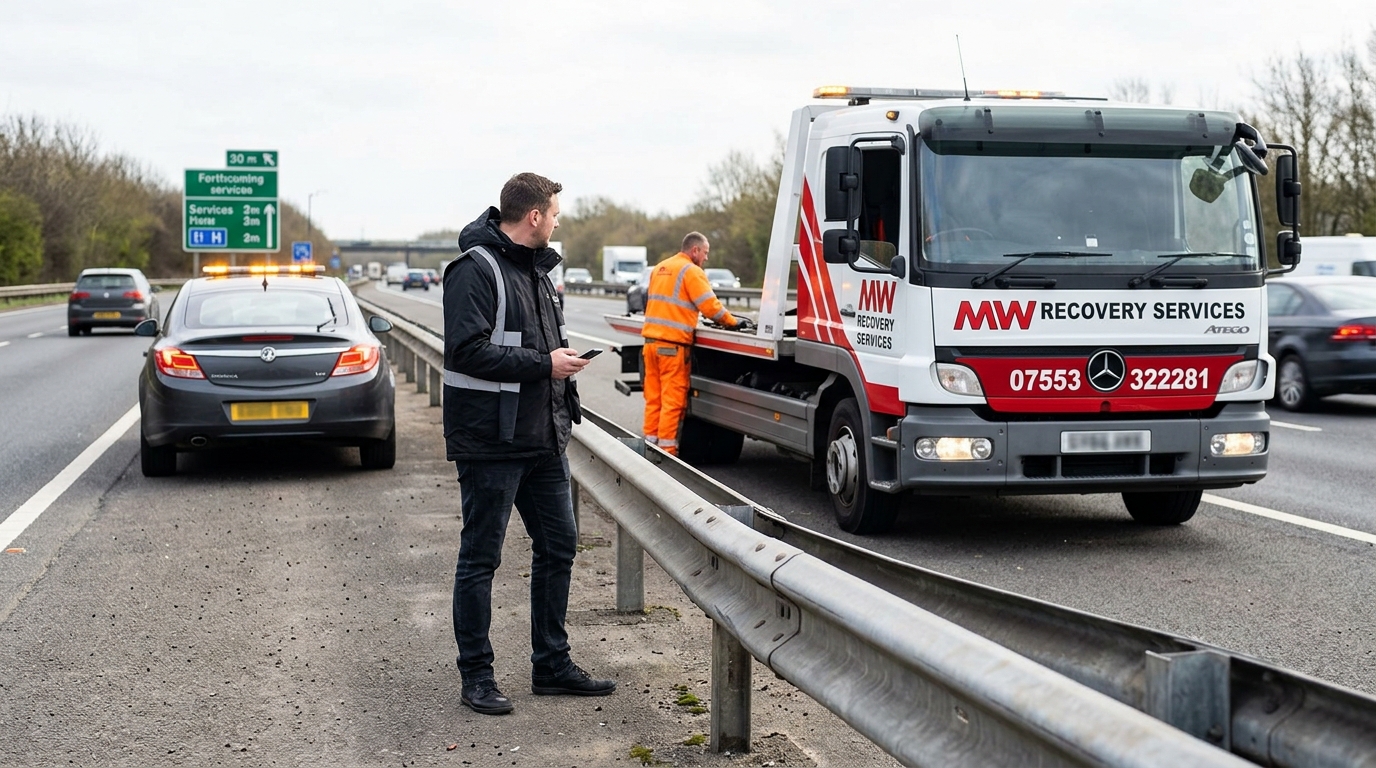
Step three: if it is safe to exit the vehicle, get out from the left-hand side only. Do not open the door into traffic. Do not go around the back or front of the vehicle into live lanes. Once out of the vehicle from the left side, move immediately to the nearside barrier and get behind it. Standing beside or in front of your vehicle in a live motorway lane is extremely dangerous.
Step four: call 999 to report that your vehicle is stationary in a live lane, giving your direction of travel and the last junction or overhead gantry number you saw. Then call for recovery on 07553 322281. MW Recovery Services provides motorway recovery on all major routes around Manchester.
Step five: do not get back into your vehicle while it is in a live lane, even if other traffic is passing safely. The most dangerous moment is re-entering the carriageway. A closing speed of 70mph gives very little reaction time for other drivers if something goes wrong.
Red X Lanes: Enforcement and What It Means for You
The red X displayed on an overhead gantry sign means that lane is closed. This is not advisory. It is a legal requirement enforced by cameras positioned on the gantries. Driving in a lane marked with a red X is a specific offence carrying an automatic £100 fixed penalty notice and three penalty points on your licence.
The red X is the mechanism that is supposed to protect stopped vehicles in live smart motorway lanes. When a breakdown is detected by cameras or reported by the driver, the control centre operator closes the lane with a red X to stop traffic from continuing to use it. This gives recovery operators a safer approach corridor and prevents further incidents from drivers running into the stopped vehicle.
The critical issue identified in safety investigations into smart motorway fatalities is the time between a vehicle stopping and a red X being displayed. Detection by camera requires an operator to see the stopped vehicle, confirm it is not moving, and manually or automatically deploy the lane closure. On sections without automatic stopped vehicle detection technology, this process can take several minutes. In several documented cases in the UK, the gap between a vehicle stopping and the lane being closed proved fatal.
Automatic stopped vehicle detection, which uses radar and camera AI to identify stationary vehicles and trigger a red X without operator intervention, is being rolled out on more sections of the network. Until it is universal, the delay risk remains.
The Safety Controversy: Where Things Stand
The safety concerns around smart motorways, particularly All Lane Running configurations, have been well documented since the mid-2010s when fatalities began to be linked to the absence of a permanent hard shoulder.
A series of coronial inquests, an independent review by the House of Commons Transport Select Committee, and sustained campaigning by road safety organisations culminated in the Government announcing in April 2023 that no new All Lane Running motorways would be built. Existing schemes under construction at the time were paused for review.
The Government also committed to additional safety measures on existing All Lane Running sections including improved ERA spacing, retrospective installation of automatic stopped vehicle detection, and improved driver education about smart motorway procedures. Progress on these commitments has been uneven and campaigners have argued that the pace of safety improvement has not matched the urgency of the problem.
For drivers using smart motorway sections around Manchester today, the practical situation is that these sections exist, are used by millions of vehicles, and require greater driver preparedness than a traditional motorway. Knowing where the ERAs are, understanding what to do when the vehicle shows warning signs, and having a recovery company number saved in your phone are the most useful preparations you can make.
Smart Motorway Recovery Around Manchester
MW Recovery Services attends motorway breakdowns across the Greater Manchester motorway network on the M60, M62, M56, M61, and M66. Our drivers carry full motorway safety equipment including traffic warning devices and follow correct procedures for approaching broken-down vehicles on both standard and smart motorway sections.
On smart motorway callouts, we coordinate with the Regional Traffic Control Centre and follow lane closure confirmation before approaching a stopped vehicle in a running lane. Our response times on the Greater Manchester motorway network are typically 30 to 45 minutes from your call. Call 07553 322281. Have your direction of travel and the last junction or gantry number ready when you call to help us locate you quickly.
Frequently Asked Questions
Common questions about this topic
Try to reach an Emergency Refuge Area immediately. If you cannot, switch on your hazard lights and exit from the left-hand side as soon as it is safe to do so. Get behind the nearside barrier. Call 999 to report the hazard, then call MW Recovery Services on 07553 322281.
Need Car Recovery in Manchester?
MW Recovery provides fast, professional breakdown recovery and roadside assistance across all of Greater Manchester. One call and we are on our way.