
Motorway Hard Shoulder Rules UK: What You Can and Cannot Do
The rules around the motorway hard shoulder in the UK have changed with smart motorways. This guide explains what you can and cannot do on a traditional and smart motorway hard shoulder, and what to do when you break down.
Table of Contents
The motorway hard shoulder might look like a safe strip of tarmac when your car breaks down, but the rules governing what you can and cannot do on it have changed significantly in recent years. Getting this wrong has serious consequences, both for your safety and legally. This guide covers everything UK drivers need to know about hard shoulder rules in 2026, including the specific changes that came with smart motorways and what you must do if you break down on any type of motorway.
Whether you are breaking down on the M60, the M62, or any other motorway in the UK, understanding these rules before you are in the situation is far better than working it out under pressure at the roadside.
What Is the Hard Shoulder and Why It Exists
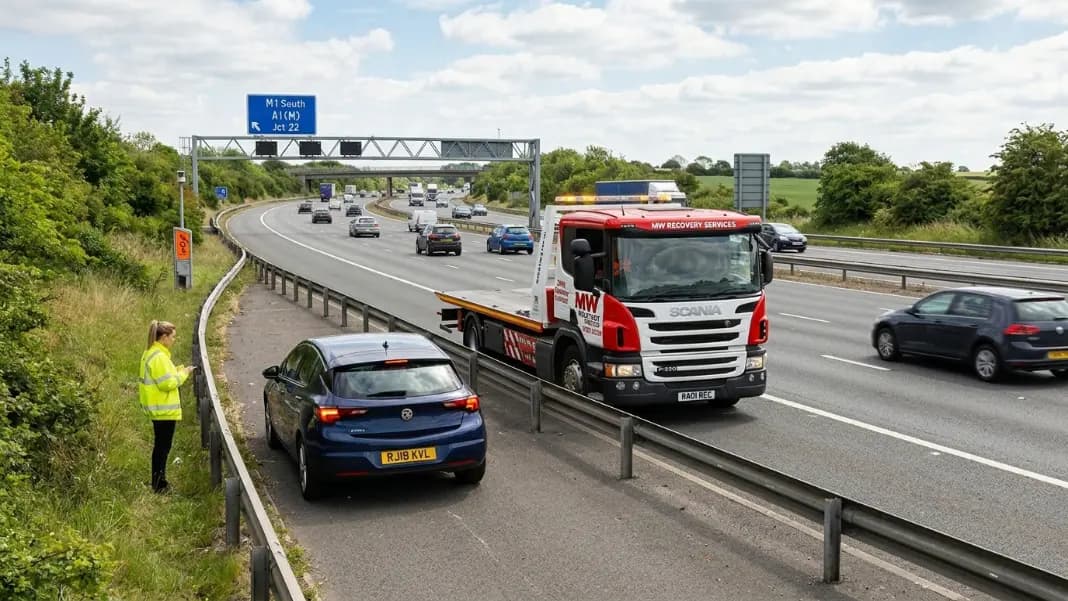
The hard shoulder is the surfaced lane running along the left-hand edge of a motorway carriageway, separated from the main running lanes by a solid white line. It was designed as a refuge for broken-down vehicles and emergency access for recovery and emergency services. For decades, the rule was simple: the hard shoulder was not a running lane and drivers could stop there only in an emergency.
That clarity has become complicated by the rollout of smart motorways, where the hard shoulder has in many cases been converted into an additional running lane. This change has created confusion among drivers about what the rules are, where a safe space exists when breaking down, and what to do when there is no hard shoulder at all. The consequences of misunderstanding these rules can be fatal.
In 2023, the government announced a pause on new smart motorway schemes with no hard shoulder, and committed to additional safety improvements on existing stretches. However, existing smart motorways remain operational across the UK, including sections affecting routes around Manchester. Understanding how to behave on each type is not optional knowledge for UK motorists.
Hard Shoulder Rules on a Traditional Motorway
On a traditional motorway, the hard shoulder runs continuously along the left edge of the carriageway. Here are the rules that apply:
What you CAN do on a traditional motorway hard shoulder:
- Stop there in a genuine emergency or if your vehicle has broken down
- Use it temporarily if you feel unsafe to continue driving
- Allow emergency services to pass using it when traffic is stopped
- Exit your vehicle from the nearside (left) door and stand on the verge behind the barrier
- Use an emergency telephone to call for assistance
What you CANNOT do on a traditional motorway hard shoulder:
- Drive along it as a through lane, including during heavy traffic
- Stop there to make a phone call, check a map, or rest when no emergency exists
- Pick up or drop off passengers
- Turn around or attempt a U-turn
- Remain in your vehicle once stopped, unless it is unsafe to exit
- Stand near the nearside running lane between your vehicle and live traffic
When you stop on the hard shoulder, you must switch your hazard lights on immediately. Exit from the nearside door, move as far from the carriageway as possible, ideally behind a safety barrier, and stand well away from your vehicle. Do not stand between your vehicle and live traffic under any circumstances.
Smart Motorways: A Different Set of Rules
Smart motorways come in three configurations, each with different rules about the hard shoulder:
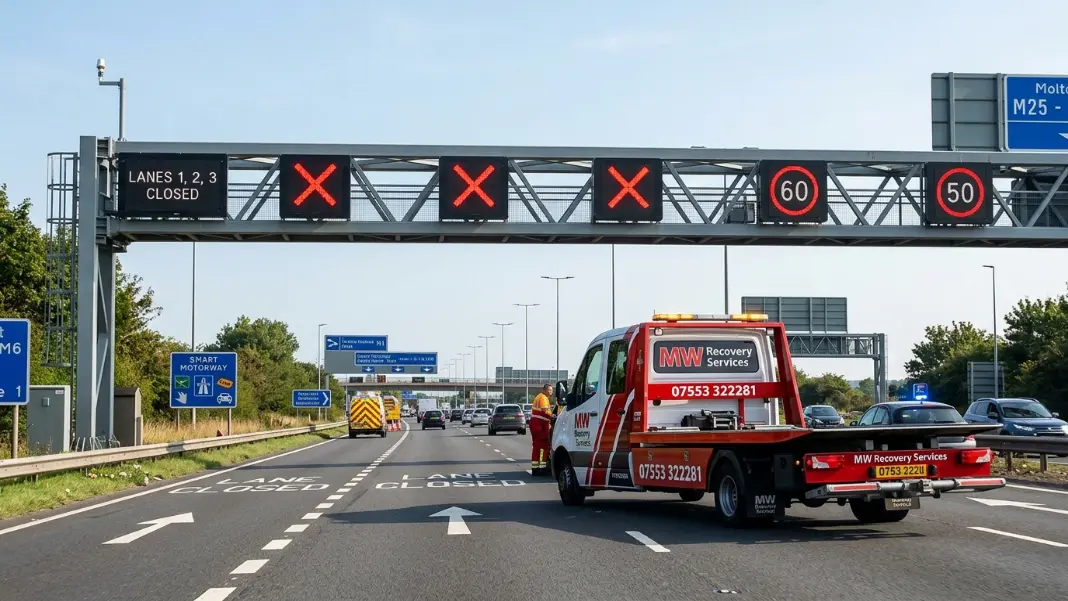
Controlled motorways: The hard shoulder is preserved but variable speed limits are displayed on overhead gantry signs. The hard shoulder rules are the same as a traditional motorway. You stop there only in a genuine emergency.
Dynamic hard shoulder motorways: The hard shoulder can be opened as a running lane during peak traffic periods. When a red X sign is not displayed above it, the hard shoulder is available for traffic. When a red X is displayed, it is closed and you must not drive in it. If you break down, aim to reach an Emergency Refuge Area if the hard shoulder is open as a running lane.
All-lane running motorways: There is no hard shoulder at all. All lanes, including what was the hard shoulder, are live running lanes at all times. If you break down on an all-lane running motorway, you must reach an Emergency Refuge Area. If you cannot reach one, stop as far left as possible, switch on hazard lights, exit the vehicle from the nearside, get behind any available barrier, call 999, and then call recovery.
Sections of the M60 and M62 near Manchester include smart motorway stretches. Knowing which type of smart motorway you are on when you break down can make a significant difference to your immediate response.
Emergency Refuge Areas: What They Are and How to Use Them
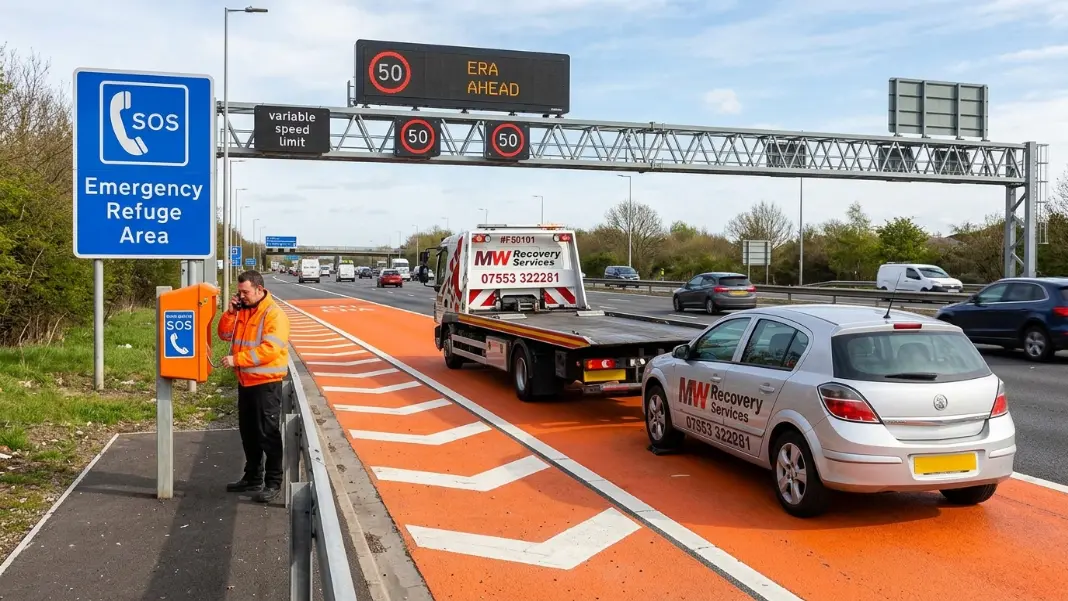
Emergency Refuge Areas (ERAs) are the designated stopping points on smart motorways that replace the hard shoulder. They are surfaced bays set back from the carriageway, marked with orange surfacing and a blue ERA sign, and equipped with an SOS telephone connected directly to National Highways.
If your vehicle develops a fault on a smart motorway, your first priority is to reach an ERA. They are spaced at intervals of roughly 1 to 1.5 miles on most smart motorway stretches, though this distance has been criticised as too great for vehicles that lose power suddenly. If you feel your vehicle is developing a problem, act early: do not wait until you have no power or control. Reach the next ERA before the situation becomes critical.
Once in an ERA, switch on your hazard lights, exit from the nearside door, stay in the ERA behind the safety barriers, and use the SOS telephone to report your situation. National Highways can activate red X signs above the lane nearest to you, providing some protection while you wait. Do not re-enter the carriageway to attempt to push your vehicle or retrieve belongings.
The SOS telephones in ERAs connect you to National Highways, not to a recovery operator. After calling National Highways, call your recovery provider separately. For 24-hour motorway recovery across the Greater Manchester network, including the M60, M62, M56, M61, M66, and M6, our motorway recovery service is available around the clock.
What Happens If You Cannot Reach an ERA or Hard Shoulder
If your vehicle breaks down in a live running lane and you cannot move it, you are in an extremely dangerous position. The steps to follow are:
- Switch on hazard lights immediately
- Call 999 to report an obstruction on the motorway. National Highways can close the lane remotely using overhead gantry signs, but this only happens after the obstruction is reported
- If you can exit safely from the nearside door without being in live traffic, do so and get as far from the vehicle as possible
- If you cannot exit safely, stay in the vehicle with your seatbelt on
- Call your recovery operator once emergency services have been notified
The statistics on live lane breakdowns are stark. Vehicles stopped in live motorway lanes are involved in fatal collisions at a significantly higher rate than those stopped on a hard shoulder or in an ERA. The faster you can get the carriageway aware of your presence through 999 and hazard lights, the better the outcome.
The Rules Around Motorway Emergency Telephones
Orange emergency telephones are placed at one-mile intervals along traditional motorways and at ERAs on smart motorways. These connect directly to National Highways (previously Highways England) and allow you to give your exact location without needing a phone signal or a charged mobile battery. The phone also transmits your location automatically.
If you have a mobile phone, you can call 999 from a motorway hard shoulder and the operator will request your location. However, the orange telephones give a more precise location fix and are worth using if one is nearby. After calling for emergency assistance, call a recovery operator such as our breakdown recovery service or our motorway recovery team directly.
After Recovery: Re-joining the Motorway
If your vehicle is repaired at the roadside by a recovery technician and declared safe to continue, re-joining the motorway from a hard shoulder requires care. Build up speed along the hard shoulder using the acceleration distance available before merging with the main carriageway. Check your mirrors and blind spots carefully. Left-hand lane traffic on motorways travels significantly faster than many drivers remember when stationary.
If your vehicle is being towed or transported, the recovery operator handles the departure. You may be asked to wait in a police or recovery vehicle depending on the circumstances. If you travelled to the breakdown by taxi or were picked up by another vehicle, confirm the destination with the recovery operator so you can reunite with your vehicle.
Manchester Motorway Network Overview
The motorways around Manchester include a mix of traditional, controlled, and smart configurations. The M60 orbital motorway, which circles Greater Manchester, includes smart motorway stretches on several sections. The M62 between Salford and the Yorkshire border is one of the UK's highest-traffic freight routes. The M56 toward Manchester Airport sees heavy traffic at all hours including significant overnight freight movement.
For drivers who use any of these routes regularly, knowing the configuration of the specific section you travel on most frequently is worthwhile. Highways England's online map shows the type of motorway on each stretch. For recovery from any motorway section around Manchester, see our specific pages: M60 recovery, M62 recovery, M56 recovery, M61 recovery, M66 recovery, and M6 recovery.
For more detail on smart motorway breakdowns specifically, read our separate guide: Smart Motorway Breakdown: New Rules for UK Drivers. And if you need immediate breakdown recovery near you, our team covers all Greater Manchester motorways 24 hours a day.
Frequently Asked Questions
Can you stop on the hard shoulder to check your phone or map?
No. Stopping on the hard shoulder to check your phone, read a map, or take a break is illegal and carries a fine. The hard shoulder is only for genuine emergencies or vehicle breakdowns. If you need to stop, continue to the next motorway service area.
What should you do if your car breaks down on a smart motorway with no hard shoulder?
Try to reach the nearest Emergency Refuge Area. If you cannot reach one, stop as far left as possible, switch on your hazard lights, call 999 immediately to report an obstruction, then call recovery. Exit the vehicle from the nearside only if you can do so without being in live traffic.
Is it illegal to drive on the hard shoulder on a traditional motorway?
Yes, driving along the hard shoulder of a traditional motorway as a running lane is illegal and carries a fine and penalty points. The only exception is when directed to do so by police or by an official road sign, for example during a contraflow incident management operation.
How far apart are Emergency Refuge Areas on smart motorways?
Government guidelines specify a maximum spacing of 1.5 miles between ERAs on smart motorways. In practice, some sections have longer gaps, which has been a focus of safety criticism. The spacing means that if your vehicle loses power, you may need to coast for a significant distance to reach the next ERA.
Can you use the hard shoulder to overtake slow traffic?
No. Using the hard shoulder to overtake traffic or as an additional running lane on a traditional motorway is illegal under the Highway Code and can result in a fixed penalty notice or, in cases of dangerous driving, prosecution. On dynamic hard shoulder motorways, you may only use the hard shoulder as a running lane when lane signs show it is open.
The rules around the motorway hard shoulder have become more nuanced as the UK road network has changed, but the core principle remains the same: it is a space for safety, not convenience. Whether you are on a traditional motorway with a continuous hard shoulder or an all-lane running smart motorway where none exists, knowing your options before a breakdown happens makes the difference between a safe, well-managed incident and a dangerous one.
Need Car Recovery in Manchester?
MW Recovery provides fast, professional breakdown recovery and roadside assistance across all of Greater Manchester. One call and we are on our way.