
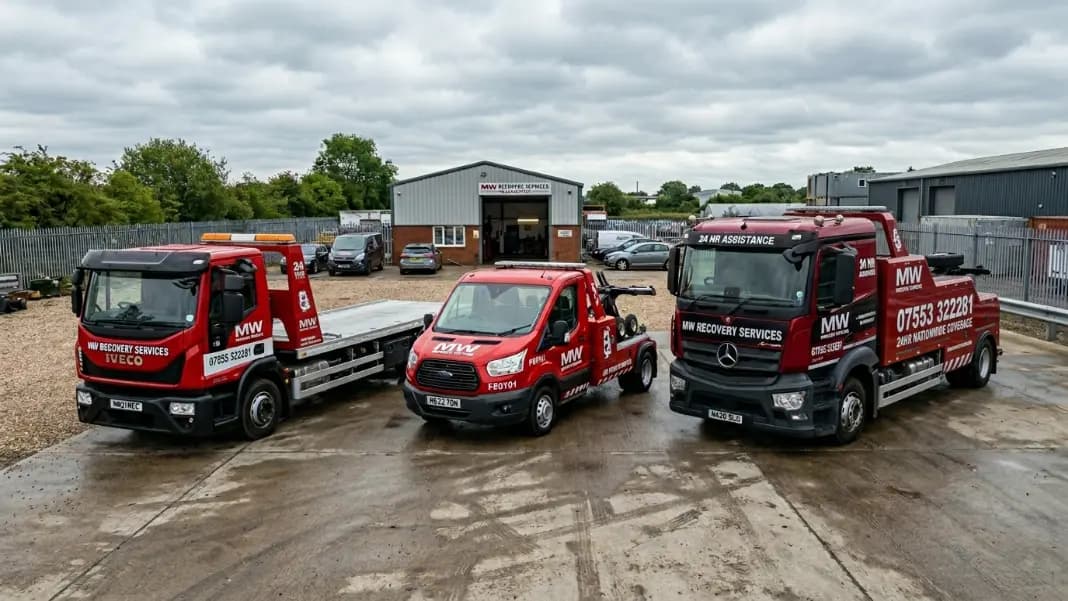
Recovery Truck Types Explained: Flatbed, Wheel-Lift, and Tilt and Slide
Flatbed, wheel-lift, and tilt-and-slide recovery trucks explained, including which type your vehicle needs and why the difference matters.
Table of Contents
When you call a recovery company, you are calling for a truck. But which truck turns up matters more than most drivers realise. The wrong recovery method for your vehicle can cause damage that costs more to fix than the original breakdown. The difference between a flatbed, a wheel-lift, and a tilt-and-slide is not just technical terminology. It is the difference between your car arriving at the garage in the same condition it left the roadside, or not.
This guide explains each truck type clearly, which vehicles each is suited for, and what to check when you book a recovery.
Flatbed recovery trucks
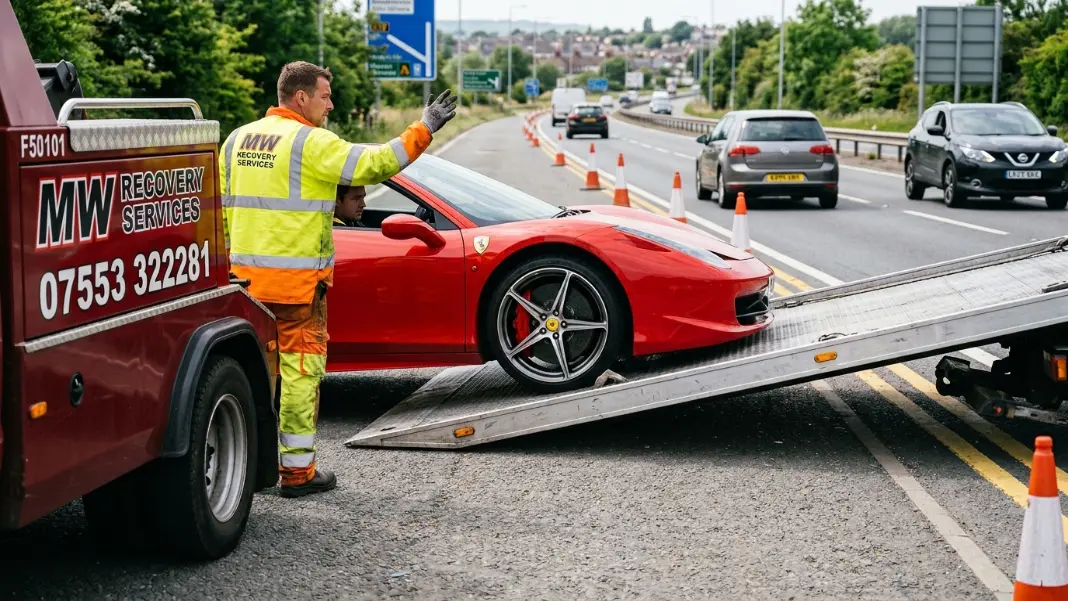
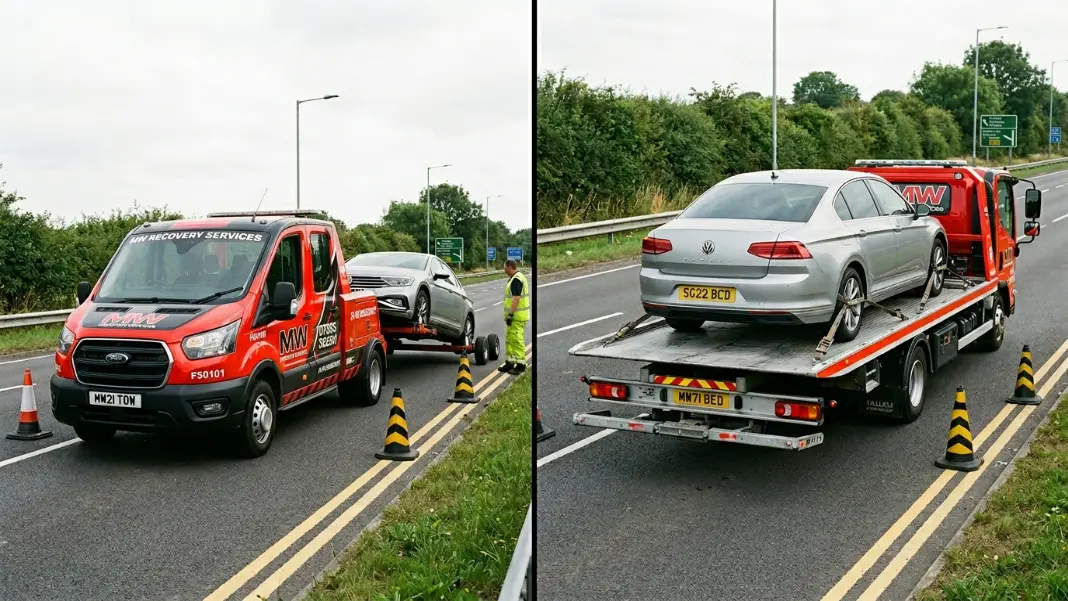
A flatbed recovery truck has a flat loading platform that the vehicle is driven or winched onto, lifting all four wheels completely off the road surface. The vehicle sits on the bed and is secured with straps at multiple points. Nothing touches the road from the moment the car is loaded to the moment it is unloaded at the destination.
This is the method we use at MW Recovery Services for the majority of our callouts, and there are good reasons why.
What flatbed is right for
Automatic gearbox vehicles must be transported on a flatbed. The gearbox pump on an automatic relies on engine power to circulate lubricating fluid. If the driven wheels rotate without the engine running, the transmission operates dry and can be damaged even over a short distance. This applies to standard autos, CVT gearboxes, dual-clutch automatics, and the vast majority of modern new cars, most of which are now automatics.
Electric vehicles must be transported on a flatbed. The electric motor connects directly to the driven wheels with no disconnectable neutral. If the wheels rotate, the motor generates electricity. That back-EMF stresses the motor windings and battery pack. Our EV recovery service uses flatbed only for every electric vehicle, regardless of brand or model.
All-wheel-drive and four-wheel-drive vehicles must be on a flatbed. Dragging an AWD car on a tow with some wheels on the ground puts unequal loads through differentials and transfer cases that are not designed for that kind of stress. The result can be expensive drivetrain damage on top of the original fault.
Vehicles with significant accident damage should be on a flatbed. A car that has been in a collision may have compromised steering, suspension geometry, or structural integrity. Towing it on a dolly or wheel-lift where it needs to track straight and respond to road input is not appropriate. Load it on a flatbed and let it travel passively.
Classic, high-value, and low-clearance vehicles should be on a flatbed. A car with a low front splitter or ground effect bodywork will not load onto a tilt-and-slide without risk of contact damage. A classic car that needs protecting from any further cosmetic or mechanical stress deserves flatbed transport.
The disadvantage of flatbed
Cost and size. A flatbed truck is larger and more expensive to operate than alternatives. For a vehicle that can be safely towed with wheels on the ground, flatbed is sometimes more than is needed. But in the majority of breakdown scenarios on modern vehicle fleets, flatbed is the correct answer.
Wheel-lift recovery trucks
A wheel-lift truck has a metal yoke that slides under the driven or steering axle of the vehicle, lifts those two wheels off the ground, and tows the car with the other two wheels rolling on the road surface. The lifted wheels determine the direction of tow. In a front-wheel-drive car, the front wheels are lifted and the rear wheels roll. In a rear-wheel-drive car, the rear is lifted and the front wheels guide the direction.
What wheel-lift is right for
Wheel-lift is suitable for manual gearbox, front-wheel-drive cars where the driven (front) wheels are lifted. With the driven wheels off the ground and in the air, the gearbox is not being turned by road motion. The car tows safely with the non-driven rear wheels rolling.
It is a faster setup than flatbed in situations where the vehicle can be accessed easily and the job type permits it. For a car that needs moving a short distance, a manual gearbox FWD vehicle, and a straightforward access situation, wheel-lift is practical.
What wheel-lift is not right for
Automatic gearbox vehicles should not be wheel-lifted unless the driven wheels are the ones being lifted. Even then, many manufacturers recommend against it. AWD vehicles should not be wheel-lifted. EVs should not be wheel-lifted. Vehicles with low ground clearance risk body contact with the yoke during setup and transport. It is a more limited method than flatbed and should be used only when it is clearly appropriate.
Tilt-and-slide recovery trucks
A tilt-and-slide truck has a loading platform that both tilts at an angle and slides rearward, allowing the platform to reach close to ground level at the back of the truck. The vehicle is then winched or driven up the inclined platform. Once loaded, the platform slides forward and levels out, and the car sits on the truck bed.
Tilt-and-slide is the most common type of flatbed recovery truck in the UK and the terms are often used interchangeably. The tilt-and-slide mechanism allows loading of vehicles with low ground clearance more easily than a fixed-angle ramp, and the ground-level approach makes winching a heavily damaged or immobile vehicle onto the bed more manageable.
What tilt-and-slide is right for
The same vehicles as flatbed: automatics, EVs, AWD vehicles, damaged vehicles, classics, and any car where having all four wheels off the ground is the right answer. The tilt-and-slide mechanism makes loading easier and reduces the ramp angle that the vehicle needs to climb, which helps with low-slung cars and vehicles that cannot drive themselves onto the bed.
Vehicles that have stopped in awkward positions, at the side of a road rather than in a car park, or on a slight incline, are often easier to load on a tilt-and-slide than a fixed flatbed. The sliding mechanism gives the driver more flexibility in positioning the truck relative to the broken-down car before loading begins.
A-frame and dolly towing
An A-frame fits to the front of a car and attaches it rigidly to the towing vehicle, with the front wheels raised. A dolly is a small two-wheeled trailer that the front wheels of the towed vehicle sit on. Both methods are legal in the UK with a standard licence for appropriate vehicle and weight combinations.
Both are niche options used primarily by motorhome and caravan owners towing a small secondary vehicle, not by professional recovery companies. They have very limited application to breakdown recovery and are not suitable for most modern vehicle types.
Our guide to towing a car in the UK covers A-frame and rope towing rules in detail if you want to understand your options for moving a vehicle without a recovery truck.
Winching: when the vehicle cannot reach the truck
Winching is not a truck type but a method used alongside the truck types above. If a vehicle has gone off the road into a ditch, over an embankment, or into a field, the recovery truck cannot simply back up to it. A winch cable is attached to the vehicle's tow points and the electric or hydraulic winch pulls the car back to firm ground where it can be loaded.
This is a specialist operation that requires knowledge of safe anchor points on the vehicle, the correct cable routing to avoid damage, and awareness of the risks of a cable under tension. At MW Recovery Services, our drivers carry winching equipment and know how to use it correctly. If you have left the road, tell us when you call so we bring the right setup and know what we are dealing with before we arrive.
What to ask when booking recovery
Before you confirm a booking with any recovery company, ask these questions:
- What type of truck are you sending? (Flatbed, tilt-and-slide, or wheel-lift)
- Is my vehicle type suitable for the method you are using?
- If my car is an automatic, AWD, or EV, will it be transported on a flatbed?
- Do you have winching capability if my vehicle is off the road?
A professional operator will answer these clearly. If the company cannot confirm what type of truck they are sending, that is a problem worth knowing before you agree to the callout.
Our flatbed towing service uses tilt-and-slide trucks capable of loading all vehicle types including EVs, automatics, AWD vehicles, and low-clearance cars. See our pricing page for recovery costs by job type, and call 07553 322281 any time for a direct quote from your location.
Frequently Asked Questions
Common questions about this topic
Flatbed or tilt-and-slide, with all four wheels off the ground. Automatic gearbox vehicles must not be towed with driven wheels rolling on the road surface as the gearbox can be damaged without engine-driven fluid circulation. If you are unsure what type of truck a recovery company is sending, ask before confirming the booking.
Need Car Recovery in Manchester?
MW Recovery provides fast, professional breakdown recovery and roadside assistance across all of Greater Manchester. One call and we are on our way.