
Towing a Car: Complete UK Guide
UK rules for towing a car, including licence requirements, speed limits, equipment rules, and when to call a recovery company instead.
Table of Contents
Most drivers never need to tow another car. Until someone breaks down in front of them, or their own car stops and they wonder whether they can sort it with a rope and a willing friend. It is a fair question. Towing a car with another car is legal in the UK, but the rules matter. Getting them wrong can damage both vehicles, cause an accident, or leave you with a fine.
This guide covers what the law actually says, what equipment you need, and the situations where towing it yourself is the wrong call compared to using a professional recovery company.
Is it legal to tow a car with another car in the UK?
Yes. Towing a broken-down vehicle with another car is legal on UK roads, including motorways. There is no law that prohibits it outright. But there are rules covering the rope or bar, the speed limits you must observe, the condition of the towed vehicle, and the driver requirements. Breaking those rules turns a legal activity into an offence.
What your driving licence actually covers
A standard Category B licence, which is what most UK drivers hold, allows you to tow a trailer or broken-down vehicle up to 750kg unbraked. It also permits heavier trailers as long as the combined weight of towing vehicle and trailer does not exceed 3,500kg, and the trailer does not weigh more than the towing vehicle's own kerbweight.
For a typical car-to-car tow with a rope or rigid bar, a standard licence is sufficient. You are not attaching a dedicated trailer. You are towing a vehicle on the road. The important thing many drivers miss: the person in the towed vehicle also needs a valid licence for that vehicle class. They are not a passenger. They are a driver.
If you passed your test after January 1997 and want to tow a trailer heavier than 750kg with a combined weight over 3,500kg, you need an additional B+E entitlement. This rarely applies to emergency car-to-car towing, but it matters if you use a trailer for other purposes.
Speed limits when towing: the rule most drivers get wrong
This is the most commonly ignored rule when towing. Speed limits drop as soon as you attach another vehicle:
- 50 mph on single carriageway roads (not the usual 60 mph national limit)
- 60 mph on dual carriageways and motorways (not 70 mph)
These lower limits apply to the towing vehicle regardless of what the national speed limit is for that road class. On an unrestricted dual carriageway where cars normally do 70 mph, your limit is 60 mph the moment another vehicle is attached. On a single carriageway where cars normally do 60 mph, your limit drops to 50 mph.
Many drivers tow at normal motorway or dual carriageway speeds without knowing the limit has changed. The lower limit applies from the moment you have another vehicle connected.
Tow ropes vs rigid tow bars
Both are legal. The difference in practice is significant.
A tow rope has some give in it, which means the distance between vehicles fluctuates as you accelerate and brake. The towed car drifts slightly as the rope goes taut and slack. This keeps the driver of the towed vehicle very busy and requires good communication and coordination. Ropes are inexpensive and easy to store, which is why they are common. But they require more skill to use safely.
A rigid tow bar keeps the distance constant and removes the slack-and-snap effect. It is gentler on both vehicles, easier for a less experienced towed-vehicle driver, and better suited to longer distances. The downside is cost and size. A decent rigid bar costs more than a rope and takes up more space.
Both must be attached securely at designated tow eyes, not bumpers or random structural points. A tow rope or bar must be no longer than 4.5 metres between the two vehicles. If it is longer than 1.5 metres, you must display a clearly visible white flag or marker so other road users can see the connection between the vehicles.
When towing with a rope is the wrong answer
Not every breakdown can safely be sorted with a rope and a helpful friend. Several situations make rope towing genuinely dangerous or likely to cause further damage.
Automatic gearbox vehicles
This is the most common mistake people make. If you tow a car with an automatic gearbox and the engine is off, the driven wheels rotate without the gearbox pump running. That pump circulates fluid that lubricates and cools the transmission. Without it, towing an automatic even a short distance can cause serious gearbox damage. Some modern automatics have a transport or neutral mode that reduces this risk, but not all do, and most drivers do not know their car's specific requirements. The safe position is: do not rope-tow an automatic.
All-wheel-drive and four-wheel-drive vehicles
AWD vehicles face the same fundamental problem across multiple driven axles. Towing with only some wheels on the ground can stress differentials and transfer cases. The only safe method for an AWD or 4x4 that cannot drive under its own power is flatbed recovery with all four wheels off the road surface.
Electric vehicles
An EV cannot be towed with its driven wheels on the ground. The electric motor connects directly to the driven wheels and generates electricity if those wheels rotate. This back-EMF can damage the motor windings and put stress on the battery pack. Tesla, Nissan Leaf, and all other EV platforms should only be moved by flatbed. Our EV recovery service covers all electric vehicle makes across Greater Manchester.
Vehicles with brake or steering problems
If the towed vehicle's brakes are not working, the driver inside has almost no ability to react in an emergency. A tow rope provides no braking assistance from the front vehicle. A car with failed power steering is similarly difficult to control. If the mechanical fault affects the vehicle's ability to be steered or stopped, flatbed recovery is the only safe option.
Rules for the driver in the towed vehicle
The person steering the towed car has real responsibilities, not just a passenger role. They need a valid licence for the vehicle class. They must actively steer and use the brakes. Passengers are not permitted in the towed vehicle under any circumstances.
Hazard lights must be on throughout the journey. If they do not work because the electrical system is dead, this is a sign the vehicle is not safe to rope-tow on a public road. Other drivers behind need warning that this vehicle is not moving normally.
Both drivers need to agree their signals and their plan before setting off. What does a horn or headlight flash from the towing driver mean? Where are you stopping? How long is the journey? Agreeing this before moving saves problems once you are on the road.
Towing on a motorway
Legal, but worth treating with respect. At motorway speeds, the reaction times available to the towed-car driver if something goes wrong are short. The speed differential between your 60 mph and the 70 mph traffic around you is manageable, but it requires the towed car's driver to be experienced and focused.
Most practical advice points towards calling a professional recovery company for motorway situations rather than attempting a tow from the hard shoulder. Setting up a rope tow from a hard shoulder in moving traffic is a genuinely hazardous operation. Our M60 motorway recovery service operates around the clock and reaches most motorway locations within 20 to 35 minutes. The same applies across the M62 and other Greater Manchester motorways.
What flatbed recovery does differently
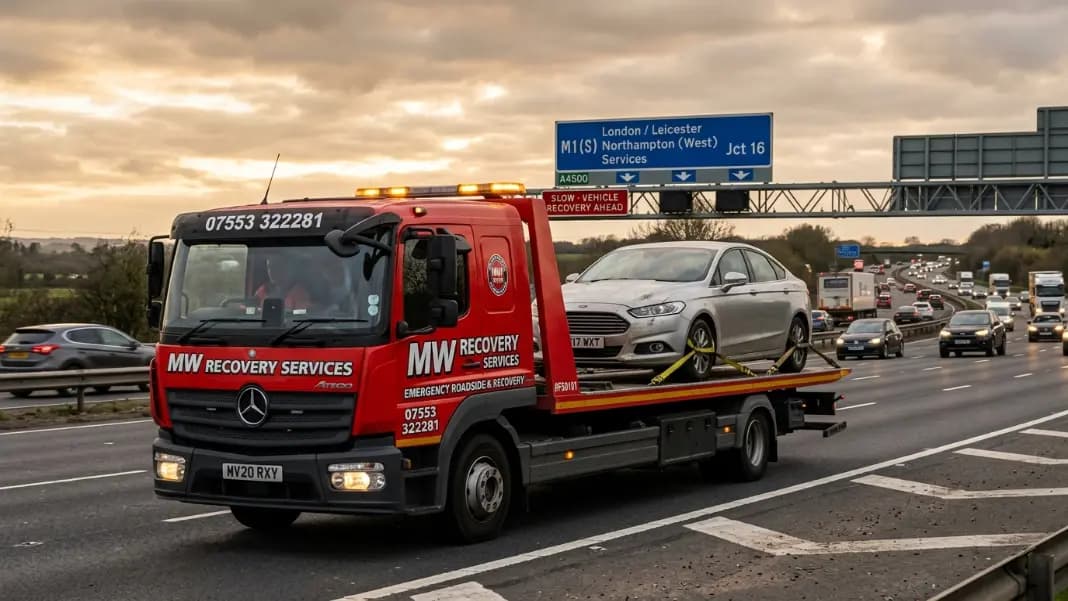
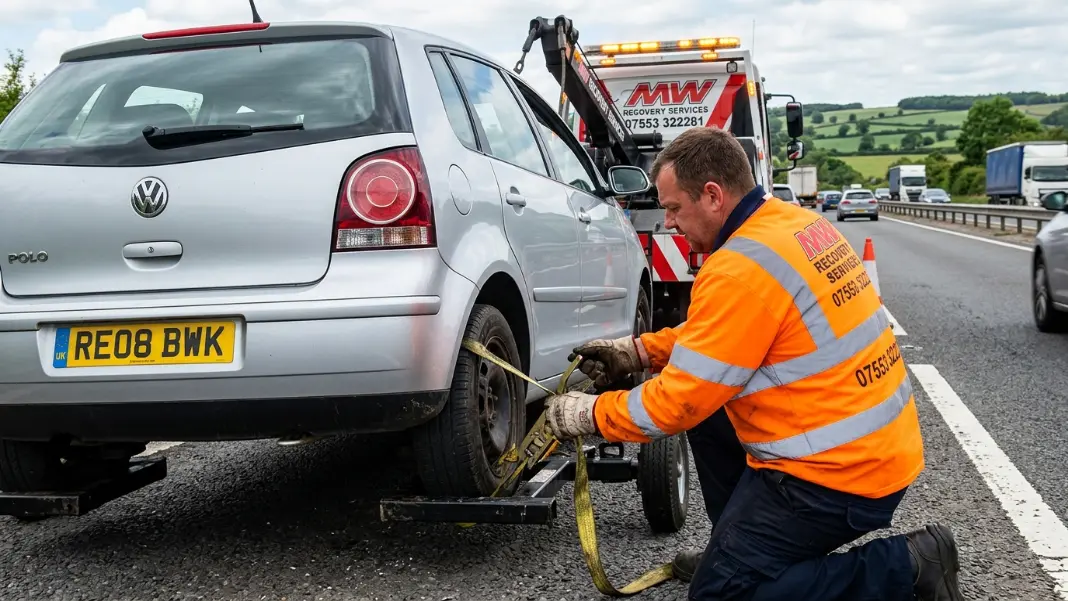
A flatbed truck loads the vehicle completely onto the bed with all four wheels clear of the road. The car is secured with straps and transported with none of its own mechanical systems under any load. No drivetrain stress. No requirement for a second driver. No speed limit complications.
This is the correct method for automatics, AWD vehicles, EVs, vehicles with significant damage, and any situation where the car's brakes or steering are compromised. It is also faster to organise than finding a second driver and sourcing a tow rope.
The cost is lower than many people expect. Our car recovery pricing page gives real figures for common jobs across Greater Manchester, including local tows and longer-distance recoveries. For most drivers, the difference between a professional callout and a failed DIY tow attempt is smaller than they assume.
If you are unsure whether to tow it yourself or call us, our guide to breakdown recovery and breakdown cover explains how calling directly works and what to expect when you do.
When to call a recovery company rather than tow yourself
Use this as a quick check. If you can honestly answer yes to all of these, a rope tow might be workable:
- The towed vehicle has a manual gearbox
- The towed vehicle is not AWD or an EV
- The towed vehicle's hazard lights work
- The towed vehicle's brakes and steering are functioning
- You have a proper tow rope or bar with correct attachments
- You have an experienced second driver for the towed car
- The distance is short and on familiar roads you know well
If any of those is a no, call a recovery company. The cost of a professional callout is far less than gearbox repair on a damaged automatic. MW Recovery Services covers all of Greater Manchester, 24 hours a day, with no membership requirement. Call 07553 322281 and give us your location for an immediate quote.
Frequently Asked Questions
Common questions about this topic
No. Towing an automatic gearbox vehicle with its driven wheels on the ground risks serious transmission damage. Without the engine running, the gearbox pump cannot circulate fluid to lubricate and cool the transmission. Automatic vehicles must be transported on a flatbed with all wheels off the ground.
Need Car Recovery in Manchester?
MW Recovery provides fast, professional breakdown recovery and roadside assistance across all of Greater Manchester. One call and we are on our way.