
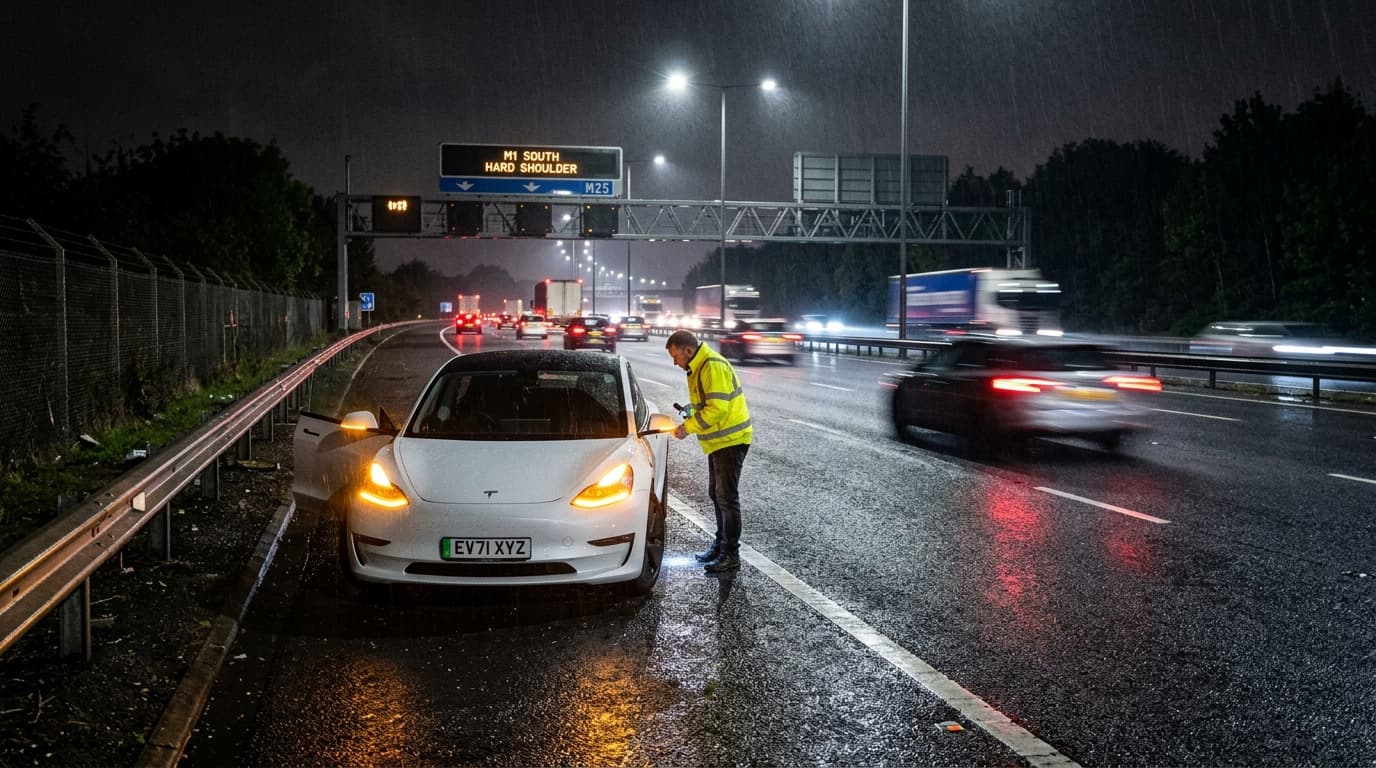
Electric Vehicle Breakdown Recovery Manchester: What to Do When Your EV Breaks Down
Electric vehicles need specialist recovery. Learn what to do when your EV breaks down in Manchester, why flatbed-only recovery matters, and where the city's EV charging dead spots are.
Table of Contents
Electric vehicles are now a familiar sight on Manchester's roads. From Teslas on the M60 to Nissan Leafs parked outside MediaCityUK and Hyundai Ionics navigating the Northern Quarter, EV ownership across Greater Manchester has grown sharply over the past three years. And as the number of EVs grows, so does the number of EV breakdowns.
The issue that catches many drivers by surprise is that electric vehicle recovery is not the same process as conventional car recovery. Get it wrong and you risk expensive drivetrain damage. This guide covers what causes EV breakdowns in Manchester, where the charging dead spots are, and exactly what to do if your electric vehicle breaks down anywhere in Greater Manchester.
How EV Breakdowns Differ from Petrol and Diesel Breakdowns
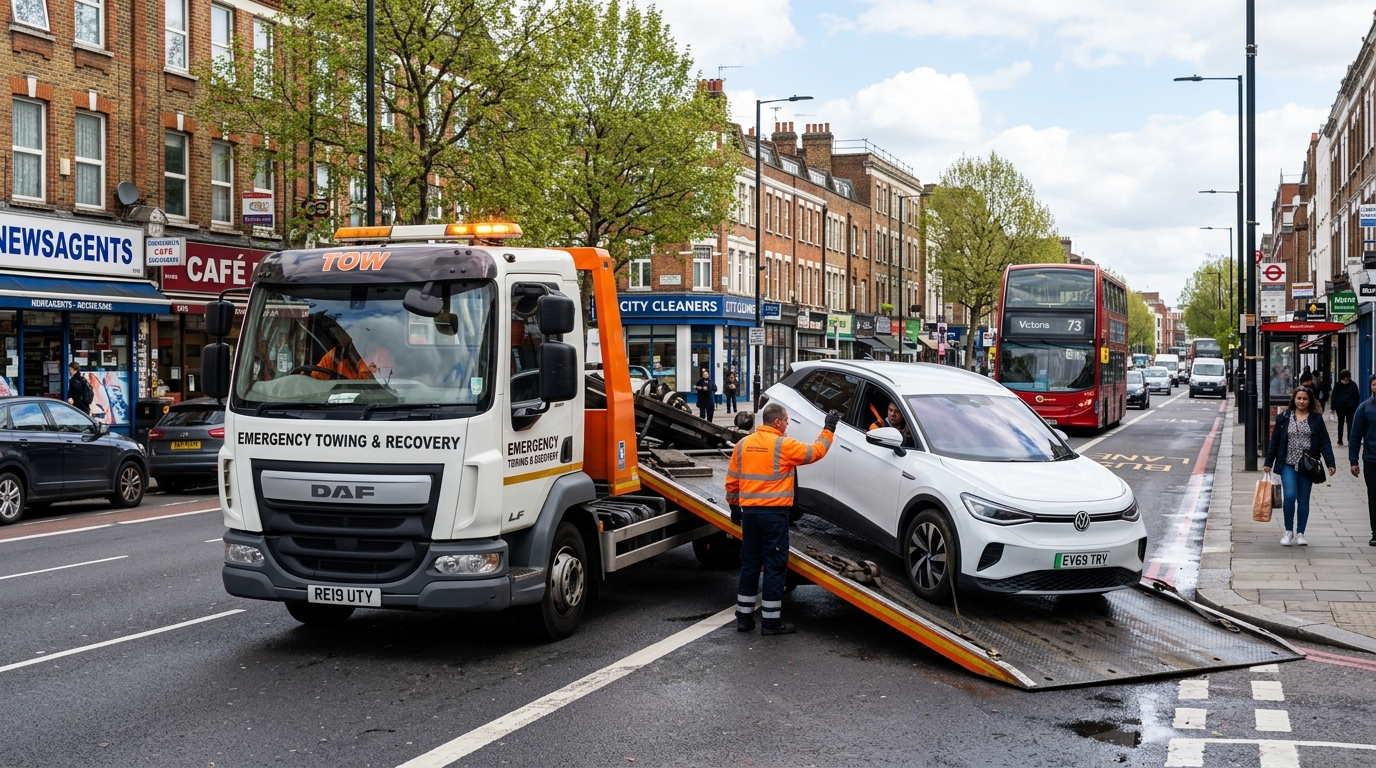
When a petrol car stops working, a recovery operator can hitch it up with a tow rope or lift the front wheels and drag it to a garage. With most electric vehicles, that approach will cause serious damage.
The reason comes down to how electric motors work. When an EV's wheels turn while the motor is off, the motor acts as a generator and feeds energy backwards through the drivetrain. In some cases this is a designed feature called regenerative braking. In the wrong context, specifically when being flat-towed, it generates heat and resistance that can destroy motor bearings, overheat components, and void the manufacturer warranty in a single recovery job.
The industry standard for EV recovery is a flatbed truck that carries all four wheels off the ground. Some vehicles also need to be placed in a transport mode before loading. Our breakdown recovery service uses flatbed vehicles for all EV recoveries, and our team is trained on the loading and transport requirements for the most common EV makes on UK roads.
The Main Reasons Electric Vehicles Break Down in Manchester
Traction Battery Running Flat
Running out of charge is the obvious concern for EV drivers and it is also the most manageable one if you plan ahead. The difficulty in Greater Manchester is that rapid charging infrastructure has not kept pace with EV adoption. While supermarket car parks and retail parks increasingly have charge points, finding a rapid charger that is available, working, and accessible without a long detour from the motorway is harder than it should be.
Cold weather makes this worse. An EV that delivers 250 miles of range in a warm summer will often drop to 180 to 200 miles in a cold Manchester January. Drivers accustomed to summer range figures get caught out during winter months, particularly on longer trips between towns or on unfamiliar routes.
12-Volt Auxiliary Battery Failure
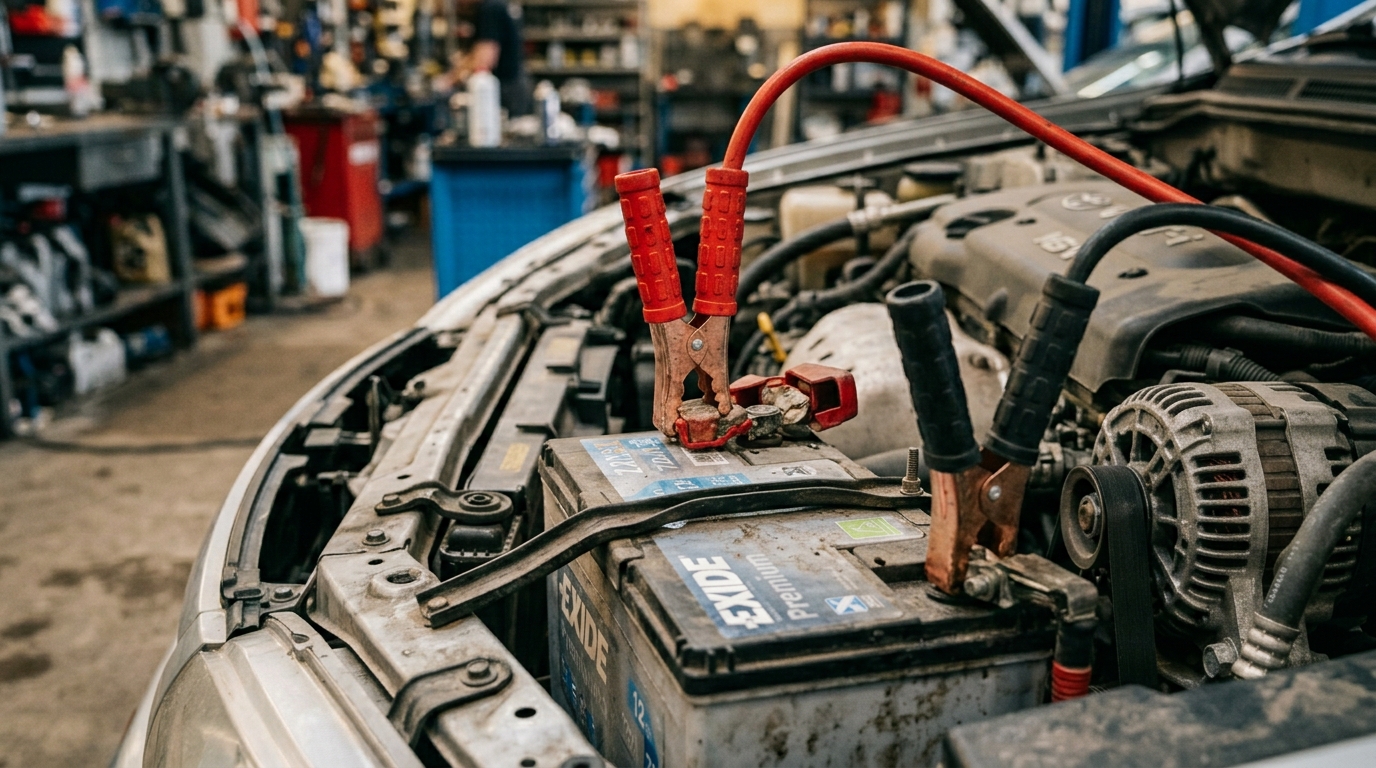
This is the breakdown that surprises most EV owners. Alongside the large traction battery that powers the motor, every electric vehicle also has a small 12-volt auxiliary battery. This powers lights, the central locking, infotainment, windows, and other ancillary systems.
When this auxiliary battery fails, the car can appear completely dead even if the traction battery has 80% charge remaining. The car will not unlock, will not start, and may not respond to the key fob at all. Many drivers assume the traction battery is the problem when the fix is often a straightforward 12-volt battery replacement or a jump start service.
These auxiliary batteries have a similar lifespan to conventional car batteries, typically three to five years, and they should be treated as a routine maintenance item rather than an afterthought.
Tyre Failures
Electric vehicles are heavier than their petrol equivalents because of the battery pack. A Tesla Model 3 weighs around 1,800 kilograms. A comparable BMW 3 Series is closer to 1,500 kilograms. That additional weight means tyres wear faster and are under greater stress, particularly during hard acceleration which EVs can deliver very quickly from a standstill.
Many EVs also use low-rolling-resistance tyres to maximise range. These tyres are optimised for efficiency rather than durability and are more vulnerable to punctures and blowouts, especially on Greater Manchester's road surfaces which vary significantly between the motorway network and the older residential streets of places like Rochdale, Oldham, and Leigh.
A large proportion of EVs do not come with a spare tyre. You get a repair kit for small punctures but nothing for a blowout or sidewall damage. If you need roadside tyre assistance, a wheel change service near you is what you need.
Software and System Faults
A modern EV is more computer than car. Software faults, failed updates, sensor errors, and module failures can all render the vehicle undriveable even when there is nothing mechanically wrong with it. These faults are particularly frustrating because they can be impossible to diagnose or clear without specialist dealer equipment.
When a software fault locks a vehicle, flatbed recovery to the nearest dealer or authorised service centre is usually the only option. Our team covers all dealership and service centre routes across Greater Manchester and can transport your vehicle directly to wherever it needs to go.
EV Charging Dead Spots in Greater Manchester
If you drive an electric vehicle regularly in and around Manchester, these are the locations where you are most likely to run into charging problems.
The M60 Ring Road
The M60 is the busiest orbital motorway in the UK outside London. Rapid EV charging directly accessible from the motorway without a significant detour is sparse between several junctions. The stretch from Junction 10 near Stretford through to Junction 15 near Oldham is particularly light on accessible rapid chargers.
If you are planning a journey that will take you around the M60 with less than 30% charge, plan your charging stop carefully and account for the possibility that your first-choice charger is occupied or out of service.
Trafford Centre
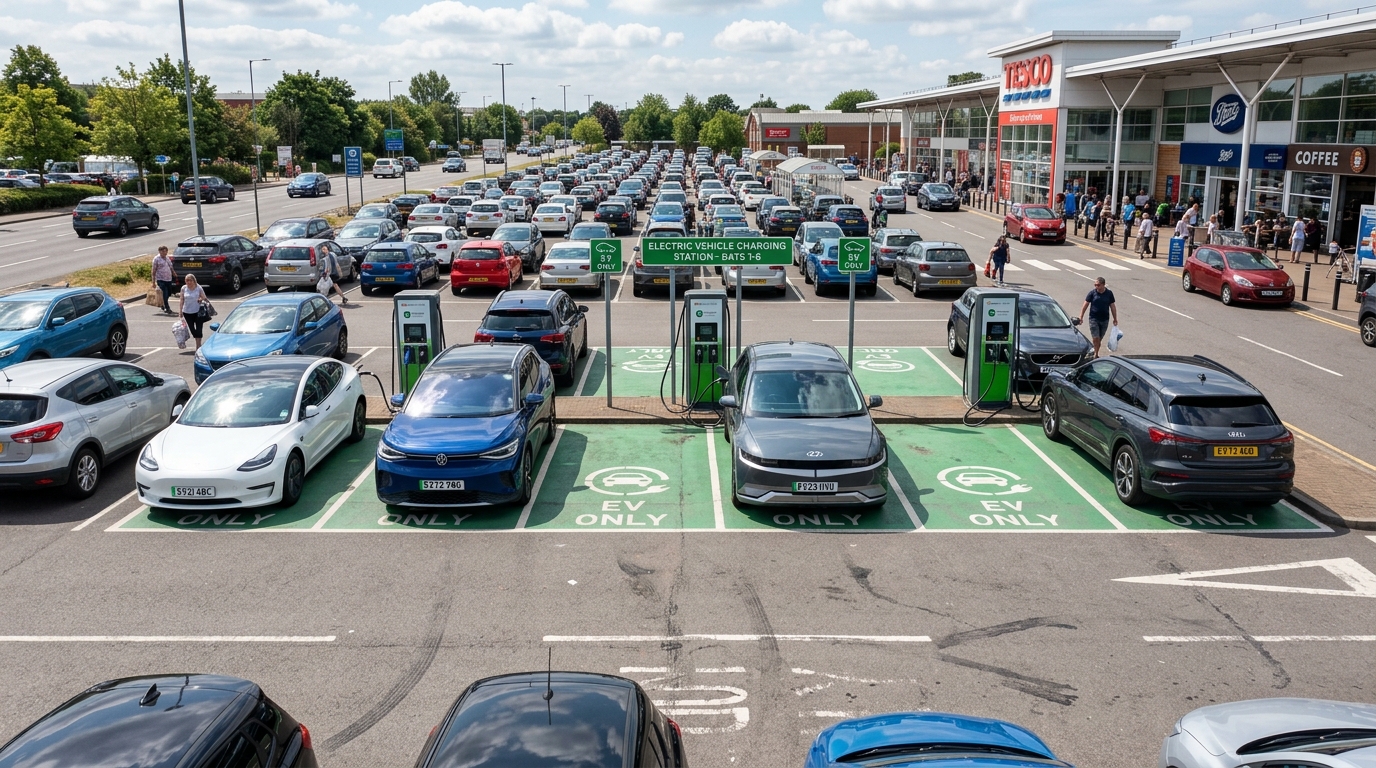
Trafford Centre has EV charging bays but they are consistently among the most heavily used in the region. On weekends and evenings, all bays are frequently occupied and queues form. Charger reliability has also been an issue at various times, with some units running at lower speeds than advertised or showing as available on apps while actually being out of order.
If you plan to charge at Trafford Centre, build in extra time and have a backup location in mind before you arrive.
Salford Quays and MediaCityUK
Salford Quays has a growing number of EV drivers but charging provision has lagged behind. The MediaCityUK area has some charging but it is not always available to the general public. Overnight home charging is the standard approach for residents here, which means drivers who forget to plug in at night face morning problems with no quick fix nearby.
What to Do When Your EV Breaks Down
Get Safe First
If you lose power on the motorway, your first priority is reaching the hard shoulder or an emergency refuge area before the vehicle stops completely. The power steering and brakes on most EVs still function for a short time after the motor cuts out, but they will require more effort than usual. Signal early, move across lanes carefully, and get as far left as possible.
Once you are safely off the carriageway, switch on hazard lights, exit the vehicle on the passenger side if possible, and move behind the barrier away from traffic. Do not stand at the rear of your vehicle. Call for assistance from that safe position.
On a regular road, pull up as close to the kerb as you can, switch on hazards, and call for help.
Check for a Transport or Tow Mode
Some manufacturers, most notably Tesla, provide a specific mode that disables the motor resistance and allows the vehicle to be loaded onto a flatbed without drivetrain stress. On Tesla vehicles this is found in the Controls menu on the touchscreen. Check your vehicle handbook before the recovery operator arrives and mention it when you call so we can advise on the exact procedure for your model.
Do Not Attempt to Push the Vehicle
Electric motors create resistance when the vehicle is pushed without power. This makes pushing an EV much harder than pushing a petrol car and potentially dangerous on any gradient. Leave moving the vehicle to the recovery operator and their equipment.
Call a Flatbed-Equipped Recovery Service
Not every recovery operator carries flatbed trucks or understands EV-specific requirements. Before you call, confirm that the operator uses flatbed vehicles for electric vehicles. MW Recovery dispatches flatbed trucks for all EV recoveries across Greater Manchester motorways and surrounding roads. Call us on 07553 322281 any time of day or night.
Tesla Breakdown Recovery in Manchester
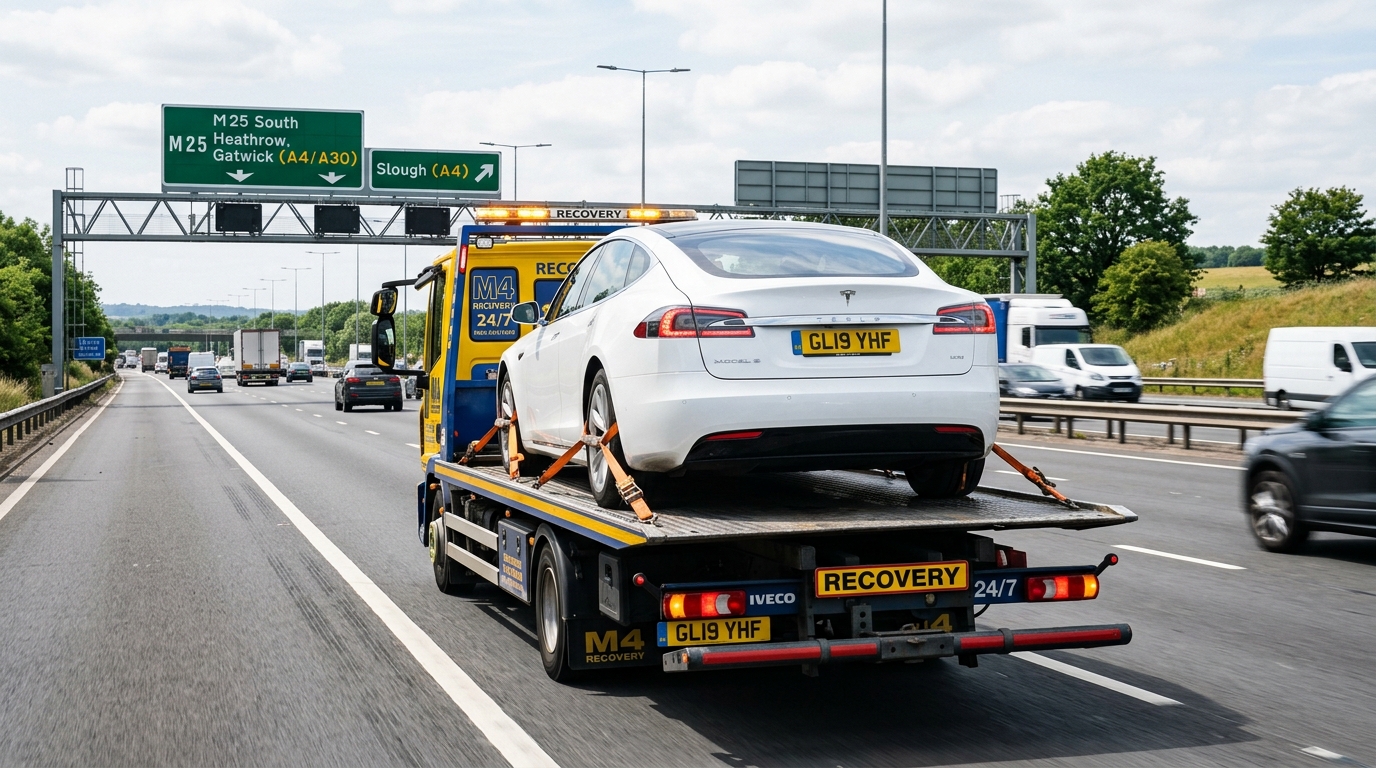
Tesla is the most common EV brand we recover across Greater Manchester. A few Tesla-specific points are worth knowing before a breakdown happens.
On many Tesla models including the Model 3 and Model Y, the boot cannot be opened when the 12-volt battery is dead because the boot latch is electrically operated. There is a manual release cable in the rear footwell area that allows emergency access. Your Tesla handbook covers the exact location for your model.
Tesla's recommended towing procedure varies by model. On any Model S, Model X, Model 3, or Model Y, transport mode should be activated before flatbed loading where possible. Flatbed remains the safest option for all distances.
Hybrid Car Recovery in Manchester
Hybrid vehicles are not fully electric but they share some characteristics that affect recovery. Standard petrol-electric hybrids such as the Toyota Yaris Hybrid or Honda Jazz Hybrid can generally be flat-towed short distances on their front wheels, but always verify with your manufacturer's guidance because the rules vary between models.
Plug-in hybrids have larger battery packs and more restrictive towing requirements in some cases. As a general rule, inform your recovery operator that the vehicle is a hybrid or PHEV so they can confirm the correct procedure before attending.
EV Recovery Cover and Your Insurance
One area many EV owners overlook is whether their existing breakdown cover actually handles electric vehicles correctly. Many policies include the language "recovery by flatbed where necessary" but it is worth checking specifically whether your insurer or breakdown provider will dispatch a flatbed for an EV as a default rather than only after other methods have been attempted and failed.
Standard roadside assistance memberships from major providers sometimes default to tow-bar recovery on their first response and only escalate to flatbed if the operator on the ground requests it. This can add significant time to your recovery and, in the worst case, result in damage if the initial operator is not familiar with EV requirements.
If you are not confident your existing cover handles EV recovery correctly, keeping MW Recovery's number saved in your phone gives you a direct line to an operator who will always dispatch the right vehicle for an electric car. For car recovery near you across Greater Manchester, call 07553 322281 any time.
Preventing EV Breakdowns in Manchester
A few straightforward habits reduce your risk of getting stuck.
Plan routes with charging in mind, particularly for longer journeys. On motorway routes, identify rapid chargers in advance using apps like Zap-Map. Do not rely on a single charger being available or working when you arrive.
Keep the 12-volt auxiliary battery in good condition. Some EV manufacturers recommend replacing it every three to five years, similar to a conventional car battery. If your car is showing slow responses on the central locking or infotainment, have the 12-volt battery tested before it fails completely.
Keep tyres inflated to the correct pressure. EV tyres carry more load than equivalent petrol car tyres and underinflation significantly increases blowout risk. Check pressures at least monthly and always before a motorway journey.
Frequently Asked Questions
Can you tow an electric car?
Most electric vehicles should only be transported on a flatbed truck with all four wheels off the ground. Flat-towing with two wheels on the ground can cause drivetrain damage on most EV models. Some vehicles have a transport mode that reduces risk during loading but flatbed remains the recommended method for nearly all EVs on UK roads.
What happens if my EV runs out of charge on the motorway?
Move to the hard shoulder or emergency refuge area if you have enough power remaining, switch on hazard lights, and call for recovery. Do not attempt to push the vehicle. A flatbed recovery truck will load your car and take it to the nearest compatible charger or your chosen destination.
How long does EV recovery take in Manchester?
MW Recovery aims to reach central Manchester and Salford within 30 to 45 minutes. For outer areas of Greater Manchester such as Bolton, Rochdale, or Leigh, the target is within the hour. Response times extend during periods of high demand, severe weather, or Bank Holidays.
Can you jump start an electric vehicle?
The main traction battery cannot be jump started in the conventional sense. However, the 12-volt auxiliary battery can be jump started or replaced in the same way as any car battery. This resolves the situation in many cases where the car appears completely dead but the traction battery still holds a charge.
Does MW Recovery cover all electric vehicle brands?
Yes. We recover all makes and models of electric vehicles across Greater Manchester, including Tesla, Nissan, Renault, Hyundai, Kia, BMW, Volkswagen, and others. Call 07553 322281 and let us know your make and model so we can confirm the correct recovery procedure for your vehicle.
Related Reading
- Motorway Breakdown Recovery: What To Do
- Tyre Blowout on the Motorway in Manchester
- Car Recovery Cost UK 2025: Full Pricing Guide
If your electric vehicle has broken down anywhere in Greater Manchester, call MW Recovery on 07553 322281. We are available 24 hours a day, 7 days a week, with flatbed trucks ready to recover your EV safely to wherever you need it.
Need Car Recovery in Manchester?
MW Recovery provides fast, professional breakdown recovery and roadside assistance across all of Greater Manchester. One call and we are on our way.