
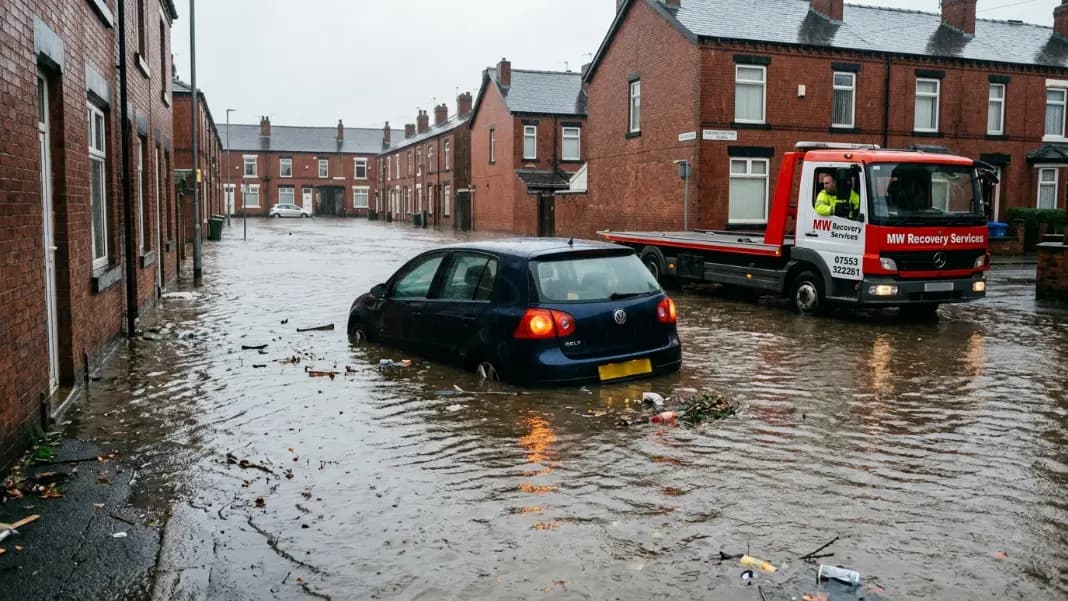
Flood Damaged Car Recovery Manchester: What to Do After Your Car Gets Waterlogged
Manchester flooding can destroy a car in minutes. This guide covers what happens when a car is waterlogged, the mistakes to avoid, when to call recovery not breakdown, and how to manage insurance and storage after a flood event.
Table of Contents
Manchester has experienced significant flooding events in recent years, with the River Irwell, River Mersey, and their tributaries all having caused road closures and vehicle damage across Greater Manchester. Every time flood levels rise, drivers make the same mistakes: they attempt to drive through standing water that turns out to be deeper than it looked, and they pay for it with a stalled, waterlogged, or write-off vehicle.
If your car has been caught in floodwater, either by driving through it or by being submerged while parked, this guide covers exactly what to do, what to avoid, when you need recovery rather than a breakdown callout, and how to manage the insurance and storage process that follows.
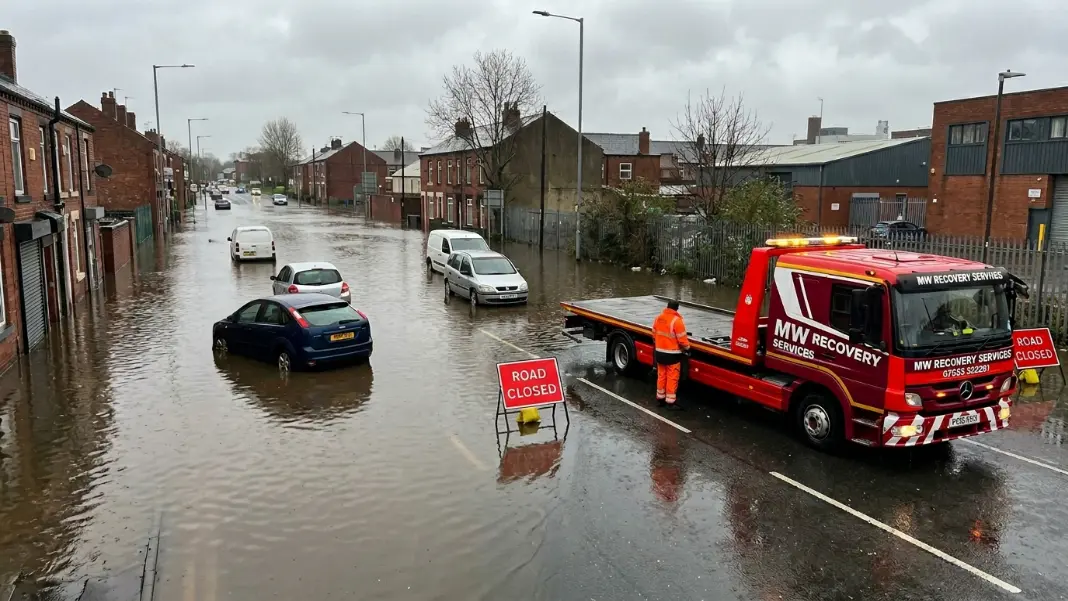
Manchester and Flooding: The Local Reality
Greater Manchester sits in a river-heavy landscape. The Irwell runs through the heart of Salford and Manchester. The Mersey flows through Stockport, Sale, and Trafford. The Medlock, Irk, Tame, and Roch all contribute to flood risk across different parts of the borough network. In December 2015, Storm Eva brought severe flooding to Rochdale, Bury, Bolton, and Salford. Storm Ciara in February 2020 caused widespread road closures across the region. These are not once-in-a-generation events.
The roads most frequently affected by flooding in Greater Manchester include the A580 East Lancashire Road at its lower-lying sections, underpasses and dips on urban A-roads, several sections of the A57 corridor, and residential roads adjacent to flood plains across Salford, Eccles, and the Mersey Valley. If you regularly drive through any low-lying area of Greater Manchester, understanding flood water risk is genuinely practical knowledge.
What Happens When a Car Drives Through Floodwater
The risks from driving through floodwater are more varied than most drivers realise. The most dramatic failure mode is hydrolock, where water is drawn into the engine through the air intake. When water enters a combustion engine, it causes the pistons to try to compress a fluid that cannot be compressed. The connecting rods bend or break, and the engine is destroyed. This can happen in seconds on a modern car whose air intake is positioned low on the front bumper.
However, hydrolock is not the only risk. Electrical damage is increasingly a problem on modern vehicles, which have significantly more electronic control units than cars from 20 years ago. Water ingress to the ECU, transmission control unit, ABS module, or other electronics can cause failures that appear days after the event. The water itself does the initial damage, but corrosion from dried residue causes secondary failures over the following weeks.
Brake failure is a more immediate risk. Water entering the brake drums or disc assemblies temporarily reduces braking effectiveness. After driving through any standing water, pump the brakes several times while at low speed to dry the pads and discs. If braking feels spongy or reduced, do not accelerate until normal braking is restored.
Transmission damage can occur when water enters automatic or manual gearboxes through breathers or seals. For automatic vehicles specifically, this is a serious risk, as automatic transmission fluid contaminated with water loses its lubricating properties rapidly. We cover this in more detail in our guide to automatic gearbox car recovery.
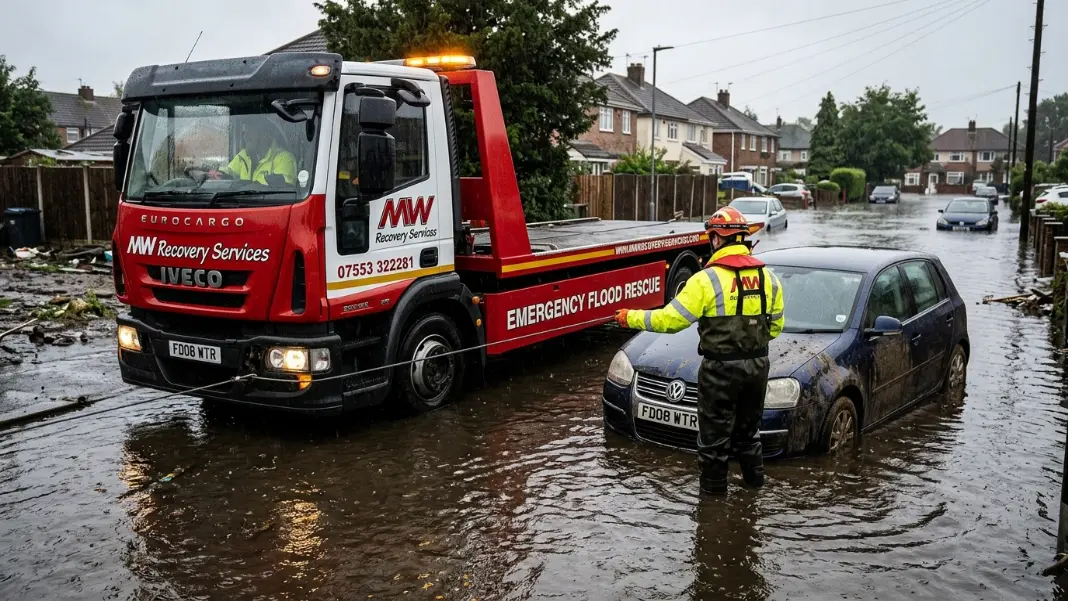
Warning Signs That Your Car Has Flood Damage
If you have driven through floodwater or your car has been submerged while parked, look for these signs before attempting to drive:
- A water line visible on the interior door cards, seats, or dashboard
- Wet carpets or a damp smell inside the vehicle
- Water visible in the footwells
- The engine management light appearing after the event
- Unusual engine behaviour, misfires, or rough running
- Electrical items behaving erratically: windows, dashboard lights, audio system
- A milky appearance to the oil on the dipstick, indicating water contamination
- Discolouration or a white residue on electrical connectors
Any of these signs after a flood event means the vehicle should not be driven. The damage may not be immediately apparent when the engine first starts, but driving a flood-damaged vehicle before it has been properly assessed risks turning a repairable car into a write-off.
What NOT to Do After Your Car Gets Waterlogged
The mistakes drivers make after a flood event often cost more than the original flooding itself. The most important things to avoid are:
Do not try to start the engine. If the engine has water in the cylinders and you try to start it, you risk causing hydrolock damage even if the engine did not seize initially. Turn the ignition to accessories and check warning lights without cranking the engine. Only attempt to start once a mechanic has confirmed the engine is clear of water.
Do not drive on a waterlogged car. Even if the engine starts and appears to run normally, electrical damage may cause failures at any moment. Brake systems may be compromised. The safe approach is to have the vehicle assessed before it moves under its own power.
Do not assume the car is fine because it started. Post-flood engine failures can occur hours or days after the event, as water-contaminated oil reaches critical components. Electrical failures triggered by corroding contacts can appear days later. A clean start after a flood event is not a clean bill of health.
Do not leave the car standing in residual water any longer than necessary. Extended immersion causes significantly more damage than brief contact. If the car is in a flooded garage or parked area, recover it to dry ground as quickly as possible even if it is not being assessed immediately.
When You Need Recovery, Not Breakdown Assistance
There is an important distinction between a breakdown callout and a recovery job when it comes to flood-damaged vehicles. A breakdown technician attends to diagnose and repair a fault at the roadside. A recovery operator attends to move a vehicle that cannot or should not be driven.
A flood-damaged car should be treated as a recovery job from the outset. The vehicle needs to be moved to a dry, secure location where it can be properly assessed, drained, and dried. A breakdown technician attempting to repair a flood-damaged vehicle at the roadside in a flooding event is not the appropriate response. Call a recovery operator and tell them the vehicle has flood damage and should not be started or driven.
Our breakdown recovery and accident recovery teams handle flood-damaged vehicles on flatbeds, without starting or driving the car, and deliver to a workshop, compound, or other secure location of your choice. Our flatbed towing Manchester service is the correct tool for any car that has been submerged or significantly waterlogged.
For electric vehicles caught in flooding, the risks are additional and more serious. Water ingress into a high-voltage battery pack creates a risk of electrocution and fire. An EV that has been submerged should be treated with extreme caution, and the recovery operator should be told immediately that the vehicle is electric. See our EV recovery Manchester service for EV-specific flood recovery.
Insurance, Storage, and What Comes Next
A flood-damaged vehicle is typically assessed by your insurance company before any repair work proceeds. Call your insurer immediately after the flood event, before the vehicle is moved if possible, so they can document the situation. Most comprehensive policies cover flood damage, but excesses apply and the insurer may declare the vehicle a write-off if water damage is extensive.
If the vehicle needs to be stored while awaiting an insurance assessment, confirm the daily storage rate with the recovery operator before agreeing to storage. As we cover in our guide on what is included in a car recovery quote, storage charges accumulate daily and can become substantial if the insurance assessment takes several days. Ask your insurer how quickly they can arrange an assessor visit and factor this into your storage decisions.
Our accident management team can assist with the coordination between recovery, storage, and insurance assessment, reducing the number of separate conversations you need to manage in what is already a stressful situation.
Flood Recovery Across Greater Manchester
We provide flood damage recovery across all areas of Greater Manchester, including locations most frequently affected by flooding events. Whether you are in Salford, Bolton, Rochdale, Manchester city, or any of the low-lying river valley areas across the region, our flatbed vehicles are available around the clock to recover flood-damaged vehicles safely.
For more information on whether your insurance covers recovery in flooding situations, see our guide to does car insurance cover breakdown recovery. To arrange immediate recovery of a flood-damaged vehicle, contact us via our contact page or call directly.
Frequently Asked Questions
How deep does water need to be to damage a car engine?
As little as 15 to 30 centimetres of fast-moving water can be enough to cause hydrolock on a car with a low-mounted air intake. Still water requires greater depth, typically 45 centimetres or more for most modern cars, but the risk varies considerably by vehicle type. SUVs with higher ground clearance have greater tolerance than low-slung hatchbacks.
Can a flood-damaged car be repaired?
It depends on the extent of the damage. Vehicles that have experienced surface water contact without significant ingress can often be dried and cleaned without lasting damage. Vehicles with water ingestion into the engine, gearbox, or electronics face significantly higher repair costs, and insurers frequently write off heavily flood-damaged vehicles. A professional assessment is essential before any repair decision.
Does car insurance cover flood damage in the UK?
Comprehensive car insurance policies typically include accidental damage from flooding. Third-party only policies do not cover your own vehicle in any circumstances. Fire, theft, and third-party policies may not include flood damage. Check your policy documents specifically for flood or water damage cover and for exclusions relating to driving knowingly through standing water.
What is a category S or category N flood write-off?
If an insurer writes off a flood-damaged vehicle, it is categorised based on the damage level. Category S means structurally damaged but repairable. Category N means non-structurally damaged but an economic write-off. Both categories are recorded on the vehicle's history. A Category S or N marker significantly affects resale value and may affect future insurance premiums.
How soon after a flood event should I arrange recovery for my car?
As quickly as possible. Every hour a vehicle remains in or adjacent to flood water extends the damage. Electrical components, carpets, and upholstery absorb moisture over time, increasing the scope of damage. If the vehicle is accessible, arrange recovery within hours of the flood receding rather than waiting days.
Manchester flooding is a recurring reality rather than an exceptional event, and drivers who understand the risks of floodwater are far better placed to protect their vehicles when conditions deteriorate. The core rules are simple: do not drive through water if you cannot see the bottom, do not start a vehicle that has been submerged, and treat any flood-damaged car as a recovery job rather than a breakdown. For immediate flood damage recovery anywhere across Greater Manchester, our team is available around the clock.
Need Car Recovery in Manchester?
MW Recovery provides fast, professional breakdown recovery and roadside assistance across all of Greater Manchester. One call and we are on our way.