
Motorcycle Breakdown on a Motorway: What You Must Do
Breaking down on a motorway on a motorcycle is one of the most dangerous situations a UK rider faces. This guide covers the exact steps to take, how to stay safe, and why motorcycles always need specialist flatbed recovery.
Table of Contents
A motorcycle breakdown on a motorway is one of the most dangerous situations a biker can face in the UK. Unlike a car driver, you have almost no protection at the roadside if traffic encroaches. The exposure, the noise, and the narrow stopping options make motorway motorcycle breakdowns genuinely high-risk, and the steps you take in the first two minutes determine how safe or dangerous the next hour will be.
This guide covers exactly what you must do if your motorcycle breaks down on a motorway, how the rules differ for motorcyclists compared to car drivers, how to call for specialist motorcycle recovery, and what to expect from the recovery process. Whether you ride regularly on the M60, the M62, or other motorways around Manchester, having this knowledge before you need it is essential.
Why Motorcycle Breakdowns on Motorways Are Especially Dangerous
Cars have a metal shell, airbags, crumple zones, and the physical mass to absorb some impact if a vehicle clips them while stationary. A motorcycle has none of these. A biker standing at the roadside next to a stationary machine is exposed in a way that a car driver in their vehicle simply is not.
The second factor is visibility. A motorcycle is narrower than a car and lower to the ground. At night, in rain, or in fast-moving motorway conditions, a stationary bike is significantly harder for approaching traffic to see than a stationary car with its tail lights blazing. Hazard lights on a motorcycle are smaller and less prominent than on a car, which means you need to take additional steps to make yourself and your machine visible as quickly as possible.
Third, motorcycles are harder to push to safety. Pushing a heavy motorcycle, particularly a tourer or adventure bike, across the hard shoulder to an emergency telephone or into a safer position is genuinely difficult for one person. Knowing in advance that you should aim to coast to a stop rather than let the bike stall suddenly in a live lane is knowledge that could prevent a very bad situation.
The Moment Your Bike Develops a Problem: Act Early
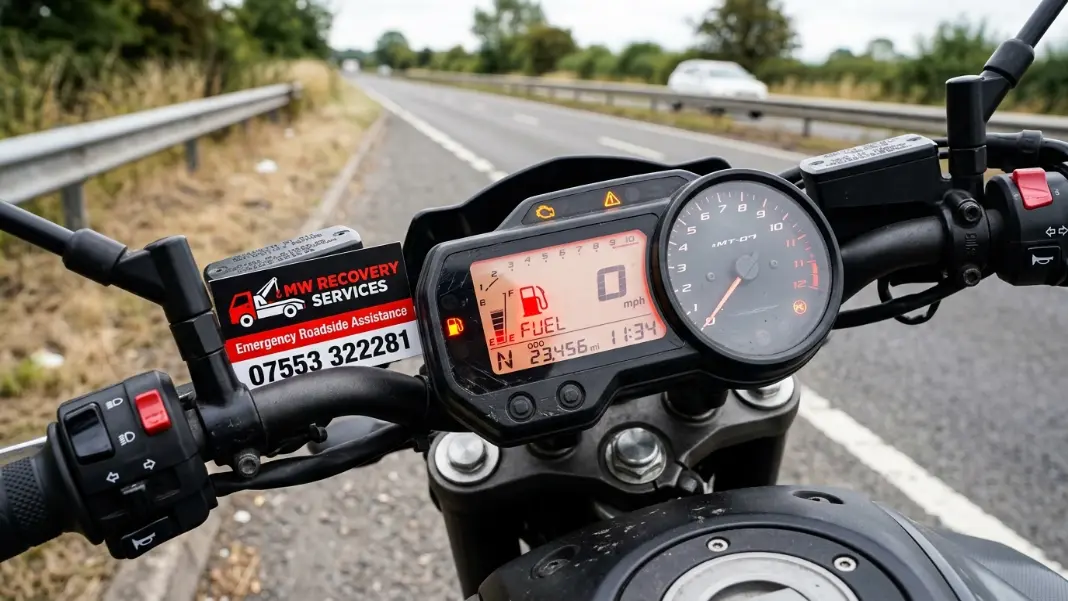
If you notice any warning signs that your motorcycle is developing a fault while on a motorway, act on them immediately rather than hoping the issue resolves. Warning signs include unusual engine behaviour, a loss of power, abnormal vibration, a tyre that feels soft or pulling to one side, or any warning light appearing on the instrument cluster.
The moment you suspect a problem, signal left and begin moving toward the hard shoulder or the nearest Emergency Refuge Area on a smart motorway. Do not wait to confirm the problem is serious. Acting early gives you more distance to coast to a safe stopping point. A sudden complete failure at 70mph with no warning is a far more dangerous situation than the same failure diagnosed and managed at 50mph with 500 metres of hard shoulder visible ahead.
If you have any remaining power and control, use it to reach the next Emergency Refuge Area on a smart motorway, or to coast as far along the hard shoulder of a traditional motorway as possible. Distance from live traffic is safety.
Stopping Safely: Where to Position Your Motorcycle
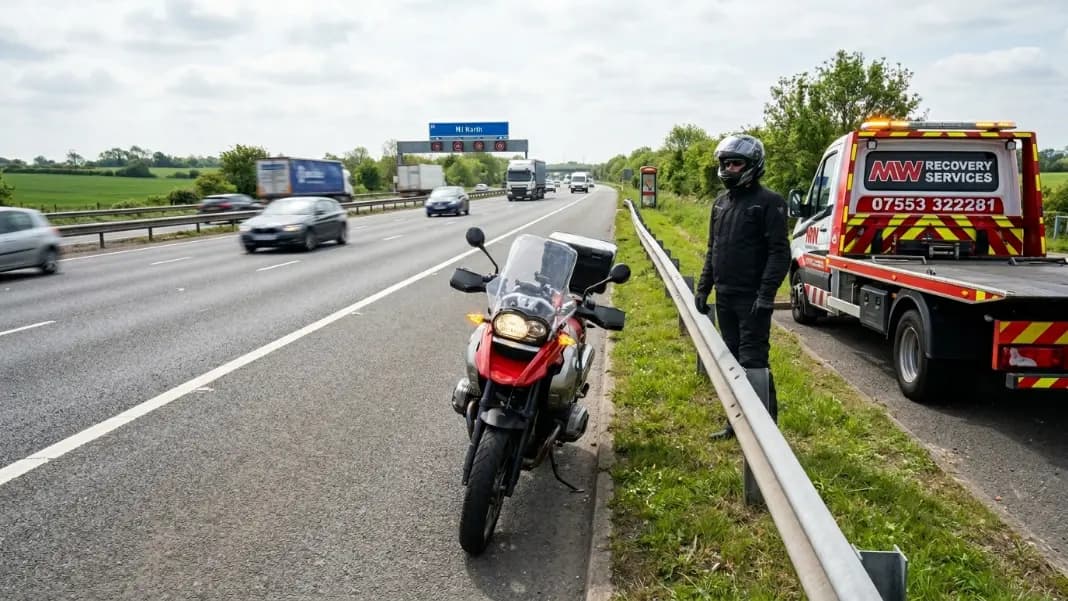
On a traditional motorway with a hard shoulder: stop as far to the left as possible. Ideally, get the motorcycle onto the verge or at least with the wheels touching the white line at the left edge of the hard shoulder. Switch on hazard lights immediately upon stopping. If there is a safety barrier or Armco behind you, position yourself and the bike so the barrier is between you and the carriageway.
Do not place the motorcycle in the middle of the hard shoulder or leave it anywhere it could be struck by a car also pulling into the hard shoulder. If another car comes onto the hard shoulder for an emergency and hits your motorcycle, the consequences for you as a biker standing nearby are severe.
On a smart motorway with an all-lane running configuration: reach an Emergency Refuge Area. The orange surfacing and blue ERA sign mark the only official safe stopping points. The SOS telephone inside each ERA gives your precise location to National Highways automatically.
Once Stopped: What to Do Immediately
After stopping safely, follow these steps in order:
- Switch on hazard lights
- Get off the motorcycle from the nearside (left side) and move away from it, ideally behind any available safety barrier
- Do not stand between the motorcycle and live traffic under any circumstances
- Remove your helmet if safe to do so, as it reduces your hearing of approaching traffic and makes you harder for emergency services to communicate with
- Call 999 if you are in a live lane or in a position where your motorcycle is causing an obstruction or danger
- Call your recovery provider
- Stay on the verge side of any barrier until recovery arrives
Do not attempt to push the motorcycle along the hard shoulder to reach an emergency telephone if doing so requires you to walk in or near the hard shoulder for any distance. Use your mobile phone instead. Emergency telephones are useful if your mobile has no signal, but walking 400 metres along a hard shoulder is not worth the exposure.
Calling for Motorcycle Recovery
When you call for recovery, be specific about the vehicle type. A motorcycle cannot be recovered on a standard wheel-lift or towed on a dolly as a car can. It needs to be loaded onto a flatbed or a specialist motorcycle trailer. A recovery operator who sends a standard car recovery vehicle to a motorcycle incident either does not understand what they are dealing with or does not have the right equipment, and you should be clear about this on the call.
Give the operator your exact location using the marker posts on the motorway hard shoulder. These small blue and white posts appear every 100 metres and carry a motorway number, a direction indicator (A or B), and a distance reference. Providing this three-part reference gives the recovery operator a precise location that speeds up their arrival significantly.
Our motorcycle recovery Manchester service uses flatbed vehicles equipped to safely load and secure motorcycles of all types. We cover all motorways in the Greater Manchester area, including the M60, M62, M56, M66, and M61. For a breakdown anywhere in the Manchester area, our breakdown recovery near me service covers motorcycles alongside all other vehicles.
Why Motorcycles Need Specialist Recovery Equipment
Attempting to recover a motorcycle using equipment designed for cars risks damage to the frame, the fairings, the forks, or the exhaust. A motorcycle that is improperly secured during transport can shift on the flatbed, particularly under braking, causing damage that a proper load-securing system would prevent. For high-value motorcycles, an incorrectly recovered bike can arrive at its destination with damage that exceeds the cost of the original recovery job several times over.
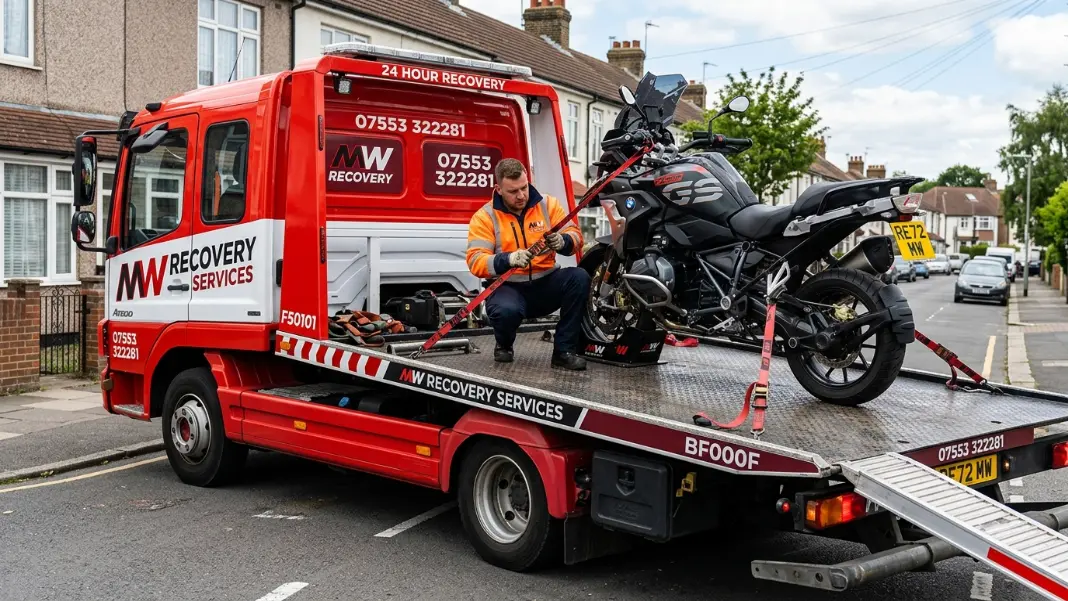
Specialist motorcycle recovery uses wheel chocks to hold the front wheel in a straight line, tie-down straps attached at proper structural attachment points rather than at fairings or handlebars, and a flatbed with a loading ramp that allows the bike to be wheeled on under its own weight rather than being lifted at an angle. If the recovery operator arriving at your motorcycle cannot describe how they are going to secure your bike before they load it, ask questions before they proceed.
Our flatbed towing Manchester service carries the equipment needed for safe motorcycle recovery and our operators are trained in proper motorcycle load-securing. Your bike arrives at its destination in the same condition it was loaded.
Manchester Motorways: Where Bikers Break Down Most Often
The most common motorway breakdown points for motorcycles around Manchester reflect the routes bikers use most frequently. The M60 southern arc, particularly around junctions 11 to 13 near Stockport, is a high-frequency route for bikers heading toward the Peak District via the A6. The M62 toward the Pennines carries significant biker traffic particularly on summer weekends. The M56 is the primary route for Airport-bound trips.
For riders heading out of Manchester on the A57 Snake Pass or A537 Cat and Fiddle road, breakdowns on these A-roads present different challenges to motorway incidents. The recovery procedures differ from motorway rules, but the principle of getting to a safe off-road position quickly and calling a specialist motorcycle recovery operator applies equally.
For immediate motorcycle recovery from any location in or around Manchester, call us directly or use our car recovery near me page. Our team confirms motorcycle-specific equipment availability on every call before dispatch.
Frequently Asked Questions
Can I push my motorcycle to an emergency telephone on the hard shoulder?
If the distance is very short and the hard shoulder is clear, pushing a motorcycle to reach an emergency phone is possible, but it exposes you to traffic for an extended period. Using a mobile phone is safer in most cases. Emergency telephones are most valuable when your phone has no signal or battery.
Does standard breakdown cover include motorcycle recovery?
Not always. Many personal breakdown cover policies are for cars only. If you ride a motorcycle, check specifically whether your policy covers motorcycles and whether it includes motorway recovery. Some policies require a separate motorcycle endorsement or add-on.
Can a motorcycle be towed behind a car from a motorway?
No. Towing a motorcycle behind a car on a public road is illegal in the UK. Motorcycles must be transported on a flatbed or trailer. If a recovery operator suggests towing your motorcycle with a bar or rope, decline and request proper flatbed recovery.
Should I stay with my motorcycle on the hard shoulder?
No. Leave the motorcycle on the hard shoulder and move to safety behind the nearest barrier or on the verge. The risk of being struck by a vehicle on the hard shoulder while standing next to your motorcycle is significant. Your priority is your own safety, not the security of the bike.
How long does motorcycle recovery typically take on a Manchester motorway?
A specialist motorcycle recovery operator positioned in Greater Manchester can typically reach a motorway incident within 30 to 45 minutes during standard hours. Out-of-hours response times may be longer. Giving a precise location reference using the blue marker posts shortens response time considerably.
A motorcycle breakdown on a motorway is one of the higher-risk incidents a UK rider can face, but managing it correctly significantly reduces that risk. Getting to a safe position quickly, making yourself visible, calling emergency services if needed, and then calling a specialist motorcycle recovery operator with the right equipment covers the essentials. For more on what happens during smart motorway incidents, read our smart motorway breakdown guide and our dedicated piece on motorway hard shoulder rules.
Need Car Recovery in Manchester?
MW Recovery provides fast, professional breakdown recovery and roadside assistance across all of Greater Manchester. One call and we are on our way.