How to Jump Start a Car in Manchester: What to Do When Your Battery Dies
A flat battery is one of the most common reasons drivers get stranded across Greater Manchester. This guide covers the exact jump lead connection order, when not to attempt a jump start, Manchester locations where batteries tend to fail, and what to do when you have no leads or no donor car nearby.
Table of Contents
You get in the car on a Tuesday morning, turn the key, and the engine gives a slow groan before going silent. Or it is late on a Friday night and you have come out of an NCP in the Northern Quarter to find the car completely dead. A flat battery is one of the most common call-outs across Greater Manchester, and while it feels like a crisis in the moment, it is usually fixable in under 20 minutes if you have the right equipment and know what you are doing.
This guide covers the full jump start process from start to finish: what causes batteries to go flat, the exact connection order for jump leads, common mistakes that can damage modern car electronics, and what your options are if you have no leads or no donor vehicle nearby. If you would rather call someone to handle it, our jump start service covers all of Greater Manchester around the clock.
Why Car Batteries Go Flat in Manchester
Cold weather is a significant factor. Manchester winters are damp and cold without being extreme, but even temperatures of two or three degrees Celsius slow the chemical reaction inside a lead-acid battery enough to reduce its cranking power noticeably. A battery that starts the car without issue in October can struggle to turn the engine over by January, particularly on cold mornings before the car has had any time to warm up.
Short journeys are just as damaging over time. A lot of city driving in Manchester involves trips of five to ten minutes: from Chorlton into the city centre, from Salford Quays back to Eccles, from Didsbury to the supermarket and back. On journeys that short, the alternator barely has time to replace the charge used to start the engine. The battery slowly discharges over weeks until one morning it does not have enough power left to start the car at all.
Other common causes include:
- Leaving interior lights, headlights, or a phone charger plugged in overnight
- A battery that is more than four or five years old and no longer holds a full charge
- A faulty alternator that is not recharging the battery properly while you drive
- The car sitting unused for two or more weeks, which happens frequently with Manchester Airport long-stay parking or a second vehicle left on the street over winter
- Extreme summer heat, which accelerates the evaporation of electrolyte fluid inside older batteries
If a jump start gets the car going but the battery dies again within a day or two, the battery itself has likely failed and needs replacing. Our guide on signs your car battery is dying covers the warning signs to watch for before you end up stranded again.
What You Need Before You Start
Two things are required: a set of jump leads and a working vehicle to act as the donor.
Jump lead quality matters more than most people expect. Thin, cheap cables from discount shops can overheat under load or fail to carry enough current for larger engines. Look for leads that are at least four metres long so you have flexibility in how you position the two cars, and that use a wire gauge of at least 10 AWG. Halfords stock decent sets at their Greater Manchester stores, and most petrol stations carry a basic option as well.
If you do not have a donor vehicle available, a portable jump starter pack is a solid alternative. These are compact lithium battery packs that fit in a glovebox and can reliably start a petrol or diesel car without a second vehicle. They are worth keeping in any car used mainly for short city journeys, which is exactly the driving pattern that drains batteries fastest.
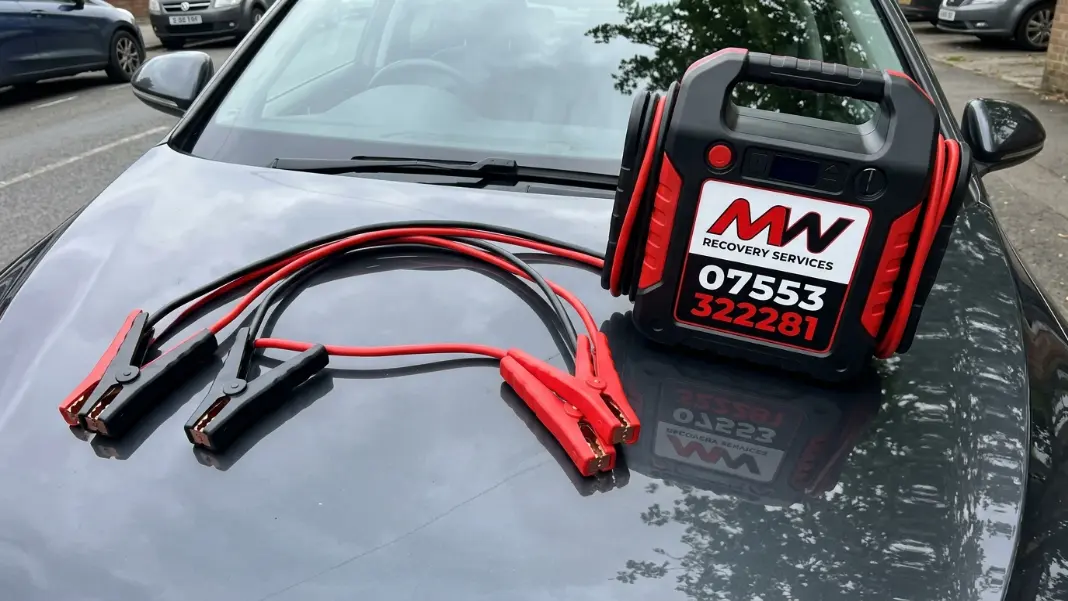
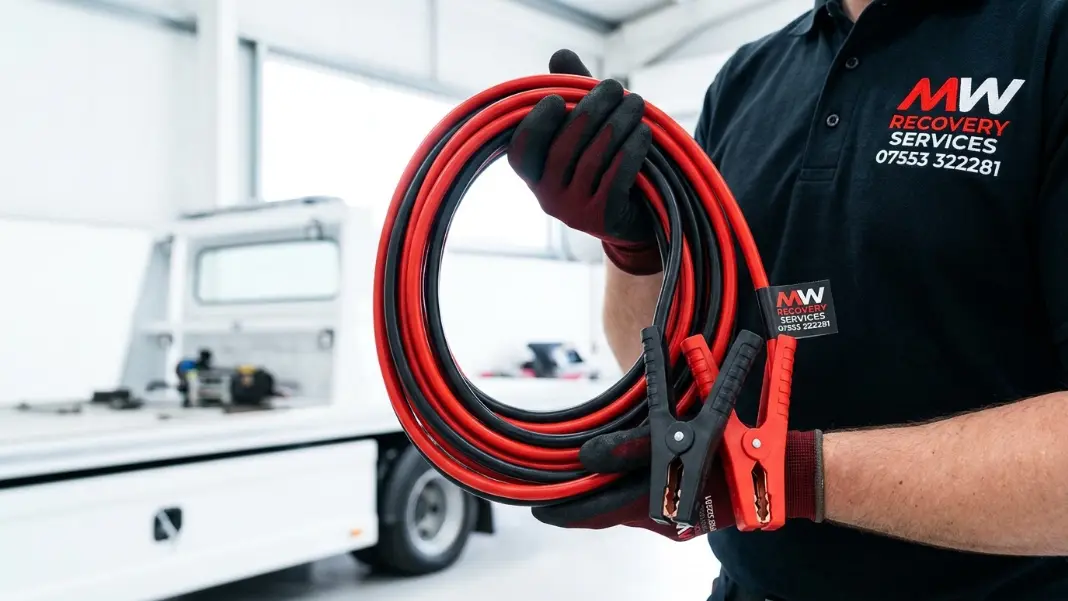
Good quality jump leads and a portable jump starter pack are all you need to deal with a flat battery at the roadside
Is It Safe to Jump Start Where You Are?
In most situations across Greater Manchester, a roadside jump start is perfectly safe. A residential street in Salford, a supermarket car park in Stockport, a retail car park in Trafford, a layby off the A57 or A56. These are low-risk spots where you have space to work and are not in danger from passing traffic.
There are situations where you should not attempt a jump start and should call for professional recovery instead:
- On a motorway hard shoulder or emergency refuge area. If your battery has died on the M60, M62, or M56 hard shoulder, do not open the bonnet. Stay in your vehicle with your seatbelt on, turn on your hazard lights, and call for motorway recovery. The risk from passing traffic on a smart motorway far outweighs waiting for a recovery truck.
- If you can smell fuel or petrol near the battery. Jump leads create a small spark when connected. Fuel vapour and sparks together are dangerous.
- If the battery is visibly cracked, swollen, or leaking fluid. A damaged battery can release hydrogen gas or sulphuric acid. Do not touch it and do not attempt a jump start.
- If the car is a hybrid or electric vehicle. The procedure for EVs and hybrids is completely different. Using standard jump leads on an electric vehicle can cause serious and expensive damage to the high-voltage system. Read our guide on electric vehicle breakdown recovery in Manchester for the correct approach for EVs.
How to Jump Start a Car: Step by Step
This process applies to standard 12V petrol and diesel cars with lead-acid batteries. Modern cars built in the last decade sometimes have the battery in the boot rather than under the bonnet. If you cannot locate the battery, check the owner's manual. Some manufacturers provide dedicated jump start terminals in the engine bay for exactly this situation.
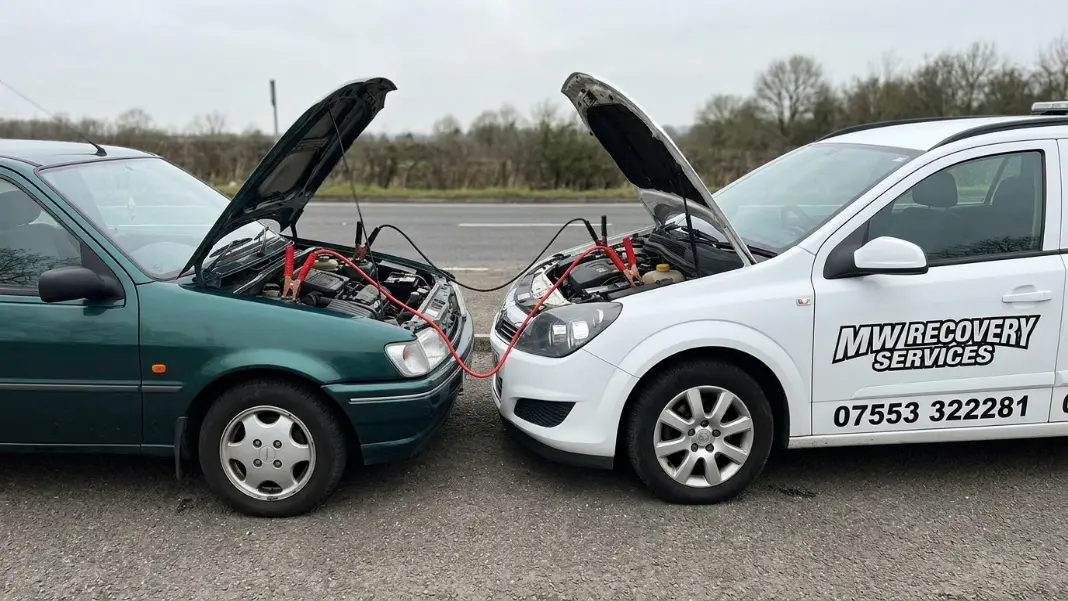
Red to positive, black to earth point on your car. Getting the connection order right protects your car's electronics
Step 1: Position the Two Cars
Park the donor vehicle so both batteries are within reach of your jump leads. Nose to nose or side by side both work depending on where the batteries are located. Turn both engines off. Apply the handbrakes on both cars.
Step 2: Connect the Red Lead to Your Flat Battery
Clip one end of the red (positive) lead firmly to the positive terminal on your flat battery. The positive terminal is marked with a plus sign (+) and is usually slightly larger than the negative. It may have a red plastic cover.
Step 3: Connect the Other End of the Red Lead to the Donor Battery
Clip the other end of the red lead to the positive terminal on the donor car's battery. You now have a red cable connecting the two positive terminals across both cars.
Step 4: Connect the Black Lead to the Donor Battery
Clip one end of the black (negative) lead to the negative terminal on the donor battery. This is marked with a minus sign (-).
Step 5: Connect the Other Black Lead to an Earth Point on Your Car
This is the step most people get wrong. Do not clip the final connection to the negative terminal on your flat battery. Instead, attach it to an unpainted metal part of the engine block or chassis on your car. A bolt, a metal bracket, or an unpainted strut away from the battery all work. This reduces the risk of a spark near the battery where hydrogen gas can accumulate during the charging process.
Step 6: Start the Donor Car
Start the working vehicle and let it run for two to three minutes at a fast idle. This gives some charge time to transfer to your flat battery before you attempt to start your own car.
Step 7: Try to Start Your Car
Attempt to start your vehicle. If it starts, good. If it does not, wait another two or three minutes and try again. If after three or four attempts the car still will not start, the battery may be too discharged to accept enough charge, or there is another fault. At that point, calling for professional help is the right call rather than draining the donor battery too.
Step 8: Remove the Cables in Reverse Order
Once your car is running, remove the leads in the exact reverse of the order you connected them. Black from the earth point on your car first, then black from the donor negative, then red from the donor positive, then red from your battery last. Keep both engines running while you do this.
Step 9: Drive for at Least 20 to 30 Minutes
Do not switch the engine off straight away. Drive at a decent speed on an A-road or dual carriageway rather than crawling through city centre traffic. The alternator charges the battery more effectively at higher engine speeds. Idling in a car park for half an hour will not recharge the battery properly.
The Connection Order at a Glance
Save this somewhere accessible for when you need it.
Connecting:
- Red to your flat battery positive (+)
- Red to the donor battery positive (+)
- Black to the donor battery negative (-)
- Black to a metal earth point on your car (not the battery terminal)
Disconnecting (reverse order):
- Black from the earth point on your car
- Black from the donor battery negative
- Red from the donor battery positive
- Red from your flat battery positive
Always connect red first. Always disconnect red last.
What to Do If You Have No Jump Leads
Not carrying jump leads does not mean you are out of options.
Ask another driver. In a car park, at a petrol station, or on a residential street, most people will help if you explain what has happened. The whole process takes about ten minutes and most drivers with leads in the boot will pull alongside without much hesitation.
Use a portable jump starter pack. If you already own one, this is the quickest solution since no second vehicle is needed. If you do not have one yet, they are genuinely worth buying if you do a lot of short journeys around Manchester.
Call a professional jump start service. Our jump start service covers all of Greater Manchester including Manchester city centre, Salford, Trafford, Stockport, Bolton, Wigan, Oldham, Rochdale, Bury, and surrounding areas. We carry the equipment to get your car started without a donor vehicle and without you having to flag someone down.
One thing to avoid: do not attempt to push start an automatic car. Push starting only works on manual gearbox vehicles and is not recommended on busy roads in any case. If you have an automatic, jump leads, a jump pack, or calling for help are your three realistic options.
No leads and no one nearby to help?
MW Recovery covers all of Greater Manchester 24 hours a day. Call now and we will have a technician with you in 30 to 60 minutes.
Call 07553 322281View our jump start service across Greater Manchester
Where in Manchester Batteries Tend to Fail
A flat battery can happen anywhere, but certain locations across Greater Manchester produce these call-outs more often than others, usually because of how long cars sit parked and in what conditions.
Manchester Airport long-stay car parks. People fly out for two weeks, return tired after a long journey, and find the battery is dead. Cold temperatures over a fortnight combined with a battery that was already marginal is a very reliable recipe for a flat. Our airport jump start guide covers what to do if you arrive back to a dead car at the airport.
NCP multi-storeys in the city centre. Long days at work, a light left on, a phone charger left plugged in. City centre multi-storeys are consistently among our most frequent jump start call-out locations.
Residential streets in Salford, Eccles, and Stretford. Cars parked on the street through winter without being driven regularly lose charge slowly. Many owners do not notice until they try the car on a cold morning and nothing happens.
Trafford Centre car park. Long shopping trips with the car sitting in the outdoor sections of the car park for three or four hours on a cold day.
MediaCityUK and Salford Quays. Early morning arrivals parking up for a full day shift and coming back after dark to a cold car that has been sitting for ten hours.
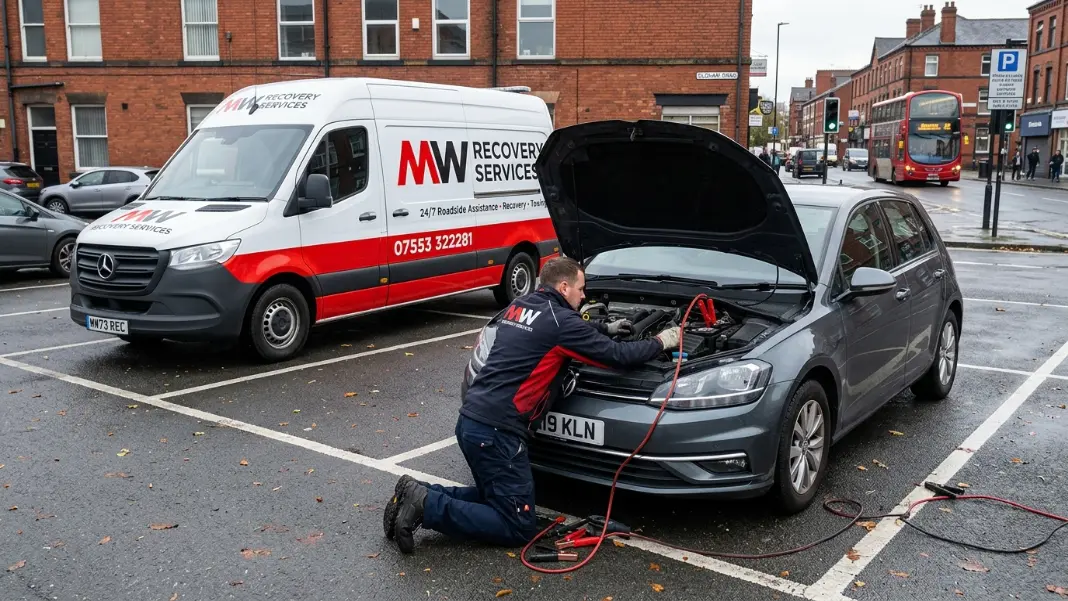
MW Recovery provides jump starts across all of Greater Manchester 24 hours a day, with a typical response time of 30 to 60 minutes
After the Jump Start: What to Check
Getting the car started is not the end of the job. A successful jump start confirms the battery will accept charge from an external source. It does not confirm the battery is healthy or that the problem will not repeat itself.
Get the battery tested. Halfords will test your battery for free at most of their Greater Manchester branches while you wait. Many independent garages and tyre centres across the city will also do it without an appointment. A battery test takes about five minutes and tells you clearly whether the battery is healthy, borderline, or needs replacing now.
Check the alternator. If the battery tests as healthy but keeps going flat within a few days, the alternator may not be recharging it properly while the engine runs. This needs a garage diagnosis. Our Salford workshop can check charging system faults and carry out repairs on the same day in most cases.
Look for a parasitic drain. If the battery is losing charge even when the car is not being used, something electrical may be drawing power when it should not. A poorly fitted aftermarket stereo, a faulty relay, or a door not sealing properly and leaving a light on are common causes. A garage can check for this with a multimeter test.
If the battery is more than four years old and has failed once already, replacing it is usually the more practical decision than waiting for the next failure. Our guide on what to do when your car battery is dead in Manchester covers replacement options and what to expect from the process.
How Much Does a Jump Start Cost in Manchester?
If you need a professional jump start from a recovery company, costs vary depending on the time of day, your location within Greater Manchester, and the company you call.
At MW Recovery, a jump start is one of the most straightforward jobs we do. There are no hidden fees for out-of-hours call-outs and no minimum spend requirements. Full pricing is available on our car recovery prices page. If the jump start holds but you would also like a battery test or mobile replacement at the roadside, ask when you call and we will confirm what is available for your area.
For drivers who have broken down and need the car transported to a garage rather than just started at the roadside, our breakdown recovery service covers vehicle collection and transport across the whole of Greater Manchester.
Frequently Asked Questions
Common questions about this topic
Yes. If you have jump leads and a donor vehicle, one person can connect the leads and start both cars without assistance. The main things to get right are the connection order and using an earth point rather than the battery negative for the final black cable. If you are not confident about the process or the battery location is awkward, calling a professional is a safer option.
Need Car Recovery in Manchester?
MW Recovery provides fast, professional breakdown recovery and roadside assistance across all of Greater Manchester. One call and we are on our way.
You Might Also Like
More helpful articles from our blog